When Newfoundland and Labrador’s energy and industry minister walked onto the conference stage at the Hydrogen Americas Summit in Washington, D.C., on Thanksgiving Day, he was seizing an opportunity he couldn’t afford to waste.
Skip to content

 Andrew Parsons, now Newfoundland and Labrador’s energy and industry minister, in St. John's in June 2017. Photo: The Canadian Press/Paul Daly

The Big Read
Ottawa has lofty ambitions for Canada’s hydrogen future. Can it realize them?
Prime Minister Justin Trudeau and German Chancellor Olaf Scholz speak as they walk along the Stephenville, N.L. waterfront on August 23, 2022. Photo: The Canadian Press/Adrian Wyld
Prime Minister Justin Trudeau and German Chancellor Olaf Scholz speak as they walk along the Stephenville, N.L. waterfront on August 23, 2022. Photo: The Canadian Press/Adrian Wyld
When Newfoundland and Labrador’s energy and industry minister walked onto the conference stage at the Hydrogen Americas Summit in Washington, D.C., on Thanksgiving Day, he was seizing an opportunity he couldn’t afford to waste.
Andrew Parsons’s keynote speech was third on the program as the summit opened—after U.S. Energy Secretary Jennifer Granholm and President Joe Biden’s top climate advisor Ali Zaidi.
“You are not in this room, obviously, if you don’t think there’s a strong economic future for hydrogen,” Parsons said, in his soft Newfoundland accent. “You’re not in this room today unless you’re ahead of the curve on adoption, and you’re wanting to stay ahead of that curve on development and commercialization. So if you’re in this room, you should be thinking about Newfoundland and Labrador.”
Talking Points
- Canada wants to sell clean hydrogen to Europe to replace fossil fuels and imagines it as a $50-billion-a-year industry supporting 350,000 jobs by 2050
- The country has a lot to plan, build and regulate if it has any hope of making that vision reality
Newfoundland is Ground Zero for Canada’s clean-hydrogen plans, the place Prime Minister Justin Trudeau and Germany’s Chancellor Olaf Scholz signed a preliminary agreement for Germany to buy Canadian-produced hydrogen in bulk.
By 2050, Canada imagines a domestic hydrogen industry that supports 350,000 high-paying jobs in a sector worth $50 billion a year. But realizing those lofty ambitions is far from certain, made more complicated by hydrogen’s high production costs, a bloated regulatory environment and lack of necessary infrastructure. Despite recent hype, it remains unclear how widely governments and businesses will integrate hydrogen into current systems.
Still, the industry appears poised for rapid growth, according to some estimates. Accounting firm EY expects hydrogen to account for 27 per cent of Canada’s energy demand by 2050, up from just one per cent today. Some see further potential in overseas markets: an internal assessment of Atlantic Canada’s hydrogen industry prepared at Natural Resources Canada and obtained by The Logic through access-to-information legislation said hydrogen exports to Europe from the region could be worth $9 billion by 2050.
Related Articles

“But,” the document said, making that happen “will require infrastructure to transport hydrogen from high-capacity, low-cost production regions to a port hub, and would also require liquefaction for hydrogenation processing capability as well as bunkering capacity.”
New Brunswick, Nova Scotia and Prince Edward Island should focus on decarbonizing domestic industries to cut their greenhouse-gas emissions, concluded feasibility studies used in the NRCan document. But Newfoundland and Labrador has great potential as a hydrogen exporter, even after supplying its neighbours.
The eventual size and shape of that hydrogen market will be determined by how and where it is integrated with the existing energy system. Hydrogen is often called the Swiss Army knife of energy sources, useful for filling gaps along the decarbonization chain rather than offering broad-based emissions reductions.
Unlike electricity, which offers a comparably low and steady energy source, hydrogen burns twice as hot as gasoline at a blistering 585 C. That gives it a punchiness ideal for industrial applications like steelmaking or for long-haul shipping, where batteries might struggle to propel trains or heavy-duty trucks.
Hydrogen can also be stored, allowing it to pick up the slack when renewable power sources are operating below capacity, similar to hydro or nuclear power—make hydrogen when the wind is blowing or the sun is bright, burn it when they’re not. Combined with nitrogen, hydrogen can be made into ammonia for easier transport.
“There are going to be different technologies and different uses for hydrogen all along the value chain,” said Andrew Botterill, partner at Deloitte Canada.
Canada already produces around three million tonnes of hydrogen a year, or about four per cent of the global market. But expanding hydrogen’s role in the energy mix comes with complications, and with an enormous price tag.
Cost has slowed many final investment decisions in hydrogen, analysts at Deloitte said in a recent report. Powering a city bus using hydrogen costs almost four times what diesel does. The energy crisis in Europe and broad-based inflation has put immense pressure on households and power grids in particular, further complicating investment timelines.
“This energy transition does cost, and if you’re a power company, let’s say that wants to switch to hydrogen, those costs are going to be added to the rate base,” Deloitte Canada senior manager Michelle Leslie said. “Are we saying that we don’t proceed down this path? Absolutely not. But in the context of what is happening around us, I think there’s a really hard, cold reality.”
Those cost concerns could be smoothed over by establishing clear rules within the regulatory regime that oversees hydrogen development, Deloitte analysts said, while tax credits or direct government spending can reduce cost burdens. Proponents of major projects in Canada have scrapped building plans in the face of legal and regulatory opposition, and Trudeau has floated lighter regulation as a way to ensure future liquefied natural gas facilities get built.
Several technical challenges could also hamper hydrogen’s adoption. Hydrogen causes corrosion in the steel pipelines used to transport natural gas, which limits how much hydrogen can be injected and blended into that existing infrastructure. Water consumption is another challenge. Generating hydrogen through the process of electrolysis, as Atlantic provinces plan to do using renewable power, requires roughly nine litres of water for every gram of hydrogen. It also needs “tremendous” amounts of electricity, Leslie said.
“As a general rule of thumb, it will take you about twice as much energy to produce hydrogen than the energy that you extract from it,” she said.
In Western Canada, energy companies are looking to produce so-called “blue hydrogen,” or hydrogen derived from natural gas, in an effort to decarbonize. Proponents say the method is cheaper than “green hydrogen,” but some environmental organizations are unconvinced that blue hydrogen will drive down emissions, even using carbon-capture and sequestration technology.
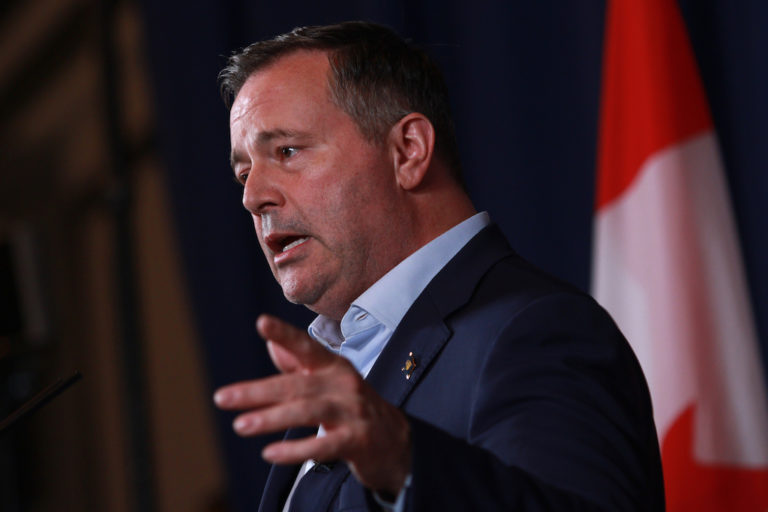
Western Canada produces 76 per cent of Canada’s hydrogen, followed by central Canada (17 per cent) and Atlantic Canada (seven per cent). The bulk of Western Canada’s hydrogen production is currently used by oil and petrochemical refining facilities near Edmonton, but new applications are underway. Former Alberta premier Jason Kenney claimed capital investment in the Edmonton region alone could top $60 billion.
Calgary-based CP Rail has detailed plans to build one-megawatt hydrogen refueling stations in Calgary and Edmonton, and expects to be powering some locomotives using hydrogen next year. Air Products, a U.S. gas and chemicals company, is building a $1.6-billion net-zero facility that will supply hydrogen to buyers including Imperial Oil, which will develop “renewable” diesel.
Bryan Helfenbaum, executive director of advanced hydrocarbons at Alberta Innovates, said hydrogen has reached “peak hype” as governments and private industry seek out low-emissions energy sources. While costs for both blue and green hydrogen sources are steep, he says hydrogen derived from natural gas will continue to dominate in the near term.
“For the next five to 10 years, the blue hydrogen opportunity is going to be much, much cheaper than most green hydrogen opportunities,” he said. “Keep in mind the feds effectively signed an agreement with Germany based on green hydrogen that does not exist yet.”
Newfoundland’s Parsons is keen to change that. In his pitch in Washington, the energy minister touted his province’s proximity to key markets and long history of resource development. Newfoundland is 1,400 miles from D.C., 1,900 miles from Ireland, and it’s an island that “sort of looks like one of those foam fingers you get at a stadium,” he said. The province is a longtime friend of the United States (Winston Churchill and FDR signed a treaty there, it has navy and air bases, and let me tell you for just a moment about Gander and 9/11, maybe you’ve heard of the Broadway show Come from Away?), an oil and gas supplier with a highly skilled workforce, oodles of government land, hydro power, deepwater ports, a stable government, fresh water to turn into hydrogen with electrolyzers and clean electricity—anything you could want.
“We have the best wind resource in North America,” Parsons told The Logic after his Washington presentation. “Sounds like a joke amongst Newfoundlanders and Labradorians—120 kilometres [an hour] of wind, for me, it’s just a regular day.”
Although the province’s electricity supply is already overwhelmingly green (96 per cent of its power came from hydroelectric generation in 2019), the government has been moving methodically to encourage wind farms. It released a renewable-energy plan in December 2021, lifted a 15-year moratorium on wind development in April and issued a call for wind-power producers to nominate “areas of interest” in July, with any Crown land in the province potentially available.
Parsons said the call brought in 31 responses, which his ministry is examining now. The island’s west coast is the area of primary interest, he said, but there are possibilities in Argentia and Come By Chance in the southeast near St. John’s, and along the south coast. The provincial government intends to call for formal bids on Dec. 15.
Where the wind generation ends up will determine what port or ports make sense as hydrogen export hubs, he said, and what infrastructure needs to be built to connect them.
“When you think about government processes, this one’s moving at warp speed, given the fact that the opportunity has been thrust upon us. And I think it’s been expedited by world affairs,” Parsons said.
Elsewhere in Atlantic Canada, other operators see similar opportunities in Europe’s need to replace the Russian natural gas so many countries have relied on.
“The war in Ukraine broke out and the world changed forever. That has really accelerated our thinking about what we want to do,” said Rishi Jain, the Canadian managing director of New York-based Cross River Infrastructure Partners, which has an agreement in principle to build a hydrogen plant at the Port of Belledune in New Brunswick.
Announced just before Scholz’s August visit, the agreement is for a 200-megawatt commercial-scale pilot plant, one meant to be powered by the province’s existing electricity grid. The electrolyzer will run when New Brunswick has electricity to spare.
“For that size of industrial user, which will be by far the largest in New Brunswick and amongst the largest in the region outside of some very large iron mines, you don’t really get that opportunity,” Jain said. “As a system operator and as a utility, you have this without having to build new generation, [so] you get a big revenue possibility,”
Ultimately, Jain said Cross River hopes to build a small modular nuclear reactor at Belledune to power a larger plant—that was actually the initial plan, before the urgent global need for new energy sources set in.
For the port, becoming a green-energy hub is part of a just-released 30-year plan to remake itself following the closure of a nearby Glencore smelter (the reason the port was built in the first place) and the impending end of coal use at a provincial power plant the port serves.
The Belledune port has always relied on extractive industries that depend on limited supplies of raw materials, use them up and then leave, the plan says. The port “must seek new industrial partners that operate in a circular economy where restoration and regeneration translate to sustainability and longevity.”
One difference between New Brunswick and Newfoundland and Labrador: their current power supplies. Where Newfoundland’s electricity now is overwhelmingly hydro, New Brunswick uses nuclear power even without Cross River’s plans. (Coal and natural gas are in the mix as well, even if coal is on the way out.)
Whether Europe will want hydrogen produced with nuclear power or from a power grid that includes fossil fuels is uncertain, Jain acknowledged. Germany has paused this process temporarily, but part of its acute energy crisis comes from closing its own nuclear plants on environmental grounds.
If necessary, he said, Cross River can add wind turbines in New Brunswick to ensure all the power for Belledune hydrogen comes from the greenest sources. Ultimately, though, the world’s electricity needs will be so great that only nuclear power can meet them.
“I think at the end of the day, what we’ll see is pragmatism is going to win out,” he said.
A 200-megawatt ammonia plant will prove the concept, but he said a standalone plant would need to be four or five times that size to be commercially viable. Solar and wind became ubiquitous because of government support, he said, and hydrogen will need the same.
“You have to have to give the industry time to come down the cost curve and learn and go up the learning curve. And you only really can do that if you actually put steel in the ground,” he said.
Cross River is talking with the Canada Infrastructure Bank about de-risking some of its investment at Belledune, he said.
Hydrogen might be a huge opportunity for Canada but in Newfoundland, Parsons is mindful of the risk of a generational mistake. Ironically, the province’s hydrogen industry could get a kickstart from a previous one: the Muskrat Falls hydro project in Labrador, which was supposed to supply economically transformative clean energy but ended up threatening Newfoundland and Labrador’s provincial finances so badly the federal government stepped in to rescue them.
“I come from a province that is still wearing scars from megaprojects from 50 years ago,” Parsons said. Hydrogen won’t be one, he said—the government will help but will not be the prime mover.
“I don’t see public investment, per se, but I do see the possibility for incentivization, tax credits, things like that,” Parsons said. Federal money will also likely be needed, he said.
“I have small kids who live in the province, my goal is to stay in this province with them, and for them to live and grow up here and be employed here,” he said. “I don’t want them to grow up in a province where people are saying, ‘Man, your father really messed this up.’”



Loading...
Thanks for sharing!
You have shared 5 articles this month and reached the maximum amount of shares available.
CloseThis account has reached its share limit.
If you would like to purchase a sharing license please contact The Logic support at [email protected].
CloseGift the full article!
You have gifted 0 article(s) this month and have 5 remaining.
Recipients will be able to read the full text of the article after submitting their email address. They will not have access to other articles or subscriber benefits.
Photo: The Canadian Press/Adrian Wyld
Andrew Parsons, now Newfoundland and Labrador’s energy and industry minister, in St. John's in June 2017.
Most Popular This Week




In-depth, agenda-setting reporting
Great journalism delivered straight to your inbox.
The Big Read
Alberta’s referendum is just the start of the turmoil
Briefing
EverWind plans $10B data centre and wind development in Nova Scotia
Canada ready to force Stelco to sell its Canadian operations, Joly says
Feds plan a 60 MW defence-oriented data centre for Ottawa
Best business newsletter in Canada
Get up to speed in minutes with insights and analysis on the most important stories of the day, every weekday.
Exclusive events
See the bigger picture with reporters and industry experts in subscriber-exclusive events.
Membership in The Logic Council
Membership provides access to our popular Slack channel, participation in subscriber surveys and invitations to exclusive events with our journalists and special guests.






