Germany steps up as ally in fight against U.S. auto tariffs
Across the world from the trade barbs issued in the White House rose garden, Canada’s auto industry is striking deals in Germany’s biergartens.
More Canadians than ever—over 1,000—are attending this week’s industrial trade fair, Hannover Messe, where their booths span 5,000 square metres. As tariffs threaten to pulverize the North American auto-trade corridor, many are hoping that the European Union, led by auto giant Germany, will emerge as a reliable trade partner.
Shift newsletter
Germany steps up as ally in fight against U.S. auto tariffs
Canada and its auto tech get a warm reception at one of Europe’s biggest trade fairs
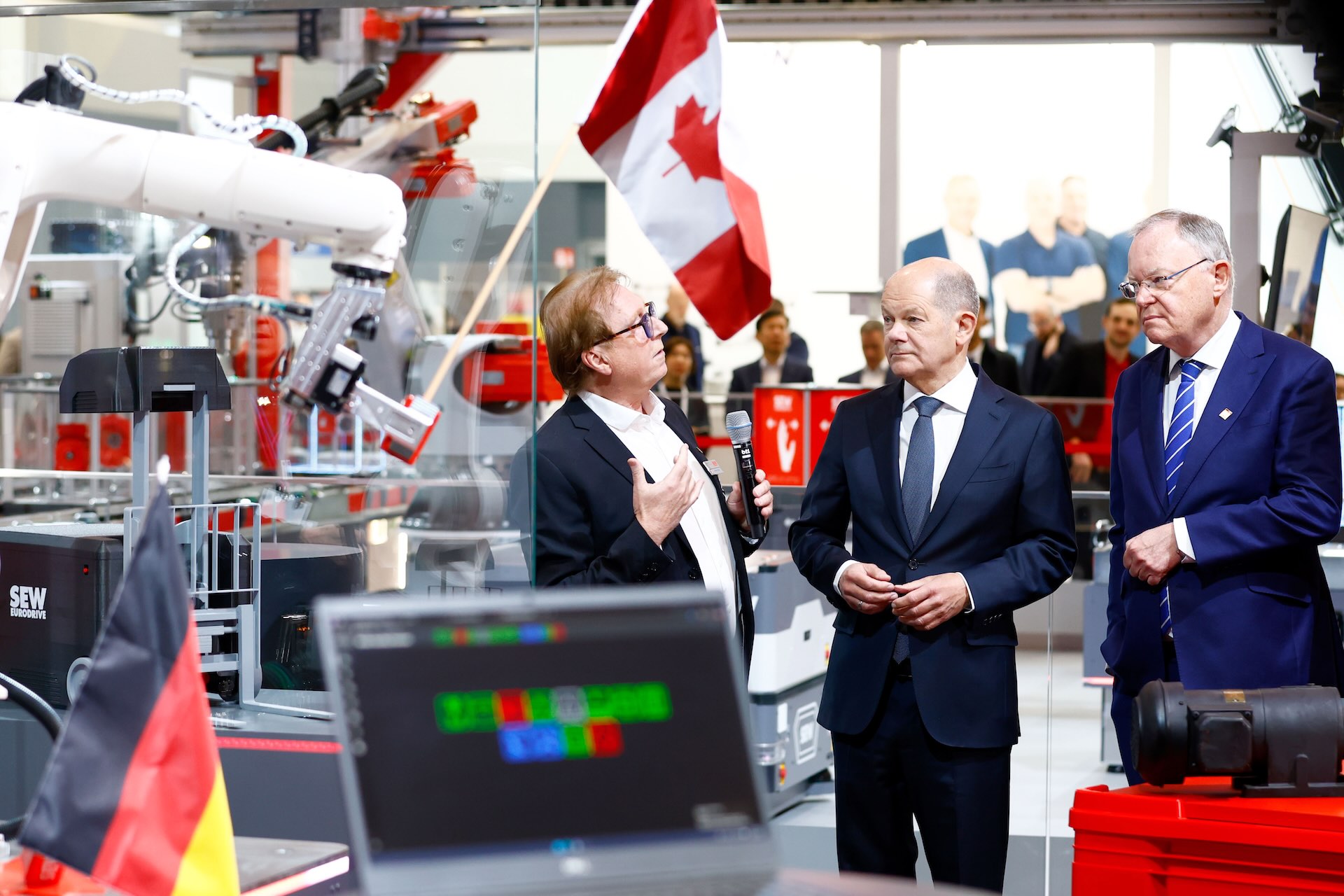
German Chancellor Olaf Scholz described Germany and Canada as a "perfect match" in a speech at the Hannover Messe industrial fair. Photo: Getty Images/Moritz Frankenberg
Across the world from the trade barbs issued in the White House rose garden, Canada’s auto industry is striking deals in Germany’s biergartens.
More Canadians than ever—over 1,000—are attending this week’s industrial trade fair, Hannover Messe, where their booths span 5,000 square metres. As tariffs threaten to pulverize the North American auto-trade corridor, many are hoping that the European Union, led by auto giant Germany, will emerge as a reliable trade partner.
“We’ve got willing partners overseas to make up for the difference after tariffs come through from the U.S.,” said Ontario Economic Minister Vic Fedeli. “They trust our integrity. All of this is in contrast, according to them, to how they feel today about the United States. They see that, so far, Canada has borne the brunt.”
In the expo’s opening remarks, outgoing German Chancellor Olaf Scholztold global manufacturing leaders that it was unusual for the event to get so political. But he went on to defend open markets, calling it “hardly imaginable” that Canada has felt the need to protect its sovereignty. Canada and Germany, on the other hand, were a “perfect match,” he said.
“Canada is not a state of anyone. Canada is a proud, independent nation. Canada has friends all over the world—and especially many of them here in Germany and Europe,” Scholz said during the Hannover Messe opening ceremony. “We stand by your side.”
Scholz noted that Canada’s exhibit at the fair included “key technologies in which we invest massively here in Germany,” and which the country is prepared to support—not only with private capital but also with public funds.
The hope is that the comments turn into action, as both countries feel the U.S. is sucker-punching their auto sectors with tariffs. European auto stocks have fallen since Donald Trump announced auto-sector specific tariffs on March 26. Mercedes has reportedly hatched tariff contingency plans to pull its entry-level models out of the U.S. market. Franz Loogen, who leads the regional automotive association E-mobil BW, said this week that the global industry faces “massive changes” in technology and trade conditions, making German-Canadian relations of “vital interest.”
While Canada symbolically swung open the door to the German auto sector with Volkswagen’s battery plant in southwestern Ontario, strugglesat Sweden-based Northvolt and Belgium-based Umicore have cast doubt on what was shaping up to be a key trade partnership with the EU.
Fedeli said the province had meetings with Volkswagen this week; he would not disclose details, but said he was encouraged that two of VW’s Canadian executives have purchased homes in St. Thomas, Ont., where the facility is being built. In the meantime, he said, Ontario is set to unveil support programs for autoworkers who will be affected by U.S. tariffs, and ramp up its international trade missions.
Canadian battery-material companies like Nano One fielded questions during the expo from German auto companies about Canada’s EV supply chain, while the investment development agency Edmonton Global has been involved in talks focused on critical minerals, hydrogen infrastructure and Canada’s AI institutes. Jayson Myers, CEO of the Canadian manufacturing association NGen, said he has organized meetings with Mercedes for 15 Canadian firms, and had heard of another Canadian company in negotiations for a multimillion-dollar deal with an investor.
Siemens was among the first multinationals to announce a Canadian investment during the event: a $150-million R&D centre that Siemens Canada CEO Faisal Kazi said will use AI simulations to reduce scrap rates in the battery sector.
“For Germany, and for a company like Siemens, it’s very important for us to invest in countries where the value system is aligned,” Kazi said, “and we feel that the German values and the Canadian values of respect, of inclusiveness, are aligned.”
Recipients will be able to read the full text of the article after submitting their email address. They will not have access to other articles or subscriber benefits.
Great journalism delivered straight to your inbox.
The Big Read
Alberta’s referendum is just the start of the turmoil
By
Meghan Potkins
Briefing
EverWind plans $10B data centre and wind development in Nova Scotia
By Catherine McIntyre |
Canada ready to force Stelco to sell its Canadian operations, Joly says
By Joanna Smith |
Feds plan a 60 MW defence-oriented data centre for Ottawa
By David Reevely |
Best business newsletter in Canada
Get up to speed in minutes with insights and analysis on the most important stories of the day, every weekday.
Exclusive events
See the bigger picture with reporters and industry experts in subscriber-exclusive events.
Membership in The Logic Council
Membership provides access to our popular Slack channel, participation in subscriber surveys and invitations to exclusive events with our journalists and special guests.