CALGARY — On March 23, Prime Minister Mark Carney called an election framed around a promise to fight U.S. tariffs by building critical infrastructure, some of it for oil and gas.
Skip to content

News
Canada got serious about building oil pipelines. Then prices tumbled
The industry is set to rein in capital spending just as the political window for new projects opens
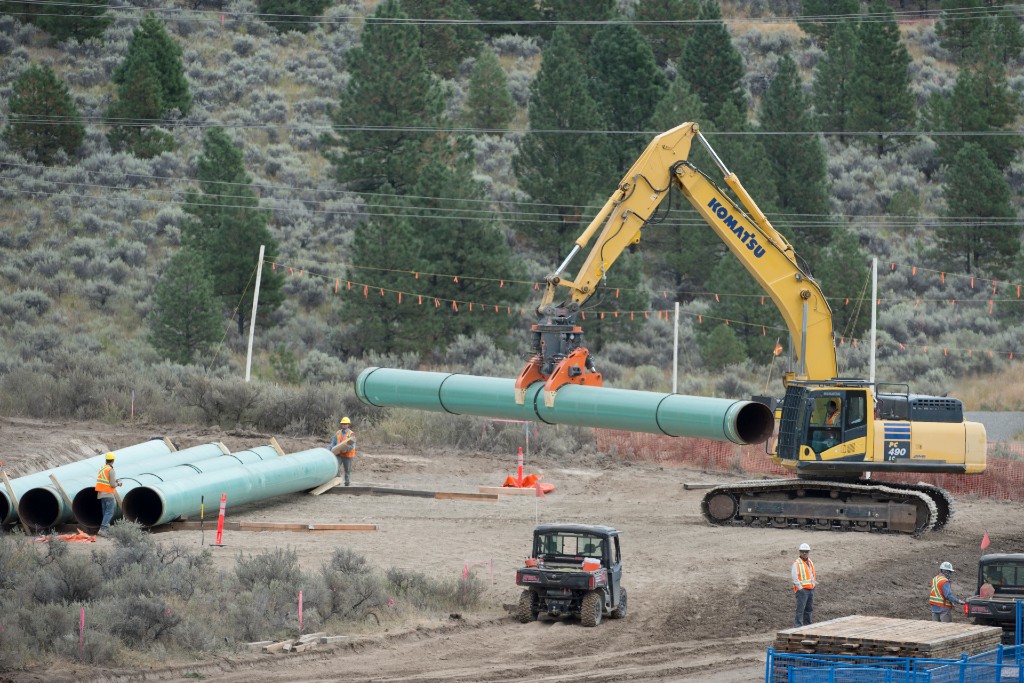
The price gap between Canadian and U.S. oil has closed since the Trans Mountain pipeline expansion came online last year. Photo: The Canadian Press/Jonathan Hayward
CALGARY — On March 23, Prime Minister Mark Carney called an election framed around a promise to fight U.S. tariffs by building critical infrastructure, some of it for oil and gas.
A week later, Canadian oil prices plunged below US$50, their lowest in 10 years aside from the pandemic. The drop, while rarely discussed in the context of Ottawa’s new-found resolve to fast-track major projects, was a reminder that commodity prices aren’t always in step with the political priorities of the moment.
Talking Points
- Prime Minister Mark Carney wants to encourage companies to build major projects in response to U.S. tariffs. That could extend to new oil and gas infrastructure like pipelines
- The renewed enthusiasm for such projects comes as oil prices sink to fresh lows, however, potentially dampening industry’s appetite to build
That could have consequences when it comes to getting companies involved in ambitious new builds. The latest slide in prices will weigh on firms’ balance sheets, which history suggests will dampen their willingness to invest in the sort of long-term infrastructure that would expand capacity, or reduce their dependence on U.S. buyers.
James Coleman, a professor specializing in energy at the University of Minnesota, said major oil development tends to coincide with elevated prices. “It’s very common that higher oil prices will motivate a whole number of proposed projects,” he said. “Here, we don’t have high-level prices. They’re not rock bottom, but they’re lower.”
Oil companies and analysts are quick to say that day-to-day prices don’t determine the feasibility of decades-long projects. Many firms have locked in a portion of their sales over long-term contracts, insulating them from daily market fluctuations.
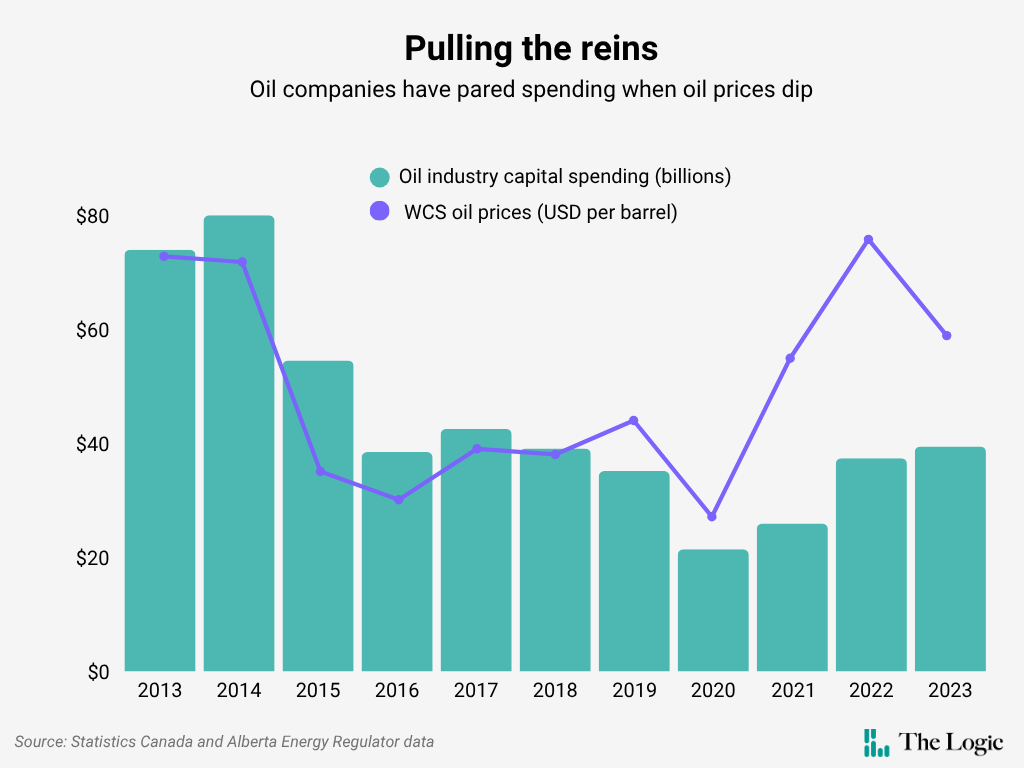
Yet the industry’s capital expenditures—including on major projects like oilsands plants or pipelines—have historically risen and fallen in line with oil markets.
Western Canadian Select (WCS), a Canadian crude oil benchmark, traded around US$53 per barrel on Wednesday, half of the US$109 peak it briefly hit in 2022. Over the last decade, it has generally traded in the US$55 to US$70 range.
In the face of that decline, Canadian oil producers already appear to be pulling the reins on spending. Canadian oilpatch investment is now expected to fall between two and five per cent this year, from $35 billion in 2024, according to ATB chief economist Mark Parsons. Spending globally is also in decline, as economic uncertainty and OPEC’s plans to ramp up oil production have suppressed prices.
Related Articles

For federal and provincial governments keen to get projects started, the pullback in Canada could pose problems. The current drive for nation-building projects is based on a fragile consensus of uncertain duration; with the clock ticking, getting quick buy-in from companies is essential.
What’s more, the political window has opened in a period when Canadian oil producers are directing money back to investors, rather than expanding production through major projects.
After the industry’s decades-long struggle to build pipelines, those companies have paid higher dividends and bought back shares to appease investors to compensate for their lack of growth. Dividend payments among oilsands firms surged from $15 billion to $40 billion in the last few years, according to Studio.Energy, a Calgary-based research group, while investment on new infrastructure and machines has flatlined.
Carney’s newly proposed fast-track legislation expands cabinet powers to push through proposals deemed to be in the national interest. Whether it will overcome the reluctance of companies remains to be seen.
Oil pipelines passing through B.C. are among the most contentious projects, given the unceded Indigenous lands they have to traverse. Alberta Premier Danielle Smith has called on Ottawa to fast-track a pipeline to the West Coast similar to Enbridge’s the $8-billion Northern Gateway, which the Trudeau government cancelled in 2016.
Enbridge would not say whether it was considering a major oil or gas pipeline in the context of Ottawa’s push to build new infrastructure. Gina Sutherland, a spokesperson for the Calgary company, said current oil prices would have minimal influence over its decision to build one. The company is always assessing the need to expand capacity, she added—“but only when the conditions make sense.”
“Commodity prices have little to no risk on our overall business,” she said.
TC Energy, which is now solely in the natural-gas pipeline space, did not directly respond to questions about whether it plans to propose a new project. South Bow, TC’s oil pipeline spinoff, did not respond to a request for comment.
If the past year is any guide, though, more pipeline capacity is one thing that can keep Canadian oil producers more competitive regardless of price swings.
For years, Canadian firms received between US$10 and US$20 less per barrel than their U.S. counterparts, largely due to a lack of pipeline capacity that left them with a shortage of non-U.S. buyers, noted Eric Nuttall, senior portfolio manager at Ninepoint Partners. That started to change after Trans Mountain’s expansion came online in May 2024, he said. Due to the added capacity, the price gap is now less than US$10 at times.
“It’s been hugely successful in lowering the discount for WCS,” Nutall said.
Trans Mountain will likely run at full capacity by 2027, he added, meaning producers will have need for a new pipeline as little as in a few years.



Loading...
Thanks for sharing!
You have shared 5 articles this month and reached the maximum amount of shares available.
CloseThis account has reached its share limit.
If you would like to purchase a sharing license please contact The Logic support at [email protected].
CloseGift the full article!
You have gifted 0 article(s) this month and have 5 remaining.
Recipients will be able to read the full text of the article after submitting their email address. They will not have access to other articles or subscriber benefits.
Photo: The Canadian Press/Jonathan Hayward
Most Popular This Week



In-depth, agenda-setting reporting
Great journalism delivered straight to your inbox.
Commentary
Carmichael: Canadian ignorance about India is a strategic weakness
Briefing
Aritzia shares pop after earnings rise 204%
First Nation in Alberta goes to court over fast-tracked oil pipeline
Chinese EV maker Geely Auto Group to launch in Canadian market in 2027
Best business newsletter in Canada
Get up to speed in minutes with insights and analysis on the most important stories of the day, every weekday.
Exclusive events
See the bigger picture with reporters and industry experts in subscriber-exclusive events.
Membership in The Logic Council
Membership provides access to our popular Slack channel, participation in subscriber surveys and invitations to exclusive events with our journalists and special guests.