When Alvin Fiddler thinks back to the last time the federal government took a build-fast approach to major infrastructure projects, the first thing that comes to his mind is a small island on the Ottawa River, with a view of Parliament Hill.
Skip to content

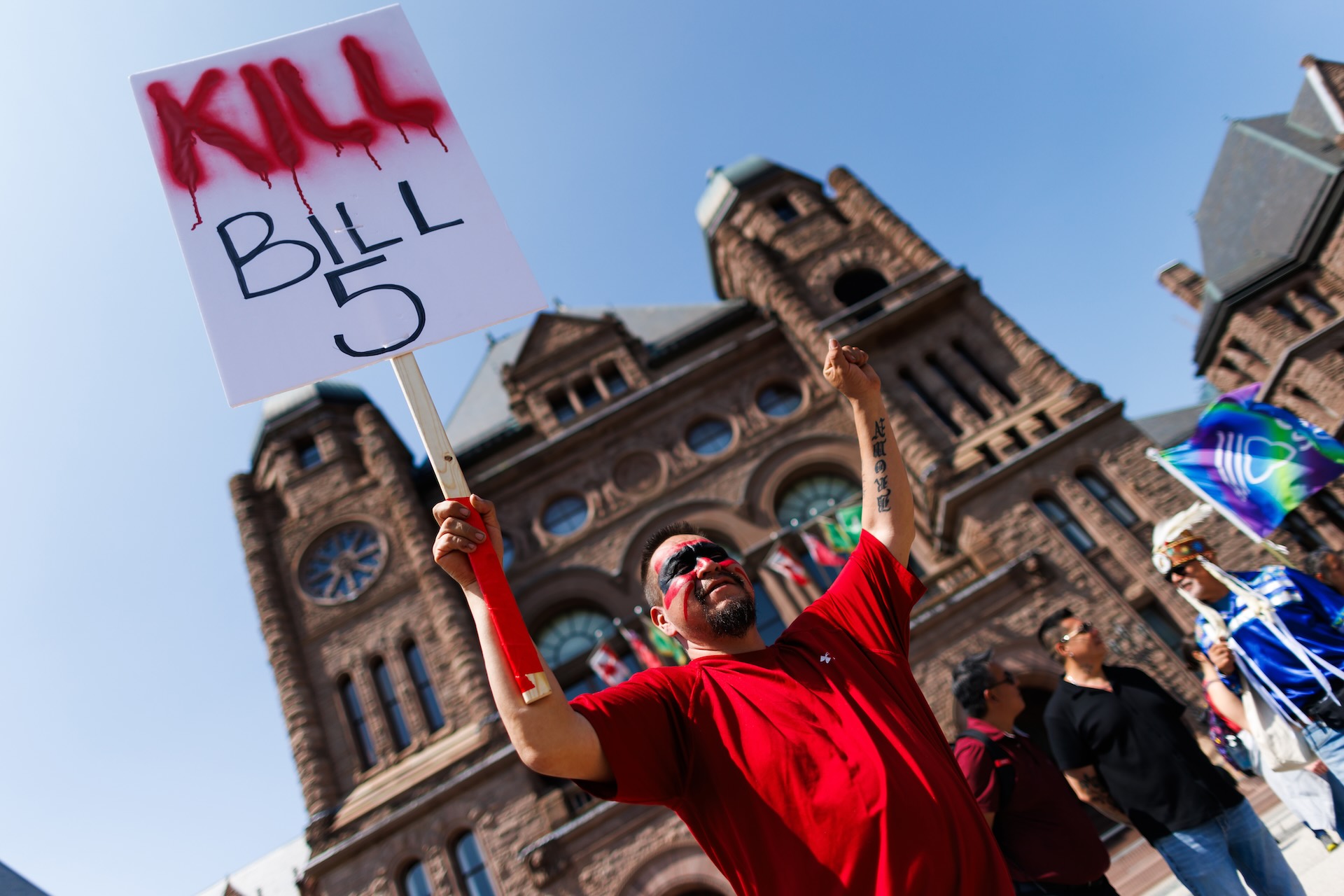 Indigenous demonstrators showed up in force this week to protest the Ontario government's passage of legislation meant to speed up approvals of major projects. Photo: The Canadian Press/Cole Burston
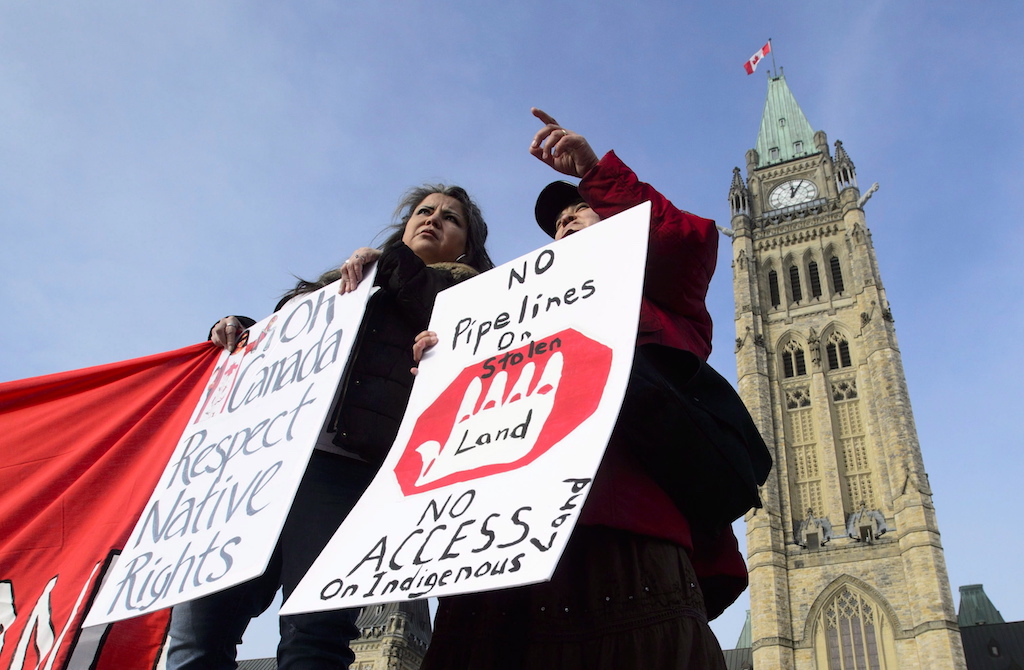 Protesters voice their opposition against pipelines during a January 2019 rally on Parliament Hill. Photo: The Canadian Press/Sean Kilpatrick
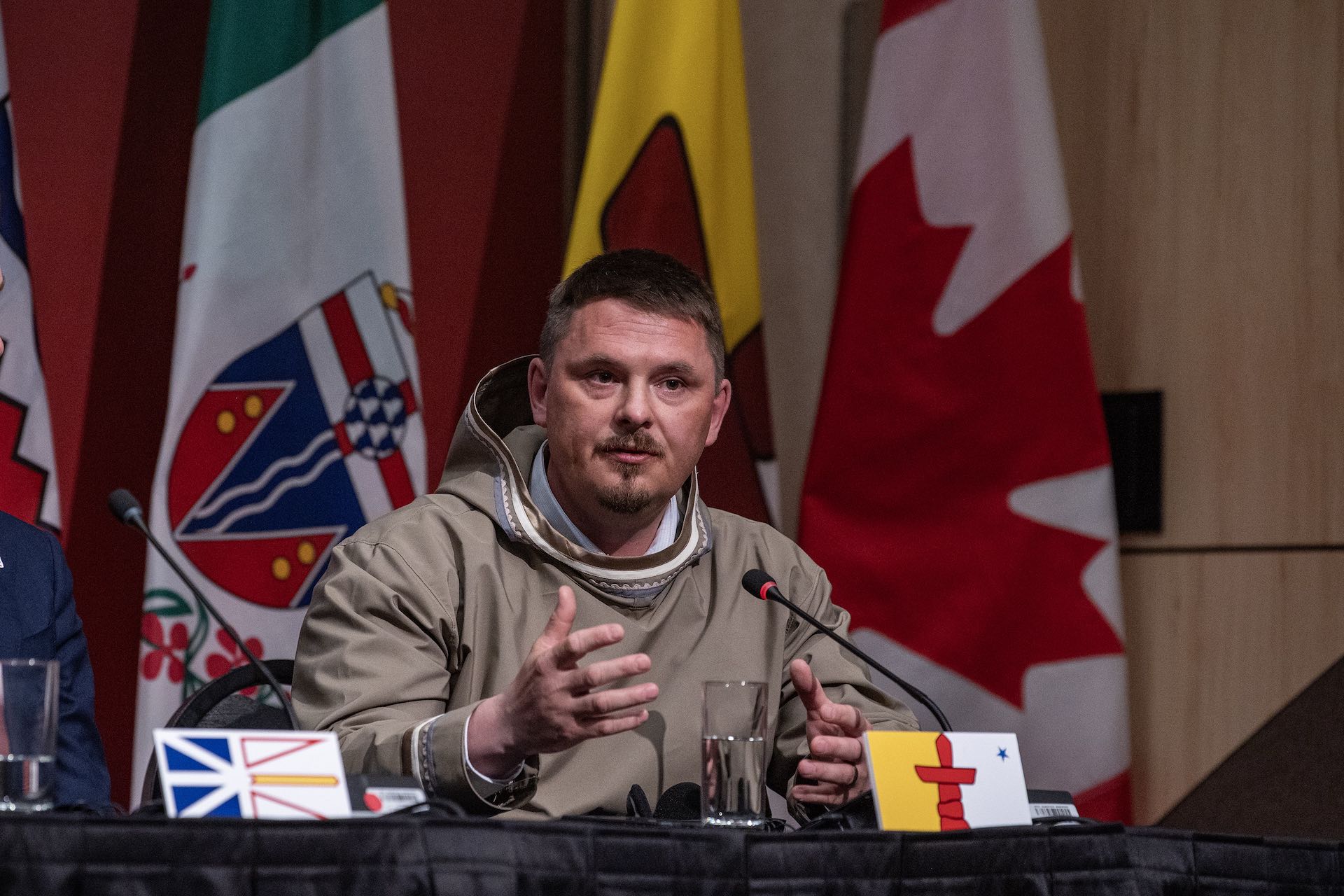 Nunavut Premier P.J. Akeeagok felt that Indigenous perspectives were considered at this week's First Ministers meeting in Saskatoon. Photo: The Canadian Press/Liam Richards

The Big Read
First Nations say they’re ready to fight the big projects Carney wants to hurry through
Leaders say they won’t let Indigenous rights be trampled in the rush to build major projects—and that they want in on crucial negotiations from the start
Protests this week against Ontario's Bill 5 gave a preview of potential First Nations opposition to legislation fast-tracking major projects. Photo: The Canadian Press/Cole Burston
When Alvin Fiddler thinks back to the last time the federal government took a build-fast approach to major infrastructure projects, the first thing that comes to his mind is a small island on the Ottawa River, with a view of Parliament Hill.
The Grand Chief of the Nishnawbe Aski Nation visited Victoria Island in Ottawa in 2013, after former Attawapiskat chief Theresa Spence erected a teepee on the park-like expanse and began a month-long hunger strike.
Talking Points
- Prime Minister Mark Carney’s promise to hurry approvals of major nation-building projects for the Canadian economy is running into objections from Indigenous leaders who insist their constitutional and legal rights won’t be sacrificed
- The federal government and multiple provinces are courting long legal challenges and protests over mines, pipelines and transportation projects
- Efforts born in Indigenous communities—not outsiders seeking co-operation from them—might be some of the easiest to build quickly
Spence, who survived mainly on fish broth for weeks, had demanded a meeting with the prime minister and governor general—an ask that seemed to paralyze the government of the day under Stephen Harper. But her longer-term demand was for First Nations to have a seat at the table when decisions are made about their land.
Her personal act of dissent became a symbol of the wider “Idle No More” movement that spread across Canada in celebration of Indigenous identity and opposition to the Conservative government’s omnibus bill to speed up government approvals. Protesters argued the new law eroded Indigenous rights and environmental protections. “We’re seeing now again, sort of the beginnings of another movement,” Fiddler says.
Prime Minister Mark Carney seems to have lit a fire under the federal, provincial and territorial governments when it comes to getting long-stalled energy, resource and infrastructure projects off the ground with his promise to “build, baby, build.” Indigenous leaders say they will not be sidelined in the race toward big nation-building projects. If they don’t grapple with Indigenous opposition, Carney and company may be running headlong into the same roadblocks that confounded Harper’s similar aspirations.
Related Articles
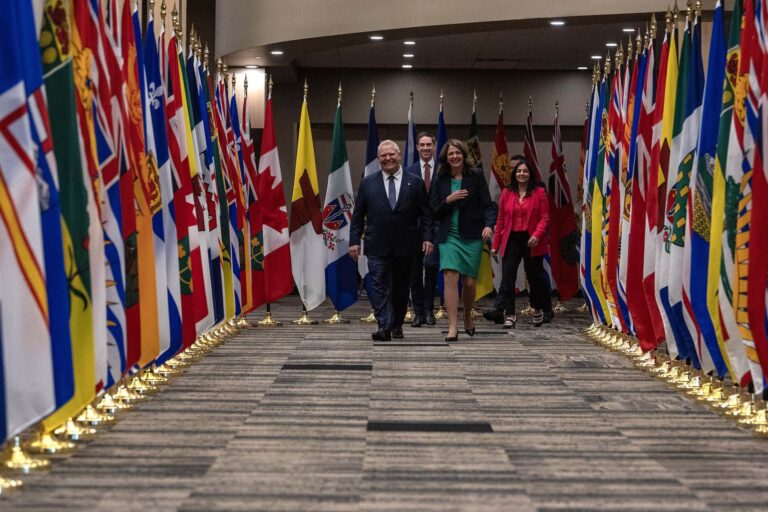

Major national projects will get yes or no decisions within two years, Carney says, and his government will pass a bill—expected to be introduced today—creating an office to shepherd a list of high-priority projects. Carney convened a meeting on Monday of provincial and territorial premiers in Saskatoon to work out some of the details, from which they emerged praising the prime minister’s get-stuff-done spirit.
Yet in their respective capitals, many of the leaders have run hard into opposition from Indigenous leaders whose people have rights—to their land, to environmental protection, to benefit from development that affects them—and say they will insist that those rights be honoured.
This week, the fight was at Queen’s Park in Toronto.
The point of Bill 5, said the Ontario government when it introduced the legislation, is to “cut the red tape and duplicative processes that have held back major infrastructure, mining and resource development projects, including in the Ring of Fire.”
That region in northern Ontario is rich in critical minerals. Enabling mining companies to dig them out has been on governments’ to-do lists for over a decade—it will take not only the mines themselves, but roads, rail lines and electricity—and Premier Doug Ford put developing the deposits on his list of Ontario’s priority nation-building projects.
To do it, the governments and companies with stakes will need to co-operate with numerous First Nations that have rights to the land that the development projects will affect. Although Bill 5 explicitly says it does not affect Indigenous rights, it does give the government the power to override any other provincial or local law to advance projects in “special economic zones.”
As the government was preparing on Wednesday to push the bill through, Energy and Mines Minister Stephen Lecce told the legislature Ontario won’t use its new authorities to steamroll Indigenous rights.
“The government has a constitutional obligation which we plan to fulfill and to discharge fully,” he said. In its most recent budget, Ontario boosted—by billions of dollars—a loan-guarantee program to help First Nations invest in major projects, Lecce said, a symbol of its good faith.
Opposition MP Sol Mamakwa, who is Anishinaabe and represents the northern riding of Kiiwetinoong, scoffed at the idea that money will get Ontario or companies working there the consent they need. “You cannot just buy us off with $3.1 billion,” he said. “We are worth more than that.”
If development moves forward without First Nations’ consent, Mamakwa said, “They will once again be ‘Idle No More.’”
“If free, prior and informed consent is not obtained from First Nations, this legislation will be mired in conflict and protracted litigation.”
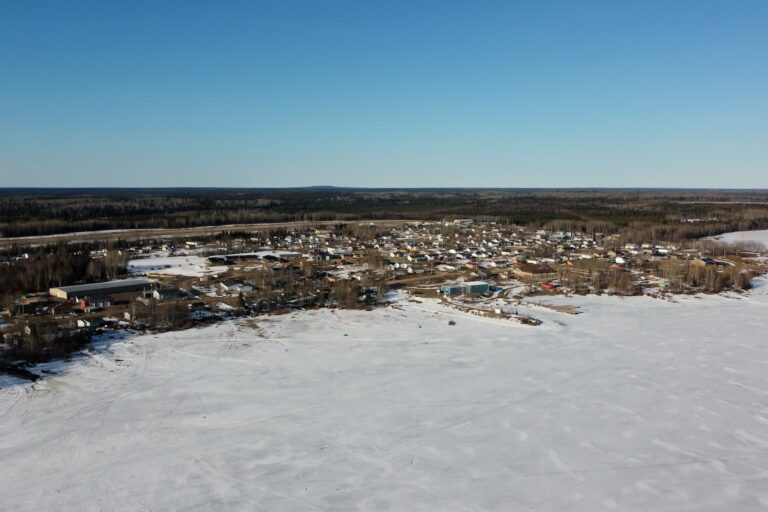
Plans are already underway in the Ring of Fire region to fight Ontario’s new approach, said Neskantaga First Nation Chief Gary Quisess. “Right now, they’re violating the treaty rights,” he says of the province. Neskantaga, about 430 kilometres north of Thunder Bay, Ont., hasn’t had safe drinking water for more than 30 years. Despite the potential economic boon mining projects could bring to the remote community, the chief has continuously called for more consultation.
Noting that Ford has taken to saying “Canada is not for sale,” Quisess said the same “goes for the minerals that we have, the resources we have in our area.” Young people in the community are particularly fed up and prepared to fight for their land rights, he adds. “I got people that are standing strong regarding this issue.”
The tension between the provincial government and Ontario First Nations offers a preview of what to expect if Ottawa takes a similar tack, Fiddler says. “Not only are we now fighting Ontario on Bill 5, but we’re also gearing up for what will happen on the federal front as well.”
To Fiddler, the solution is to bring First Nations to the table from the beginning, rather than asking them to weigh in on decisions that have already been made. That goes for developing projects and drafting new legislation. “It can’t be after the fact,” he says. In his view, both Ottawa and Ontario have failed yet again in that regard.
Before Carney’s meeting with the premiers, the federal government wrote to First Nations leaders to ask for their feedback on his plan, citing U.S. threats against Canada’s economic future. Yet it gave them only a week to respond, saying they plan to table the legislation in early June.
“We understand the timelines are accelerated, but immediate co-operation is required to secure our national interests,” said the letter obtained by The Logic, which was signed by two senior members of the Privy Council Office.
Fiddler says the letter suggests Carney is using U.S. President Donald Trump’s threats against Canada’s economy and sovereignty to justify the threat his plan poses to the sovereignty of First Nations.
The previous iteration of the Liberal government tried to give First Nations a greater role in the approval process by creating the Impact Assessment Agency in 2019 to address environmental, health, social and economic impacts of new pipelines, mines and other projects. Instead it contributed to project “paralysis,” says Martin Ignasiak, head of energy regulation at the Bennett Jones law firm in Calgary.
Calgary-based pipeline giant Enbridge is calling for major changes to simplify that process, and encourage firms to move ahead with major energy projects. But bypassing Indigenous rights isn’t one of them. Enbridge spokesperson Gina Sutherland says the company’s duty to consult with First Nations is a “foundational part” of how it operates that it would pursue regardless of the regulatory environment.
Enbridge’s proposed Northern Gateway oil conduit was opposed by many First Nations, and ultimately rejected by former prime minister Justin Trudeau in 2016. Alberta Premier Danielle Smith hopes to revive it, or a similar project to get Alberta oil to northern B.C., and while no one is currently putting their hand up to build it, Carney has expressed openness to the idea.
Ignaskiak says many of his clients hope to see this new approach extended to smaller regional projects. “We certainly have to work very closely with Indigenous groups to ensure they benefit from those projects wherever possible, and to ensure that they are adversely affected as little as possible,” says Ignasiak. The law, however, does not give First Nations the power to veto projects, he says.
The government has so far struggled to navigate that distinction. On Tuesday, federal Justice Minister Sean Fraser said something very similar in a Parliament Hill scrum—to disastrous effect.
Governments have a duty to consult and engage and to acknowledge Indigenous rights, he said, and “to the extent that those rights can be accommodated, we should make every effort to.” But veto power? No.
By Wednesday, Fraser was back in front of microphones apologizing. He’d heard from Cindy Woodhouse Nepinak, the national chief of the Assembly of First Nations, he said, and reconsidered.
“I think my comments actually caused hurt and potentially eroded a very precarious trust that has been built up over many years to respect the rights of Indigenous people in this country,” he said. “At every stage of the process, from project selection to conditions that may be imposed, we’re going to engage, properly consult and work in partnership to respect the rights of Indigenous Peoples.”
Fraser ought to have known he needed to take care. Before Monday’s meeting of Carney and the premiers in Saskatoon, Woodhouse Nepinak told the prime minister that the First Nations she represents will not be railroaded.
As things stand, it’s unclear how far the government thinks its duty to consult will extend, or whether the courts will agree.
In 2021, the Liberal government passed legislation aimed at harmonizing Canadian laws with the UN Declaration on the Rights of Indigenous Peoples (UNDRIP). Though the word “veto” never appears in the declaration, it says governments must obtain “free, prior and informed consent” from Indigenous Peoples for anything that might affect them—including acts related to their lands, territories or resources.
The justice minister at the time, now a key advisor to Carney, David Lametti, said the variety of Indigenous governance structures and decision-making processes put a single definition of “consent” out of reach. Instead, he said, the government was trying to ensure meaningful consultation.
Long before that, the Supreme Court had established the Crown’s duty to consult First Nations, Inuit and Métis communities whose rights, or even potential rights, might be affected by their actions.
“The rights of First Nations under international law and the Constitution of Canada are at stake,” Woodhouse Nepinak wrote earlier this week in an open letter. “If free, prior and informed consent is not obtained from First Nations, this legislation will be marred and mired in conflict and protracted litigation.”
Indigenous buy-in has proven increasingly necessary to get projects built in Canada. Michael Sabia, the president and CEO of Hydro‑Québec, described last fall just how much things have changed since the Crown corporation and the Quebec government built the massive hydroelectric power station on the east coast of James Bay in 1971.
“If we are not able to work in partnership with First Nations, then we’re going to build about as many megawatts as you can count on your left hand,” he said last October at a conference in Ottawa.
In the past, Hydro‑Québec and the provincial government might create some jobs in the community, pay some compensation and then “flood hundreds of kilometres of their territory,” said Sabia, a former federal deputy minister of finance. “That’s not going to work anymore,” he added, partly because it’s not right from a social justice point of view, and partly because First Nations have become adept, “as they should,” at fighting back in court.
Versions of these conflicts are happening across the country.
In British Columbia, First Nations leaders recently objected to a pair of bills from Premier David Eby’s NDP government—one focused on “streamlined” approvals for renewable energy projects, the other on different types of infrastructure.
The B.C. legislature passed both bills by one vote at the end of May; Regional Chief Terry Teegee of the B.C. Assembly of First Nations called it “a new low point in the relationship between the Provincial Crown and First Nations” and promised to use “every legal available tool at our disposal to protect what is rightfully ours.”
In March, the Assembly of Nova Scotia Mi’kmaw Chiefs opposed a provincial move to allow fracking for natural gas—through a bill that also repealed a ban on uranium mining—and said the chiefs might take the issue to court.
“The province of Nova Scotia and Premier [Tim] Houston are making decisions and moving at a speed that appears to be rooted in racist and colonial policies,” the assembly said in a statement.
If there’s an exception, it might be in the North. Nunavut Premier P.J. Akeeagok (who is Inuk but whose government represents everybody in the territory) said in Saskatoon that while Indigenous leaders might not have been in the room, their perspectives were at the table through the projects pitched.
“I think it’s so important to realize that a lot of these nation-building projects that we’re talking about right now are being led by Indigenous groups,” Akeeagok told reporters before heading into the meeting with Carney.
Akeeagok noted that the four projects Nunavut wants to see fast-tracked through the federal approvals process are all led by Inuit: the Kivalliq Hydro-Fibre Link between Manitoba and Nunavut communities, a deep-sea port at Qikiqtarjuaq, a hydroelectric power project in Iqaluit and the Grays Bay port and road project.
An Indigenous-led project needs the same approvals as any other, pointed out Anne-Raphaëlle Audouin, the chief executive of Nukik Corp., which is trying to build the Kivalliq power line and internet connection, and is owned by groups representing Inuit in central Nunavut. Audouin herself is not Inuk but brings long experience in the electricity sector; she used to head WaterPower Canada, representing the hydroelectricity industry.
Even if it means no special regulatory treatment, Indigenous ownership of a project can make a huge difference, she says, because the people behind it know the land, the people and the need the project is meant to answer, and they aren’t looking to just get something done and move on.
“Linear” projects such as pipelines, transmission lines and transportation links can benefit in particular from Indigenous ownership, she says, because of all the governments and stakeholders they have to engage along a long route. Anything that smooths those many, many interactions can make a big difference.
“I think, quite frankly, it is the future, and it is the way a lot of infrastructure projects will get done—not through partnerships and consultations, but through actual ownership,” Audouin says.
Indeed, on Thursday, the elected president of the Nisga’a Lisims government in northwestern B.C., hailed a provincial decision giving a natural gas pipeline permission to proceed. The Nisga’a Nation owns half the project.
Carney said in Saskatoon the approvals process for each project would involve consultations with Indigenous Peoples, so the brief time he offered to comment on Liberals’ major-projects bill isn’t the end of anything. He also said that he and Woodhouse Nepinak agreed to discuss these issues next month when the AFN gathers in Winnipeg for its annual meeting.
In the meantime, Woodhouse Nepinak said in a statement Friday morning, she has spoken to Carney about the bill and she is not mollified. The AFN, she said, “remains deeply concerned about the lack of time and appropriate process to carry out the Crown’s consultation and consent obligations, especially given the potentially massive impact on the rights of First Nations.”
Though Carney and the Liberal government have been focused on speed, Fiddler suggests they pause and look around at what is happening in Ontario if they want to avoid the missteps of the past.
“I hope the prime minister and his team are watching,” he says. “This is not how you should be trying to promote your economic agenda.”
With files from Jesse Snyder in Calgary



Loading...
Thanks for sharing!
You have shared 5 articles this month and reached the maximum amount of shares available.
CloseThis account has reached its share limit.
If you would like to purchase a sharing license please contact The Logic support at [email protected].
CloseGift the full article!
You have gifted 0 article(s) this month and have 5 remaining.
Recipients will be able to read the full text of the article after submitting their email address. They will not have access to other articles or subscriber benefits.
Photo: The Canadian Press/Cole Burston
Indigenous demonstrators showed up in force this week to protest the Ontario government's passage of legislation meant to speed up approvals of major projects.
Protesters voice their opposition against pipelines during a January 2019 rally on Parliament Hill.
Nunavut Premier P.J. Akeeagok felt that Indigenous perspectives were considered at this week's First Ministers meeting in Saskatoon.
Most Popular This Week




In-depth, agenda-setting reporting
Great journalism delivered straight to your inbox.
The Big Read
Beacon is building an AI empire by fixing Main Street’s software
Briefing
Inflation edges higher ahead of next BoC rate decision
EverWind plans $10B data centre and wind development in Nova Scotia
Canada ready to force Stelco to sell its Canadian operations, Joly says
Best business newsletter in Canada
Get up to speed in minutes with insights and analysis on the most important stories of the day, every weekday.
Exclusive events
See the bigger picture with reporters and industry experts in subscriber-exclusive events.
Membership in The Logic Council
Membership provides access to our popular Slack channel, participation in subscriber surveys and invitations to exclusive events with our journalists and special guests.







