CALGARY — Canada’s energy sector has sprung a leak, and it’s buying off its own shareholders to try to fill the hole.
Skip to content


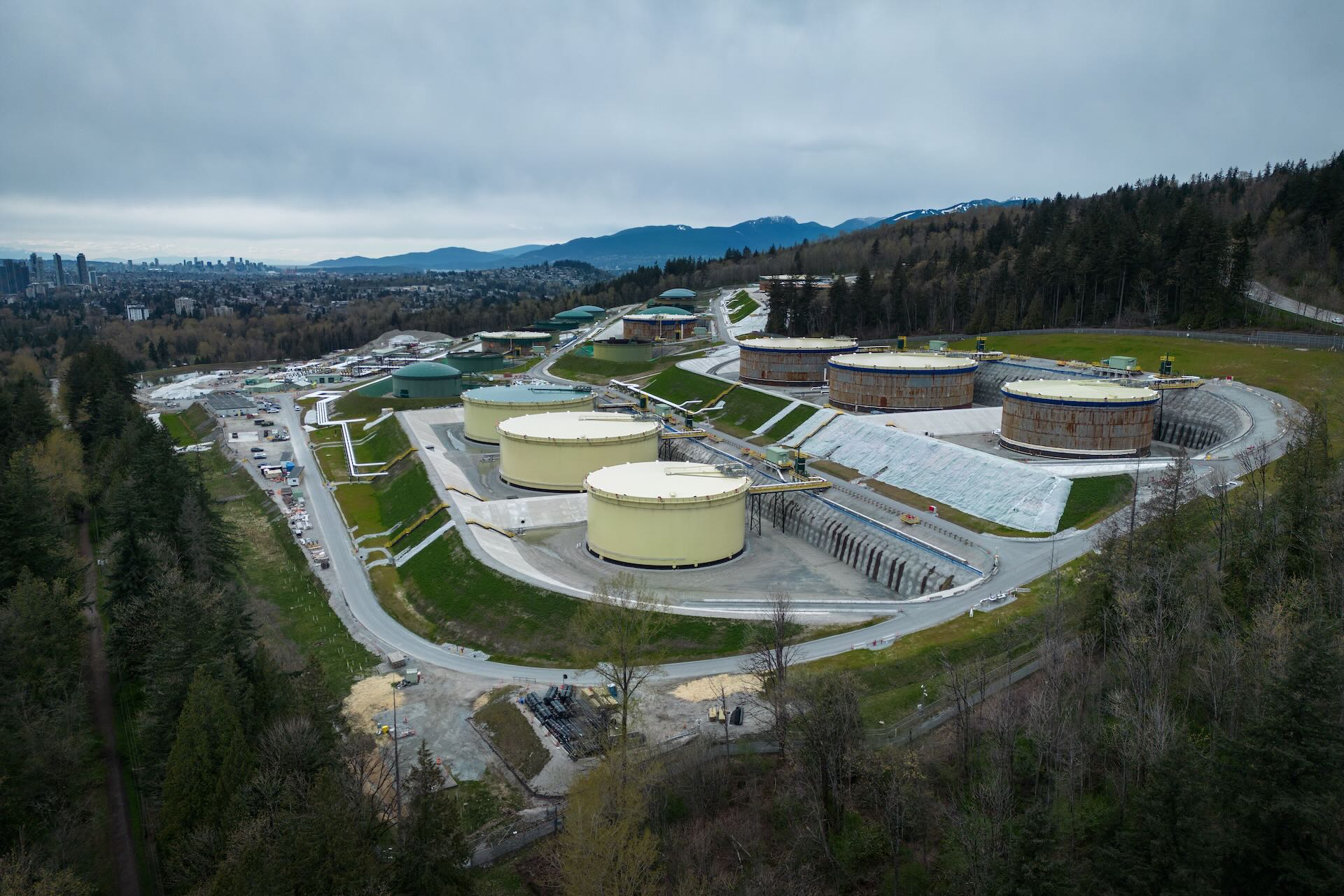 The Trans Mountain Burnaby Terminal tank farm in Burnaby, B.C., in April 2024. Photo: The Canadian Press/Darryl Dyck

Special Report
Canada’s oil and gas industry is facing its own productivity crisis
Companies are spending record sums on dividends and share buybacks, undercutting investments that would otherwise boost productivity. They blame government policy decisions.
Cenovus Christina Lake oil sands facility steam-assisted gravity drainage (SAGD) pad, southeast of Fort McMurray, Alta. in April 2024. Photo: The Canadian Press/Amber Bracken
CALGARY — Canada’s energy sector has sprung a leak, and it’s buying off its own shareholders to try to fill the hole.
Investors are fleeing the country’s oil and gas industry, chased off by onerous regulations and layers of environmental restrictions. Pipeline constraints, the rapid rise of green finance and lacklustre oil prices have left producers with little room to grow. As a result, Canadian firms are shovelling ever more capital into dividend payments and share buybacks to appease those investors who remain—a destructive cycle that has eroded investment in more productive pursuits that would increase these companies’ output.
Talking Points
- Canada’s oil and gas sector, with its high wages and massive capital investment, has long been a major contributor to the country’s productivity
- That position is now in question, as firms spend record dollars on dividends and share buybacks in order to make up for a long list of regulatory and other hurdles that have crimped investment
If left unchecked, such obstacles could threaten the energy sector’s long-held position as Canada’s productivity powerhouse, experts warn. With the country locked in a state of worrying productivity decline, energy executives are urging policymakers to loosen the reins and remove barriers that they claim have held them back. A failure to do so, they say, risks undermining a sector that, before the U.S. tariff threat, was expected to contribute a whopping $176 billion to Canadian GDP in 2025, according to Calgary-based Studio.Energy.
“We’re probably the most burdened oil industry of our competitors, so that’s a problem,” Jeff Lawson, an executive vice-president at Calgary oilsands giant Cenovus Energy, said in an interview.
“What we’ve seen over the last decade is foreign companies pull out of Canada, and investor dollars pull out of Canada and become more scarce.”
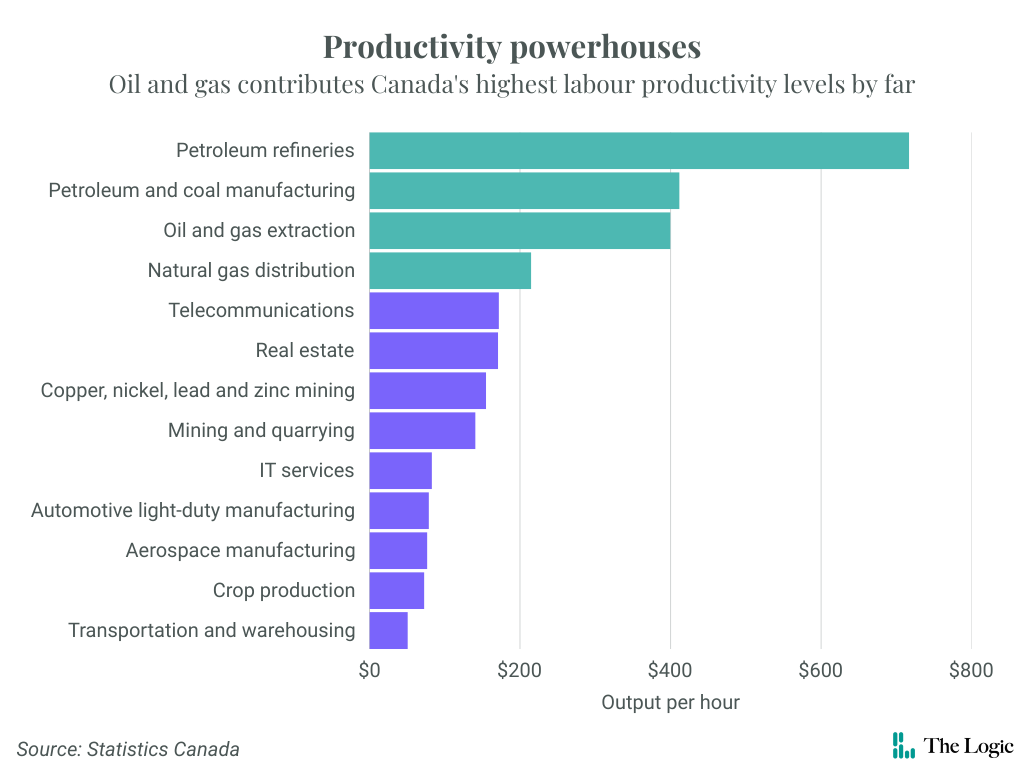
In terms of labour productivity, a measure of economic output per hour of work, the energy sector far surpasses that of other industries. Petroleum refining leads the pack, pumping out an average $717 of output per hour in 2023, according to Statistics Canada. Oil and gas extraction averaged $400 per hour, and natural gas distribution produced around $215 per hour. Power generation is around $181. Crop and animal production averaged nearly $55 in 2023, by comparison, while auto manufacturing contributed $79.
The industry’s troubles are best understood through Canadian oil and gas companies’ capital investments versus dividend payments over the last 20 years.
Between 2005 and 2014, Canadian energy companies’ total capital expenditures grew from about $40 billion to more than $80 billion, according to data provided by Studio.Energy. Capital investment has since fallen below 2005 levels, back to around $40 billion. Over that same 2005-2025 period, expenditures on dividends and share buybacks that had previously averaged around $15 billion shot up to around $40 billion starting in 2022.
Resilient Canada:
Canada has a productivity crisis. This series will unpack the problem and point toward solutions—because in a time of turmoil, a more productive Canada will be a more resilient Canada. Don’t miss the rest—follow this page for the upcoming stories.
Read more from the series:
- Most of you think Canada has a productivity crisis—but there’s hope it can be fixed soon
- It’s time to fix our productivity crisis
- Canada’s oil and gas industry is facing its own productivity crisis
- Canada can’t fix its productivity crisis without fixing housing first
- Looking for a reason for Canada’s productivity crisis? Blame Big Tech
- The rest of Canada could learn a thing or two from agriculture’s productivity boom
- Carmichael: Canada needs to unleash its entrepreneurs to fix its productivity crisis
- Event: How to fix Canada’s productivity crisis
Meanwhile, sustaining capital investment (recurring expenses aimed at maintaining operations) has made up a growing portion of companies’ overall spending. Investment in new infrastructure or machines—the types of investments that would expand capacity—is a dwindling slice of the pie.
It’s a trend that worries industry observers. Oil and gas companies have traditionally generated shareholder returns by producing more crude or building new pipelines and other infrastructure—a feat that has become next to impossible, say those in the sector, as major projects get ensnared in regulatory red tape. The sharp uptick in dividend payments has helped offset some of that lost shareholder value, but has also come at the expense of new investment for growing capacity down the road, in turn undermining the ability to pay future dividends.
“It’s a vicious circle,” Lawson said.
In the last 10 years, a suite of federal environmental policies has dramatically increased costs and administrative requirements, he said.
The Liberal government under Prime Minister Justin Trudeau introduced a new carbon tax in addition to Alberta’s existing carbon tax; tighter clean electricity regulations; a proposed oil and gas emissions cap; a clean fuel standard and stricter methane emissions regulations.
Cenovus’s CEO Jon McKenzie was among 14 energy sector CEOs who last month urged federal leaders to change Canada’s regulatory and environmental policy environment in an aggressive effort to unleash oil and gas production. The group recommended removing the federal carbon tax, scrapping its proposed cap on emissions and speeding up the approval process for major projects.
Related Articles



Cenovus plans to spend around $3.2 billion in sustaining capital in 2025, the same amount it returned to shareholders in the form of dividends last year. It has allocated $1.4 billion in growth capital for 2025, according to the company.
Peter Tertzakian, the founder of Studio.Energy and deputy director of the Arc Energy Research Institute, said a greater emphasis on dividends has further eroded Canada’s competitiveness with the U.S. energy sector, and also forced major Canadian firms into a cycle of share buybacks.
“Merely paying a dividend does not create multiples that are competitive against, say, an investor putting money in the United States versus Canada,” Tertzakian said. “So, to preserve a competitive multiple and to keep investors interested in your stock, you not only have to pay a dividend, [you] have to buy back the shares. And by the way, there’s nowhere else to put your money because you have pipeline constraints.”
The Liberal government purchased the Trans Mountain pipeline expansion in 2018, effectively nationalizing the project and helping it reach completion, but it also cancelled the Northern Gateway pipeline connecting Alberta’s oilsands to the B.C. coast. Calgary’s TC Energy shelved Energy East, which would have terminated in Atlantic Canada. In 2021, then-U.S. president Joe Biden rejected the proposed Keystone XL pipeline, which would have delivered oil to the Midwest, where it would connect to pipelines reaching the Gulf Coast. TC Energy has meanwhile completed the Coastal GasLink natural gas pipeline that will feed a major liquified natural gas facility on the West Coast, but only after facing years of regulatory delay and intense environmental protest of the kind that hampered similar projects.
Limited pipeline capacity, red tape and any other impediments to the energy sector’s growth would by default hamper Canada’s wider productivity levels, said University of Calgary professor Trevor Tombe.
“Because oil and gas is a high productivity sector relative to others, anything that makes the sector smaller than it would otherwise be means that national productivity is lower than it would otherwise be,” he said.
In a recent LinkedIn post, Charles St-Arnaud, chief economist at Credit Union Central Alberta, said Canada’s productivity declines began when oil markets collapsed at the end of 2014. As the energy sector’s capital investment dried up, “no sector was able to take the baton in driving Canada’s prosperity,” he said.
Tertzakian said the Canadian energy sector underwent a “paradigm shift” starting around 2017, when fears over long-term oil demand, a rush to green finance and the rising popularity of decarbonization policies caused a flood of capital to leave the industry.
That period also coincided with a major cost-cutting effort on the part of oilsands producers that, as The Logic has previously reported, made Canada’s oil producers among the most competitive in the world on a purely economic basis.
“The barrel is competitive, but the business environment is not competitive,” said Heather Exner-Pirot, an energy policy advisor at the Business Council of Canada and senior fellow at the Macdonald-Laurier Institute.
During that time, the oilsands consolidated around a few companies as foreign companies divested their Canadian assets, setting the stage for the remaining companies to streamline their existing operations and drive down per-barrel costs.
“What we’ve seen over the last decade is foreign companies pull out of Canada, and investor dollars pull out of Canada and become more scarce.”
While consolidation improved the sector’s productivity, it has also led to a reduced dependence on smaller, nimbler firms that tend to break things and innovate fast. Once the home of countless “junior” oil and gas companies, the rising cost and complexity of wells has all but wiped smaller producers off the map—“the hallmark of a very mature industry,” Tertzakian said.
Well costs over the last 15 years rose sharply from around $1 million to sometimes more than $10 million as drillers have sought to tap ever-deeper reservoirs, leaving smaller companies unable to match the latest capital requirements.
That means that the next technological leap—the sort of step change that would usher in the next wave of productivity gains—will need to come from a small pool of large companies primarily focused on maintaining operations, and diverting growing pools of their funds toward dividends rather than production.
Starting in the 1970s, the Alberta Oil Sands Technology and Research Authority, a provincial Crown corporation, began developing new methods of oilsands production with the help of private sector engineers. Those efforts later gave way to steam-assisted gravity drainage, a process whereby steam is injected down wellbores to produce oil. The shift revolutionized the oilsands, unlocking deeper-lying pockets of bitumen previously thought unreachable.
Decades later, Texas wildcatters would unleash similar breakthroughs in the form of fracking combined with horizontal drilling, which led to major production gains. Companies around the globe developed technology that could drill thousands of metres underground with high precision, and even drilling rigs that can walk.
It’s unclear how well Canada’s biggest oil companies are positioned to achieve the next significant advance in a sector constrained by policy and a lack of pipeline capacity.
Cenovus’s Lawson said the oilsands is as likely to see incremental productivity improvements rather than a single, game-changing breakthrough. Using nuclear power to generate steam could bring massive environmental and cost improvements, he said. Cenovus has been steadily using less steam to produce its oil with the use of solvents that help loosen up the oil, lowering energy costs. Predictive AI software has also brought significant cost savings.
However, maximizing cost or emissions improvements will be a lot more challenging if the industry’s growth plans are hobbled by restrictive policy, he said.
“Productivity and policy are linked,” Lawson said. “And I just think that success begets success and productivity begets productivity. We’re such a productive industry. Don’t stifle us, let us roll, and we’ll sort things out.”



Loading...
Thanks for sharing!
You have shared 5 articles this month and reached the maximum amount of shares available.
CloseThis account has reached its share limit.
If you would like to purchase a sharing license please contact The Logic support at [email protected].
CloseGift the full article!
You have gifted 0 article(s) this month and have 5 remaining.
Recipients will be able to read the full text of the article after submitting their email address. They will not have access to other articles or subscriber benefits.
Photo: The Canadian Press/Amber Bracken
The Trans Mountain Burnaby Terminal tank farm in Burnaby, B.C., in April 2024.
Most Popular This Week




In-depth, agenda-setting reporting
Great journalism delivered straight to your inbox.
News
A tech firm born from post-Brexit trade chaos sets its sights on Canada
Briefing
Aritzia shares pop after earnings rise 204%
First Nation in Alberta goes to court over fast-tracked oil pipeline
Chinese EV maker Geely Auto Group to launch in Canadian market in 2027
Best business newsletter in Canada
Get up to speed in minutes with insights and analysis on the most important stories of the day, every weekday.
Exclusive events
See the bigger picture with reporters and industry experts in subscriber-exclusive events.
Membership in The Logic Council
Membership provides access to our popular Slack channel, participation in subscriber surveys and invitations to exclusive events with our journalists and special guests.




