Skip to content


News
Businesses hope Trump will resume trade talks after Ontario cuts short its U.S. ad blitz
Doug Ford’s anti-tariff ad campaign south of the border drew Trump’s wrath, leading him to shut down trade negotiations with Canada
Ontario Premier Doug Ford’s anti-tariff ad drew an angry reaction from U.S. President Donald Trump. Photo: The Canadian Press/Spencer Colby; AP Photo/Evan Vucci
OTTAWA — Ontario Premier Doug Ford changed his mind about the $75-million, anti-tariff ad campaign in the U.S. after Donald Trump abruptly halted trade talks with Canada. Now, businesses hit by the trade war are waiting to see if it will be enough to change the president’s mood.
“There’s simply too much at stake for both parties not to come back to the table,” said Kip Eideberg, a senior vice-president at the Association of Equipment Manufacturers in Washington, D.C. “I fully expect that they will, after the requisite period of cooling off time—whatever it takes, to recollect themselves and get back to the negotiating table.”
Talking Points
- Ontario will “pause” its $75-million, anti-tariff ad campaign in the U.S. that angered President Donald Trump enough to call off trade talks
- Goldy Hyder, president of the Business Council of Canada, said the ad came among a series of recent moves by Ottawa that likely frustrated Trump
Earlier this month, Ontario Premier Doug Ford launched a one-minute ad to air on U.S. networks that features excerpts from a radio address that former president Ronald Reagan made in April 1987—the year before the first Canada-U.S. free trade agreement was signed. In the full version of the speech, Reagan spoke of his choice to slap duties on some Japanese goods over a trade dispute involving semiconductors. Yet he also said those tariffs were meant to resolve a particular issue and otherwise warned against damaging trade wars.
“High tariffs inevitably lead to retaliation by foreign countries and the triggering of fierce trade wars,” Reagan is heard saying in the Ontario ad over images of factory workers and shuttered storefronts. “Then the worst happens: Markets shrink and collapse; businesses and industries shut down; and millions of people lose their jobs.” It then shows Reagan reading the address.
Related Articles

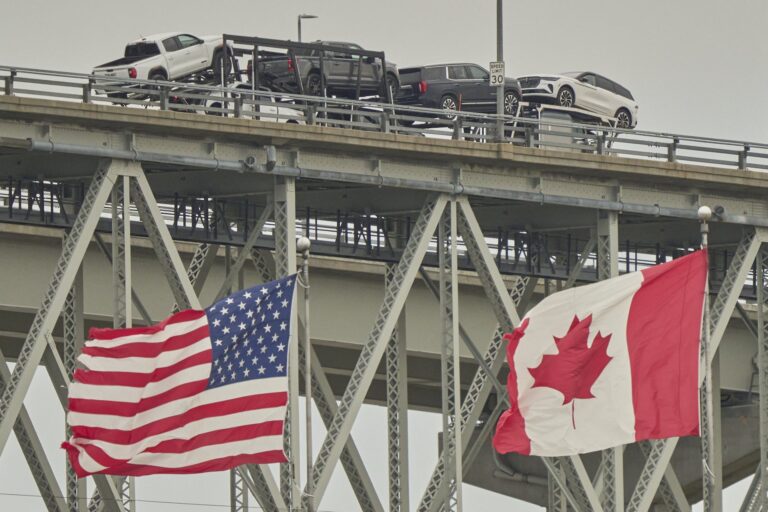
On Tuesday, Trump said he had seen the ad, which ran during the Major League Baseball playoffs the night before. Incorrectly attributing it to Canada, he suggested he would have done the same thing if the shoe were on the other foot. On Thursday night, though, the Ronald Reagan Presidential Foundation and Institute said the ad “mispresents” the presidential address, and Trump reacted strongly: “Based on their egregious behavior, ALL TRADE NEGOTIATIONS WITH CANADA ARE HEREBY TERMINATED,” he wrote on social media.
After initially doubling down on the ad and its message, Ford said on Friday that the province will suspend the campaign in the hope that trade talks can start up again. But it would not do so until Monday, he said, after the ad airs in the U.S. during the first two games of the World Series between the Toronto Blue Jays and the Los Angeles Dodgers. “We’ve achieved our goal, having reached U.S. audiences at the highest levels,” Ford said in a statement.
“It’s just another daily drama in the saga of these negotiations,” Inu Manak, a senior fellow for international trade at the Council on Foreign Relations in Washington, D.C., said Friday in an interview before Ford backtracked.
Whether and when Trump will restart trade talks, which had regained steam after Carney visited the White House on Oct. 7 for the second time, remains to be seen. Before Trump’s eruption, Dominic LeBlanc, the minister for Canada-U.S. trade, had said he was optimistic about nearing deals on steel and aluminum, which are both subject to 50 per cent tariffs, as well as on energy.
Trump and Ford are not the only ones playing hardball. On Thursday, Ottawa announced it is cutting the proportion of U.S. vehicles that General Motors and Stellantis can bring into Canada without being hit by 25 per cent retaliatory tariffs, after both firms announced moves to reduce production planned for their assembly plants in southern Ontario. The carve-out for firms making vehicles in Canada is linked to them keeping operations going and sticking with planned investments.
The Canadian Vehicle Manufacturers’ Association, the industry group representing the Detroit Three automakers, said Friday that it will just make things worse. “Canada’s competitiveness as an auto-manufacturing jurisdiction is rapidly eroding,” president and CEO Brian Kingston said in a statement. “These tariffs are an unforced error at the worst possible time.”
The Canadian Steel Producers Association has decided to wait before saying much about Trump shutting down talks. “In the meantime, we continue to work with the Canadian government to forge a path forward that works for Canadian steel,” CEO Catherine Cobden said in a statement.
The incident recalls Trump’s angry decision to shut down negotiations in late June, after Ottawa said it would move ahead with a digital services tax (DST) that had been planned for years. Hours before that rupture, LeBlanc had told The Logic he was feeling good about the negotiations, including on steel. Two days later, the federal government announced it would rescind Canada’s DST to keep the talks going.
Carney sounded on Friday like someone who has been through this before. “For months, we have stressed the importance of distinguishing things we can control and things we can’t control,” he told reporters before boarding a flight to Asia, where he will join Trump at the ASEAN summit in Malaysia. “We can’t control the trade policy of the United States.”
Jamie Tronnes, executive director at the Washington-based Center for North American Prosperity and Security, noted that something else is outside Carney’s direct influence. “You cannot control the actions of a provincial government and how they respond to the decimation of one of their major industries by another country,” she said, referring to Ford, who recently revived threats to cut the U.S. off from Ontario’s energy and critical minerals after the Trump administration staunchly defended its efforts to reshore auto manufacturing.
Goldy Hyder, president of the Business Council of Canada, said he thinks the Trump administration has had a growing list of reasons to be frustrated with Ottawa in recent days, including moves to co-operate with China and a pledge to double Canada’s non-U.S. exports within the next decade. “We need to be cognizant of that,” he said, “because job one right now is to stabilize a relationship with the United States.”
Eideberg said the tariffs on steel and aluminum are hitting equipment manufacturers on both sides of the border, increasing both input and output costs to the point where they will soon need to pass them on to the consumer. “I think we’re going to hit a point here, before the end of the year, where the time for gimmicks will be up.”



Loading...
Thanks for sharing!
You have shared 5 articles this month and reached the maximum amount of shares available.
CloseThis account has reached its share limit.
If you would like to purchase a sharing license please contact The Logic support at [email protected].
CloseGift the full article!
You have gifted 0 article(s) this month and have 5 remaining.
Recipients will be able to read the full text of the article after submitting their email address. They will not have access to other articles or subscriber benefits.
Photo: The Canadian Press/Spencer Colby; AP Photo/Evan Vucci
Most Popular This Week



In-depth, agenda-setting reporting
Great journalism delivered straight to your inbox.
News
Panel decries Canada’s chaotic way of funding world-class science
Briefing
Feds pledge $15M for U.S. satellite navigation company Xona to expand in Montreal
Inovia raises US$200M for new VC fund as it eyes AI’s impact
43% of eligible Albertans voted ahead of Monday’s referendum
Best business newsletter in Canada
Get up to speed in minutes with insights and analysis on the most important stories of the day, every weekday.
Exclusive events
See the bigger picture with reporters and industry experts in subscriber-exclusive events.
Membership in The Logic Council
Membership provides access to our popular Slack channel, participation in subscriber surveys and invitations to exclusive events with our journalists and special guests.







