Skip to content

Canada's Business and Tech Newsroom

  • Professional Subscription
  • Partnerships & Advertising
  • Licensing & Syndication
Log In Subscribe
Welcome,
  • My Account
  • Log Out
  • Business
  • Tech
  • National
  • The Big Read
  • Briefings
  • Commentary
Search
Log In Subscribe
Welcome,
  • My Account
  • Log Out
News

The Fisheries Department is losing its ability to back maritime innovations, documents warn

Listen Now
0:00
News

The Fisheries Department is losing its ability to back maritime innovations, documents warn

It has ships, the Arctic and the deep sea. Internal documents obtained by The Logic show it no longer has dedicated funding to test inventions.

By David Reevely
A wide-lens aerial shot of a red Canadian Coast Guard ship amid a sea of white ice pans. The effect of the lens exaggerates the curvature of the horizon.
The Canadian Coast Guard icebreaker Louis S. St-Laurent in Baffin Bay in July, 2008. The coast guard was long part of the Department of Fisheries and Oceans, but is now a defence agency. Photo: The Canadian Press/Jonathan Hayward
Aug 11, 2026 | 5:45 AM ET
A A
A Small A Medium A Large
Share

Gift

Share

Listen Now
0:00

OTTAWA  —  Canada’s maritime innovators could get unique benefits from working with the Department of Fisheries and Oceans, but it’s less and less able to help them because of budget decisions, according to an internal document obtained by The Logic. 

“Dedicated departmental innovation funding has eroded,” said a May briefing note for the department’s top permanent official, deputy minister Paul MacKinnon.

Talking Points

  • Budget cuts and operating demands have gutted the Department of Fisheries and Oceans’ capacity to experiment and work with innovators who could benefit from its “unique” access to Canadian waters, according to internal documents
  • Startups are rushing toward defence as the government floods that sector with money and promises to work with new and small players, leaving behind those working in science and other civilian technologies

It cited the “loss” of an internal budget used to back trials of new technologies and a special allotment for work with Innovative Solutions Canada—whose job is to help smaller Canadian firms with clever ideas get their products tested and used by the government.

His department was prepping MacKinnon for a meeting with Atlantic Canadian members of tech scale up lobby group the Council of Canadian Innovators (CCI), who were introducing themselves in Ottawa. 

Meetings with MacKinnon and Fisheries Minister Joanne Thompson were some of the best the group had that day, Dana O’Born, CCI’s chief strategy officer, said in an interview: “It was just very warm and welcoming, and they greeted us with a lot of interest and curiosity.”

The Department of Fisheries and Oceans (DFO) might not seem like an obvious target for tech lobbying, but the department needs sensors and drones and ship-based equipment, and could be an important user of artificial intelligence tools for crunching data on everything from ocean temperatures to whale movements, O’Born said.

“Ocean tech sits at the intersection of ocean science, defence, climate, economic growth and economic security,” she said. “I would say probably few sectors touch as many national priorities at once.”

Related Articles
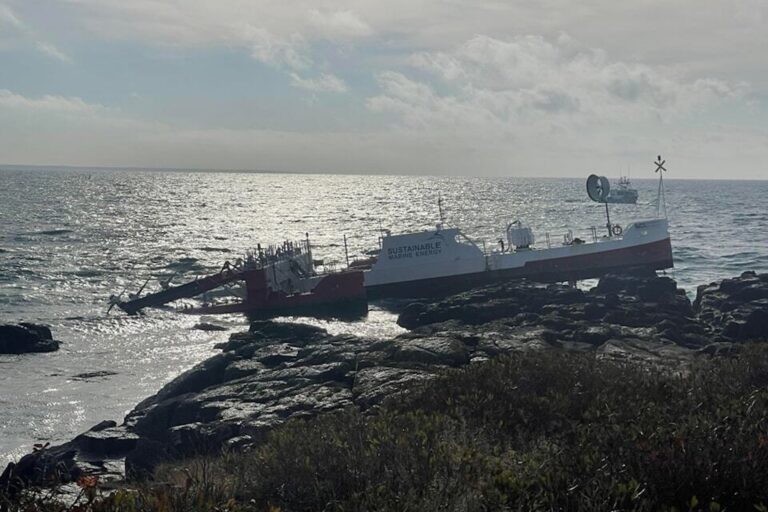
Tidal power faces ‘decisive blow’ if Fisheries Department doesn’t get out of the way: Natural Resources Canada

By David Reevely
A wide view of a coastal city and harbor bordered by hills, with various ships docked along the waterfront under a hazy sky.

The world could learn a thing or two from Newfoundland’s tech scene

By Catherine McIntyre

The briefing for MacKinnon reflected that. DFO works in places almost nobody else does, from the deep ocean to the Arctic, which makes it “uniquely positioned to test innovations across diverse operational environments,” the note said.

But it has scrapped its “departmental results fund,” the note went on. The name is dull, but other DFO documents have credited the fund with paying to test prototypes of year-round lighted navigational buoys and for research toward a new geographic information system—a detailed map-based tool loaded with data on fishing areas.

(Despite the briefing for the deputy minister saying the departmental results fund was gone, Naomi Librach, a DFO spokesperson, told The Logic in an email that it had only been renamed to the “deputy minister’s reserve.” The department had a deputy minister’s reserve already at the time, she acknowledged, and it has no fixed amount.)

The result of losing the fund, said the briefing document for the deputy minister, is that people in DFO who want to try out new technologies and tools just have to find the money in their own budgets. There’s nowhere to go for a little extra to fund an experiment.

Backing innovators can also be hard for reasons that aren’t directly about cash, the note said: “Matching innovators with the right departmental stakeholders is difficult, testing innovations in operational settings carries risk, and participation requires significant in-kind investments (personnel, vessels, facilities) that compete with core priorities.”

Many startups working on ocean-oriented technologies have reoriented toward defence because that’s where the money suddenly is, but DFO should be helping Canadian innovators commercialize less military-oriented products, said Scott Beatty, founder and CEO of Victoria’s MarineLabs.

His 10-year-old company offers hyperlocal forecasts of sea conditions based on data from its own sensors and ones it makes and mounts on customers’ equipment.

“We’re talking about wind, wave, fog—things that affect ships coming into ports from a safety as well as an operational point of view,” Beatty said. The information can inform decisions about dispatching tugboats and loading and unloading freighters, and contribute to technical studies for new coastal infrastructure.

The Canadian Coast Guard became a defence agency last year but for a long time was part of Fisheries and Oceans, including when the coast guard tried a 42-sensor system from MarineLabs. Through an Innovative Solutions Canada program, the devices were mounted all along the Pacific and Atlantic coasts, Beatty said.

“That trial was successful,” Beatty said. But the trial was where it ended. “Ultimately, what happened was the coast guard didn’t find a program requirement for this innovation, and so asked us to remove all 42.”

MarineLabs looked to the United States and other markets after that, he said. Like many Canadian startups, it’s seeing interest at home after landing customers abroad—including from the coast guard again, now that it’s with the Department of National Defence, though that hasn’t led to anything concrete, Beatty said.

Startups with more science-oriented products, such as for monitoring ocean conditions and sea life, will need DFO in their corner, Beatty said, and good luck to them. “My experience with DFO is that it’s very siloed out, procurement is very slow and opaque, and it’s piecemeal and small, and that there’s a lack of willingness to procure innovation.”

A spokesperson for Thompson, the fisheries minister, said questions about her department’s priorities and spending are outside the minister’s bailiwick.

In an email she said was written by the department, Ira Khedkar pointed to DFO’s use of sea drones, buoys and seafloor platforms to collect a range of data as evidence of its commitment to technological innovation.

Gift the full article

DFO is also one of the federal bodies involved in the national “dark vessel” detection program, which uses satellite services from MDA Space to spot ships that aren’t broadcasting their presences—often because they’re fishing or dumping illegally, or are otherwise up to some skulduggery.

“This type of solution-focus is not limited to these programs and continues to be a central focus of the work we do every day,” Khedkar’s email said.


#defence tech #economy #innovation #National #procurement

Sponsored Content

The real-world economic offshoots of sovereign AI

By Deborah Aarts
Illustration of a plane flying above a mailbox

Increasing healthcare access across Canada

By Deborah Aarts

What it takes to lead a frontier firm

By Deborah Aarts
Paid promotional content

Loading...

Thanks for sharing!

You have shared 5 articles this month and reached the maximum amount of shares available.

Close
This account has reached its share limit.

If you would like to purchase a sharing license please contact The Logic support at [email protected].

Close
Want to share this article?

Upgrade to all-access now

Close
Gift the full article!

You have gifted 0 article(s) this month and have 5 remaining.

Copy link and gift
Copy Link
Email to a friend
Send Email
Gift on Social Media

Recipients will be able to read the full text of the article after submitting their email address. They will not have access to other articles or subscriber benefits.

A wide-lens aerial shot of a red Canadian Coast Guard ship amid a sea of white ice pans. The effect of the lens exaggerates the curvature of the horizon.

Photo: The Canadian Press/Jonathan Hayward

Most Popular This Week

Four people stand in orange safety jackets and helmets stand in a factory, including Prime Minister Mark Carney, second right, speaking into microphone. They are in a plant with yellow scaffolding and a Canadian flag in the background.
News

Ottawa backs ArcelorMittal’s Quebec expansion with $125M

By Laura Osman
Shivam Mahajan and Zaaheda Islam pose in front of their company offices.
Analysis

These AI startups are making millions with tiny teams

By Catherine McIntyre
A screen displays a TSXV and Emerge banner in front of several skyscrapers in Toronto’s downtown financial district.
News

Nasdaq’s crackdown tests Canada’s bet on small public companies

By Catherine McIntyre and Anita Balakrishnan
News

Bigger deals boost Canadian VC investment in bumper start to the year

By Catherine McIntyre

In-depth, agenda-setting reporting

Great journalism delivered straight to your inbox.

A wide-lens aerial shot of a red Canadian Coast Guard ship amid a sea of white ice pans. The effect of the lens exaggerates the curvature of the horizon.
News

The Fisheries Department is losing its ability to back maritime innovations, documents warn

By David Reevely

Briefing

Ontario drone company Avidrone wins DARPA Lift Challenge

By Catherine McIntyre   |   Aug 10, 2026 | 4:04 PM ET

CEO Greg Abel pushes more of Berkshire Hathaway’s massive cash stockpile into equities

By Anita Balakrishnan   |   Aug 10, 2026 | 3:52 PM ET

Ontario Teachers’ posts 9.5% first-half return as SpaceX stake surges

By Chaimae Chouiekh   |   Aug 10, 2026 | 3:42 PM ET

Best business newsletter in Canada

Get up to speed in minutes with insights and analysis on the most important stories of the day, every weekday.

Exclusive events

See the bigger picture with reporters and industry experts in subscriber-exclusive events.

Membership in The Logic Council

Membership provides access to our popular Slack channel, participation in subscriber surveys and invitations to exclusive events with our journalists and special guests.

Recent Popular Stories

Analysis

These AI startups are making millions with tiny teams

By Catherine McIntyre   |   Aug 5, 2026
Shivam Mahajan and Zaaheda Islam pose in front of their company offices.
News

Ottawa backs ArcelorMittal’s Quebec expansion with $125M

By Laura Osman   |   Aug 6, 2026
Four people stand in orange safety jackets and helmets stand in a factory, including Prime Minister Mark Carney, second right, speaking into microphone. They are in a plant with yellow scaffolding and a Canadian flag in the background.
News

Canada’s oil majors eye the next production boom

By Meghan Potkins   |   Aug 7, 2026
Storage tanks in the primary extraction plant at the Suncor Fort Hills facility in Fort McMurray Alta, on Monday September 10, 2018.
News

Nasdaq’s crackdown tests Canada’s bet on small public companies

By Catherine McIntyre and Anita Balakrishnan   |   Aug 4, 2026
A screen displays a TSXV and Emerge banner in front of several skyscrapers in Toronto’s downtown financial district.
News

Trump’s ban on foreign robots has Canada’s tech leaders worried

By Joanna Smith   |   Aug 6, 2026
News

Toronto’s Taalas sells to AMD as AI inference market heats up

By Murad Hemmadi   |   Aug 6, 2026

Canada's most influential executives and policymakers are reading The Logic

  • CPP Investments
  • Sun Life Financial
  • C100
  • Amazon
  • Telus
  • Mastercard
  • bdc
  • Shopify
  • Rogers
  • RBC
  • General Motors
  • MaRS
  • Government of Canada
  • Uber
  • Loblaw Companies Limited
logic-logo

Canada's Business and Tech Newsroom

100% human-crafted journalism

Newsroom

  • News Tips
  • AI Policy
  • Editorial Disclosures
  • Story Pitches

Company

  • About Us
  • Terms of Service
  • Privacy Statement
  • Corporate Information

Contact

  • Contact Us
  • Advertise
  • FAQs
  • Work at The Logic

© 2026 The Logic Inc. All Rights Reserved.

Trusted by leaders

Error

Account creation failed.

Please email us at [email protected].

Create Account

[wppb-register form_name=”cozmo-registration-form-for-modal”]

I do have an account
Login
or

[wppb-login]

I don’t have an account