OTTAWA — The last time Canada was facing tough trade negotiations with Donald Trump, Ottawa gave provincial premiers talking points casting the overhaul of the North American trade agreement as an opportunity for a progressive approach to trade and investment.
Skip to content
 Prime Minister Justin Trudeau holds a press conference during his government's cabinet retreat in Montebello, Que., on Jan. 21, 2025. Photo: The Canadian Press/Sean Kilpatrick

News
As Trump tariffs loom, who speaks for Canada?
Leadership vacuum in Ottawa leaves premiers, would-be prime ministers and business leaders forging their own paths
Photo: Illustration by The Logic
OTTAWA — The last time Canada was facing tough trade negotiations with Donald Trump, Ottawa gave provincial premiers talking points casting the overhaul of the North American trade agreement as an opportunity for a progressive approach to trade and investment.
Now, the Canadian orchestra is becoming a cacophony without a maestro.
Talking Points
- Lack of clarity over who is leading Canada’s response to Trump’s trade threats can undermine negotiations, warn observers
- Canadian businesses share ideas but are bound to do what is best for their individual sectors and unique circumstances
Prime Minister Justin Trudeau is on his way out. Trump will be nearly halfway through his first 100 days in the White House by the time the Liberals choose a new leader. Canadians are expected to vote for a new government this year, but the date is not yet in the calendar.
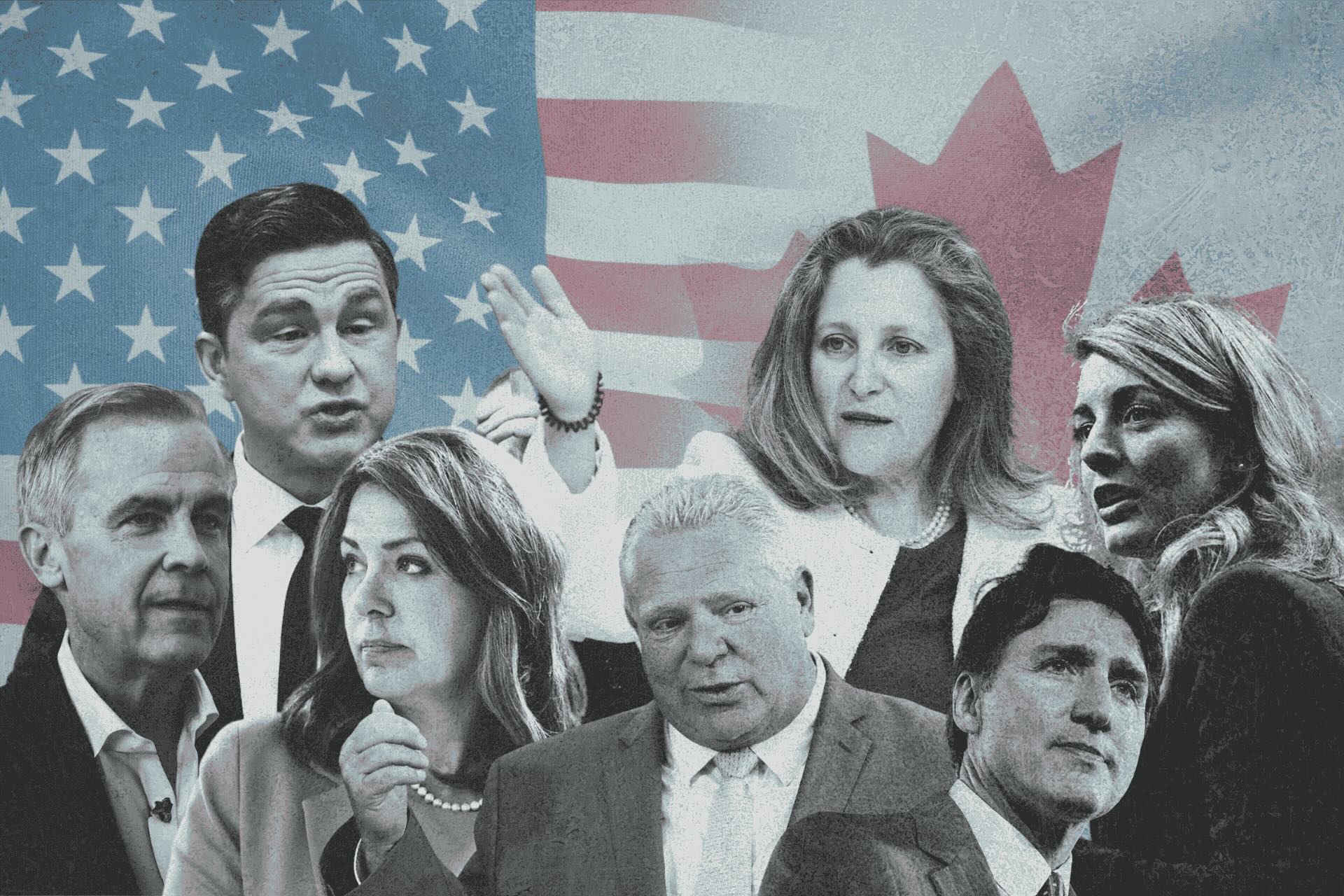
The voices competing to be heard as Canada faces what could be a devastating blow to the economy include Ontario Premier Doug Ford and Alberta’s Danielle Smith; Liberal leadership candidates; cabinet ministers glad-handing in Washington while Parliament is prorogued; and potential future prime minister Pierre Poilievre.
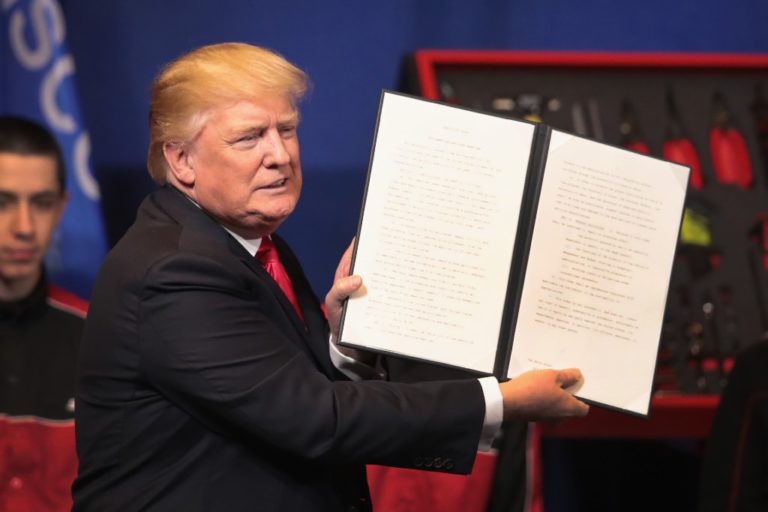
Joining the clamour are Canadian business and union leaders from the banking to the dairy sectors, who are sharing ideas with each other and the government on what to do about Trump’s threat to impose 25 per cent tariffs on all imports from Canada. Even Kevin O’Leary visited Trump at his Mar-a-Lago compound and emerged insisting that what Trump really wants is an “economic union.”
Related Articles
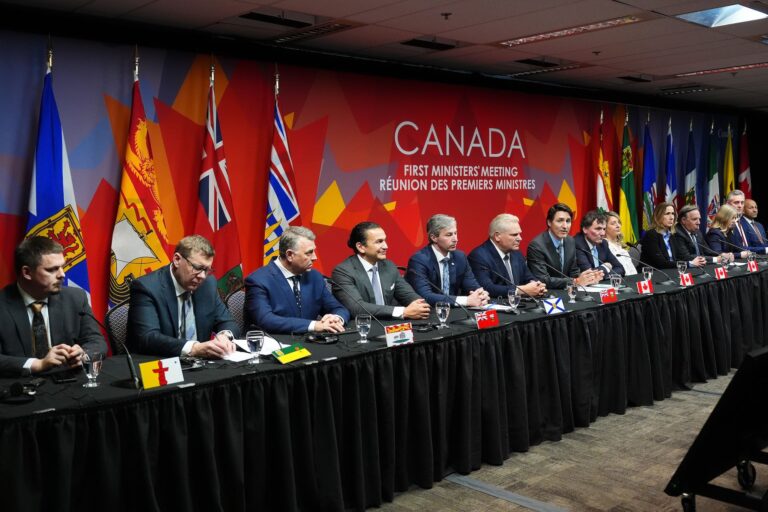

With so many dissonant voices in the choir, the Americans—and Canadians, too—might reasonably wonder: who speaks for Team Canada?
Laura Dawson, executive director of the Future Borders Coalition, said a lack of co-ordination can undermine negotiations. “We’re in this vacuum of leadership, and so we’re ending up with a lot of people jumping forward and saying, ‘Here’s my idea, here’s my idea,’” she said. “And that can be problematic, because we might end up in a situation where we’re negotiating against ourselves and talking at cross purposes.”
Premier versus premiers
Ontario’s Ford has been promoting “Fortress Am-Can,” which he says would further integrate and strengthen the North American economy while reducing reliance on China. Ford, who made his case in an op-ed published by The Wall Street Journal on Tuesday, also spoke strongly last week about the need for unity among the premiers: “Protect your jurisdiction, but country comes first.”
That message was meant for Alberta’s Smith, who is refusing to fully support the federal response to U.S. tariffs unless taxes or other restrictions on energy exports are off the table. Nearly all of Canada’s crude oil is exported—at a discount—to the U.S., travelling through cross-border pipelines to refineries. Canada imports much of it back.
Fen Hampson, a professor at the Norman Paterson School of International Affairs at Carleton University, stressed the importance of solidarity in negotiations.
“We might end up in a situation where we’re negotiating against ourselves and talking at cross purposes.”
“You don’t want to be a divided house that allows your counterparty, in this case the United States, to start playing provinces off the federal government and vice versa,” he said. Still, it can help if the U.S. knows Ottawa needs to check with the provinces before agreeing to anything, Hampson said. “It doesn’t hurt to have what’s called a domestic veto.”
Smith told reporters on Tuesday that the premiers do not have much of a choice.
“I think we’re in a difficult position, because we don’t have a government, federally, with a long enough mandate to be able to sustain the negotiations,” Smith said from Washington, D.C. “I think you’re going to see that the relationships that the premiers have … is going to be the consistent voice over the next number of months while the federal scene gets sorted out.”
Yet Smith, who joined O’Leary to meet Trump in Florida earlier this month, said Trudeau will be the one to wear any failure to stop the tariffs and accused him of damaging the relationship with the first Trump administration while renegotiating NAFTA.
“All I can do is try to repair and build relationships that should have been repaired and built over the last four years,” she said.
Still in charge
For the time being, Trudeau and his Liberal government are responsible for Canada’s initial response to Trump’s threats.
“If the president does choose to proceed with tariffs on Canada, Canada will respond, and everything is on the table,” Trudeau said Tuesday morning in Montebello, Que., where cabinet ministers were meeting to sort out the response. He said the government would be working “as Team Canada with business leaders, organized labour, civil society, Indigenous leaders and premiers from coast to coast to coast.”
No sectors, including energy, are off limits, but the federal government has said it is ready to divert any revenues from retaliatory moves to industries and businesses needing support.
The Liberals were still trying to play nice leading up to the inauguration, though, including by earmarking $1.3 billion for border security measures in the 2024 fall economic statement to address Trump’s concerns about the flow of illegal drugs and migrants into the U.S. Natural Resources Minister Jonathan Wilkinson was in Washington last week, calling for both countries to invest in a B.C. project to boost the supply of the critical mineral germanium.
Foreign Affairs Minister Mélanie Joly visited several Republican senators in Washington last week to argue that tariffs would cause economic harm to both countries. She suggested those lawmakers, busy getting ready for the transition, were unaware they had so much at stake.
To help make the case against tariffs to Americans, Trudeau convened a new Canada-U.S. relations council featuring 18 business, labour and policy leaders, including Steve Verheul, who was Canada’s chief negotiator for the talks that replaced NAFTA with the United States-Mexico-Canada agreement (USMCA).
The question is whether the Trump administration is taking any of those efforts seriously, given the likelihood the Liberals will be out of office in a few months.
“Donald Trump clearly doesn’t have to listen to anything Trudeau says,” said Stewart Prest, an international relations and political science lecturer at the University of British Columbia… In fact, Prest said, there is no reason for Trump to listen to any particular Canadian voice, “so we instead have this kind of cacophony coming from the premiers.”
Would-be prime ministers
Others are getting ready to step in.
Liberal leadership contender Chrystia Freeland has been reminding Canadians that she took on Trump when she played a key role in negotiating USMCA. She also proposed targeted dollar-for-dollar tariffs. Mark Carney appeared on The Daily Show and warned the U.S. if they do not take Canadian oil, “your other option is Venezuela.”
Poilievre wrote in a Jan. 7 social media post on X that “Canada will never be the 51st state. Period.” He has been less clear on his preferred response to tariffs. He did not say last week whether restricting energy exports should be ruled out, but said he would have approved pipelines such as Northern Gateway and Energy East to avoid being so dependent on the U.S. market.
“The Liberals are trying to divide one province against another, Canadian against Canadian, right at our moment of maximum vulnerability,” Poilievre said.
But maintaining unity might require Poilievre to make hard choices, said Prest, including ones his supporters in Alberta and elsewhere don’t like.
“It’s something inevitably every prime minister has to do at some point,” he said.
“It creates opportunities for the U.S. administration to play divide-and-conquer, where you pick off some partners that make sense to work with and ignore the rest.”
Business leaders unite
A growing list of Canadian companies, labour groups and industry associations from banking, steel, energy and other sectors decided not to wait. Their newly formed Canada-U.S. Trade Council grew out of the working relationship that Jean Simard, president and CEO of the Aluminium Association of Canada, and Catherine Cobden, president and CEO of the Canadian Steel Producers Association, developed last summer to push for Canadian tariffs on steel, aluminum and electric vehicles imported from China.
Cobden said it was different from when their industries worked “kind of in isolation from each other” against the Section 232 tariffs on Canadian steel and aluminum during the first Trump administration. They figured this bigger threat called for even more co-ordination.
They may not always want or need to work together. A recent report by Desjardins Securities suggested that the automotive and energy industries could get carve-outs because the U.S. depends so heavily on their products. According to the report, primary metals, including aluminum, and food and beverage manufacturing will be among the hardest hit.
“Each sector owns its own reality, its own story, and they will go out and protect what they have to protect,” but they will share information and “a strategic vision of things,” Simard said.
Dawson, an expert adviser to the council, said that could include “looking to the government of Canada for stability,” as well as money to continue business operations and “keep Canadians employed in these sectors during this unstable period.”
However, Prest said businesses advocating for their own interests also carries a negotiating risk.
“It creates all sorts of opportunities for the U.S. administration to play a divide-and-conquer strategy, where you can pick off some partners that make sense to work with and ignore the rest,” he said.
Some Canadian business leaders are looking beyond the U.S. to a familiar trade ally Trump is also targeting. Goldy Hyder, president and CEO of the Business Council of Canada, led a delegation to Mexico this month to meet President Claudia Sheinbaum, who has urged Trudeau not to break ranks with her country leading up to next year’s review of USMCA.
Last November, Ford said he wanted Canada to secure bilateral trade deals with Mexico and the U.S. rather than waiting for next year’s review of USMCA, over concerns about Chinese investment in Mexico.
Hyder said he told Sheinbaum that Canadian business leaders believe in the trilateral deal.
“We as business leaders have to remind all of these politicians that trade agreements are made for business to conduct business,” Hyder said. “They’re not for politicians to play politics with.”



Loading...
Thanks for sharing!
You have shared 5 articles this month and reached the maximum amount of shares available.
CloseThis account has reached its share limit.
If you would like to purchase a sharing license please contact The Logic support at [email protected].
CloseGift the full article!
You have gifted 0 article(s) this month and have 5 remaining.
Recipients will be able to read the full text of the article after submitting their email address. They will not have access to other articles or subscriber benefits.
Photo: Illustration by The Logic
Prime Minister Justin Trudeau holds a press conference during his government's cabinet retreat in Montebello, Que., on Jan. 21, 2025.
Most Popular This Week



In-depth, agenda-setting reporting
Great journalism delivered straight to your inbox.
The Big Read
Beacon is building an AI empire by fixing Main Street’s software
Briefing
Inovia raises US$200M for new VC fund as it eyes AI’s impact
43% of eligible Albertans voted ahead of Monday’s referendum
AI chip company Tenstorrent raises US$1.5B, valuing it at US$6.2B
Best business newsletter in Canada
Get up to speed in minutes with insights and analysis on the most important stories of the day, every weekday.
Exclusive events
See the bigger picture with reporters and industry experts in subscriber-exclusive events.
Membership in The Logic Council
Membership provides access to our popular Slack channel, participation in subscriber surveys and invitations to exclusive events with our journalists and special guests.