OTTAWA — U.S. President Donald Trump abruptly called off trade talks with Canada on Friday and threatened to slap another, potentially higher, tariff on the country because Ottawa is moving ahead with a digital services tax that was in the works for years.
Skip to content


News
Trump halts trade talks with Canada in fit of pique over tax on American tech giants
President’s outburst over Canada’s digital services tax throws hope for deal by mid-July into doubt
U.S. President Donald Trump announced he was cutting off trade talks with Canada just 11 days after meeting Prime Minister Mark Carney at the G7 summit in Kananaskis, Alta. Photo: The Canadian Press/Adrian Wyld
OTTAWA — U.S. President Donald Trump abruptly called off trade talks with Canada on Friday and threatened to slap another, potentially higher, tariff on the country because Ottawa is moving ahead with a digital services tax that was in the works for years.
“We have just been informed that Canada, a very difficult Country to TRADE with … has just announced that they are putting a Digital Services Tax on our American Technology Companies, which is a direct and blatant attack on our Country,” Trump posted to social media on Friday afternoon.
“Based on this egregious Tax, we are hereby terminating ALL discussions on Trade with Canada, effective immediately. We will let Canada know the Tariff that they will be paying to do business with the United States of America within the next seven-day period,” he added.
The Prime Minister’s Office had little to say after Trump pulled out of talks. “The Canadian government will continue to engage in these complex negotiations with the United States in the best interests of Canadian workers and businesses,” press secretary Audrey Champoux said in a written statement.
Talking Points
- U.S. President Donald Trump called off trade talks with Canada over the decision to move ahead with a long-established digital services tax that is set to take effect on Monday
- Canada’s government has so far said it’s prepared to go ahead with the DST, a long-standing trade irritant with the U.S., despite mounting pressure from the Trump administration and Canadian business groups
Trump initially shut down questions from reporters in the Oval Office about the state of U.S.-Canada trade talks Friday afternoon. “Don’t ask me a trade question on Canada,” he said, before moving on to queries from other journalists.
But when a question about the renewed tariff threat came up again later, Trump decided to answer it.
“We have all the cards,” he said. “Economically, we have such power over Canada. I’d rather not use it, but they did something with tech companies today, trying to copy Europe. … It’s not going to work out well for Canada.”
Talks are off “until they straighten out their act,” he added.
Related Articles


Trump’s sudden move comes at a crucial time in relations between the two countries. Prime Minister Mark Carney and Trump agreed when they met last week at the G7 summit in Kananaskis, Alta., to try to finish negotiations for a new economic and security deal within 30 days. Carney later said Canada will adjust its 25 per cent retaliatory tariffs on U.S. steel and aluminum products, depending on how much progress is made in those negotiations by July 21.
The S&P/TSX Composite Index fell immediately after Trump’s post, though the decline levelled off at about 0.5 per cent, and by the end of the trading day, it regained about 80 of the 150 points it had lost.
Though Trump’s statements suggest the tax surprised him, the U.S., even under the Biden administration, has long considered Canada’s DST to be “discriminatory” and a trade irritant. The tax was enacted by the previous Liberal government in 2024 as a way to target foreign tech companies with annual global revenue over €750 million and Canadian revenue over $20 million. That means it mainly applies to American tech giants like Amazon and Google.
The Canada Revenue Agency is expected to collect the first payments on June 30, which are retroactive to 2022. In a 2023 analysis, the Parliamentary Budget Office estimated the tax would bring in about $1.2 billion a year.
“Canada should put forward an immediate proposal to eliminate the DST in exchange for an elimination of tariffs from the United States.”
Trump has taken issue with digital sales taxes by other countries since his first presidency. Canada’s version was also in the crosshairs of his One Big Beautiful Bill Act, before Treasury Secretary Scott Bessent asked lawmakers Thursday to remove the section that would have allowed the U.S. government to retaliate against what it deemed to be “unfair foreign taxes.” In exchange, G7 leaders agreed to issue a statement exempting U.S. companies from a minimum tax agreement under the OECD. Canadian investors and tax experts had raised alarms about the so-called “revenge tax” in the U.S. bill, which they feared would allow the U.S. government to withhold billions of Canadian investment dollars.
“The Trump administration remains vigilant against all discriminatory and extraterritorial foreign taxes applied against Americans,” Bessent said on social media when he announced the change to the bill. “We will defend our tax sovereignty and resist efforts to create an unlevel playing field for our citizens and companies.”
When Trump announced on Feb. 13 that he would impose so-called reciprocal tariffs matching trade measures other countries have in place against the U.S., the White House published a fact sheet that suggested Canada’s DST was a target. When Trump shared the details of those reciprocal tariffs on April 2, however, Canada was spared.
Despite suggestions the U.K. would have to give up its own DST to secure a deal with the U.S., the agreement those countries reached last month leaves it intact. The U.S. Trade Representative’s office said it was “disappointed” by the U.K.’s unwillingness to back away from the measure.
Like many Canadian business groups, the Business Council of Canada has long opposed the DST. But in a statement following Trump’s declaration, the council’s CEO Goldy Hyder suggested Canada should treat the tax as a valuable bargaining chip.
“In an effort to get trade negotiations back on track, Canada should put forward an immediate proposal to eliminate the DST in exchange for an elimination of tariffs from the United States,” Hyder said.
In an interview with The Logic on Friday, a few hours before Trump’s post, Dominic LeBlanc would not say directly whether Canada’s DST was part of negotiations for a new economic and security relationship between Canada and the U.S. “We also have concerns about some economic policies, tax policies of the United States. That’s an example of the kind of conversation that we’re having in private with them,” said LeBlanc, the federal cabinet minister leading the Canada-U.S. trade file.
Still, LeBlanc said he had “no reason to think” there would be a change in Canada’s DST. “That measure was legislated years ago, and Canada is a sovereign country that can decide its own tax policies and its own tax legislation, and I’ve been clear with the Americans on that,” he said.
LeBlanc, who has been engaging directly with U.S. Commerce Secretary Howard Lutnick, was scheduled to speak with Canadian Ambassador Kirsten Hillman and U.S. Trade Representative Jamieson Greer by video conference soon. LeBlanc had also said he might be back in Washington, D.C., again soon. His office did not immediately say how Trump’s announcement would affect those plans.
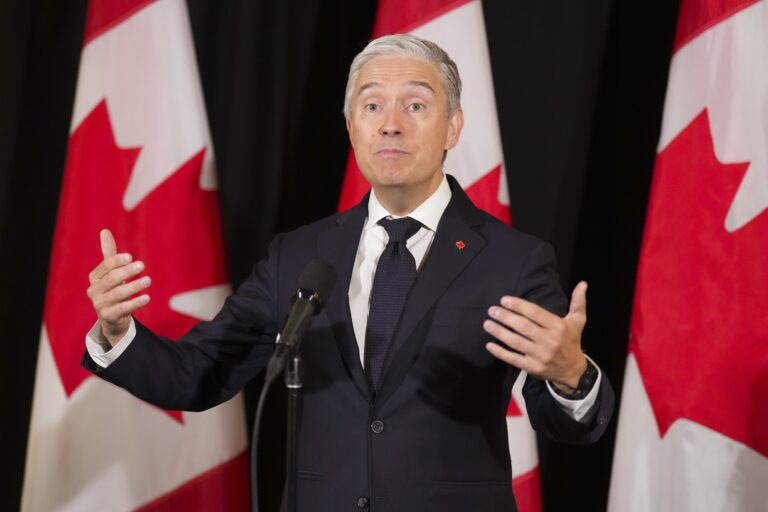
Last week, Finance Minister François-Philippe Champagne said the government would go ahead with the DST as planned, despite mounting pressure from the U.S. administration and Canadian business groups to delay.
“This was voted by Parliament,” Champagne told reporters at the time. “But obviously, all of that is something that we’re considering as part of broader discussions we may have.”
Jennifer Young, a spokeswoman for the U.S. Embassy in Ottawa, wrote Friday in an email that the embassy had “nothing additional to offer on this at this time.”
With files from David Reevely



Loading...
Thanks for sharing!
You have shared 5 articles this month and reached the maximum amount of shares available.
CloseThis account has reached its share limit.
If you would like to purchase a sharing license please contact The Logic support at [email protected].
CloseGift the full article!
You have gifted 0 article(s) this month and have 5 remaining.
Recipients will be able to read the full text of the article after submitting their email address. They will not have access to other articles or subscriber benefits.
Photo: The Canadian Press/Adrian Wyld
Most Popular This Week



In-depth, agenda-setting reporting
Great journalism delivered straight to your inbox.
Commentary
Carmichael: Canadian ignorance about India is a strategic weakness
Briefing
Aritzia shares pop after earnings rise 204%
First Nation in Alberta goes to court over fast-tracked oil pipeline
Chinese EV maker Geely Auto Group to launch in Canadian market in 2027
Best business newsletter in Canada
Get up to speed in minutes with insights and analysis on the most important stories of the day, every weekday.
Exclusive events
See the bigger picture with reporters and industry experts in subscriber-exclusive events.
Membership in The Logic Council
Membership provides access to our popular Slack channel, participation in subscriber surveys and invitations to exclusive events with our journalists and special guests.