U.S. President Donald Trump said Tuesday he thinks Prime Minister Mark Carney and his team would “walk away very happy” after their latest visit to the White House, with the two countries getting closer to deals on steel, aluminum and energy.
Skip to content


News
Steel and aluminium talks heat up after Carney’s visit to White House
Donald Trump said his tariffs on Canada are part of “natural business conflict,” but predicted Carney and his team would leave Washington happy
U.S. President Donald Trump effusively complimented Prime Minister Mark Carney on Tuesday during the leaders' meeting at the White House. Photo: Getty Images/Anna Moneymaker
U.S. President Donald Trump said Tuesday he thinks Prime Minister Mark Carney and his team would “walk away very happy” after their latest visit to the White House, with the two countries getting closer to deals on steel, aluminum and energy.
‘Mutual love’ and ‘natural conflict’
The relationship between Canada and the U.S. is “more complicated,” Trump said, because the two countries share “mutual love” yet often compete for the same business—especially when it comes to steel and autos. “It’s a natural business conflict. Nothing wrong with it.”
Carney described it differently. “There are areas where we compete,” he said, “and it’s in those areas where we have to come to an agreement that works, but there are more areas where we are stronger together, and that’s what we’re focused on.”
Related Articles

Steel, aluminum and energy at top of the list
Dominic LeBlanc, the minister responsible for Canada-U.S. trade, told reporters later Tuesday that Carney and Trump had instructed their cabinet members to work quickly to secure deals related to steel and aluminum—both currently subject to 50 per cent U.S. tariffs. LeBlanc also said the two countries were working on “strengthening the energy partnership.” Canadian energy products that do not move through the United States-Mexico-Canada Agreement (USMCA) are currently subject to 10 per cent tariffs—a lower rate than the 35 per cent imposed on all other Canadian goods.
LeBlanc, who said he was staying behind in Washington, D.C., to continue negotiations, with meetings planned for as soon as Tuesday night and Wednesday, said he understands Canadians want to see a resolution as soon as possible. “Believe me, so do we,” he added.
‘We’ll get there’
In the Oval Office, Trump hinted the auto sector is where the two countries could reach some kind of compromise. “It’s a tough situation, because we want to make our cars here. At the same time, we want Canada to do well making cars. So, we’re working on formulas. I think we’ll get there.”
LeBlanc later suggested the “formulas” Trump referred to could come into play for steel and aluminum—the sectors where he said Canada expects to make quick progress. This could involve tariff rate quotas, which cap the amounts of steel and aluminum that could be traded without duties. But he cautioned against assuming that is the only option on the table. “There can be all kinds of formulas that are discussed in terms of investment, in terms of partnerships, in terms of joint ventures to develop certain industries together.”
During their media availability in the Oval Office, Carney reminded Trump that Canada is the biggest source of foreign investment in the U.S., adding that Canada is prepared to invest another US$1 trillion over the next five years—if it gets the “agreement we expect to get.” LeBlanc later suggested those decisions would be up to the private sector, including Canada’s large institutional investors.
The North American trade pact
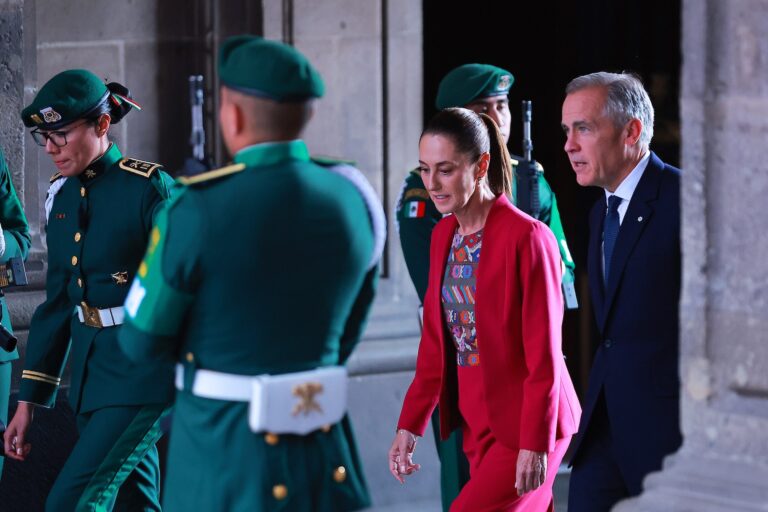
The coming review of the agreement is expected to be contentious—especially when it comes to rules-of-origin thresholds in auto manufacturing and U.S. access to Canada’s tightly controlled dairy market. Last month, Carney and Mexican President Claudia Sheinbaum committed to keeping the trilateral deal going. On Tuesday, Trump was ambivalent: “We can renegotiate it and that would be good, or we could just do different deals.”
Canada’s global trade deficit grows
Canada’s merchandise trade deficit with the rest of the world widened in August to $6.3 billion, Statistics Canada reported Tuesday, up from $3.8 billion the month before. Exports fell by three per cent, largely driven by a decline in gold, silver, platinum and their alloys. It was the first month exports had dropped since an April collapse linked to Trump’s tariffs taking effect.
This story has been updated to add details, and quotes from Canada-U.S. Trade Minister Dominic LeBlanc.



Loading...
Thanks for sharing!
You have shared 5 articles this month and reached the maximum amount of shares available.
CloseThis account has reached its share limit.
If you would like to purchase a sharing license please contact The Logic support at [email protected].
CloseGift the full article!
You have gifted 0 article(s) this month and have 5 remaining.
Recipients will be able to read the full text of the article after submitting their email address. They will not have access to other articles or subscriber benefits.
Photo: Getty Images/Anna Moneymaker
Most Popular This Week



In-depth, agenda-setting reporting
Great journalism delivered straight to your inbox.
News
Tech firms want AI models to create better versions of themselves
Briefing
Lightspeed cuts 250 jobs through layoffs and attrition
Oil tycoon Adam Waterous aims to build new Canadian energy player with US$1B fund
Data centre infrastructure firms 3C and Datalec merge, plan Calgary expansion
Best business newsletter in Canada
Get up to speed in minutes with insights and analysis on the most important stories of the day, every weekday.
Exclusive events
See the bigger picture with reporters and industry experts in subscriber-exclusive events.
Membership in The Logic Council
Membership provides access to our popular Slack channel, participation in subscriber surveys and invitations to exclusive events with our journalists and special guests.