OTTAWA — The Liberal government slapped counter-tariffs on nearly $60 billion worth of U.S. goods and then more on autos this spring—an Elbows Up move that defied President Donald Trump’s threats to escalate his trade war against any country that retaliated.
Skip to content


News
Elbows down? Canada’s retaliation against Trump’s tariffs is getting complicated
Ottawa has eased off on some retaliatory tariffs on U.S. goods in key sectors, but 70 per cent of them remain in place
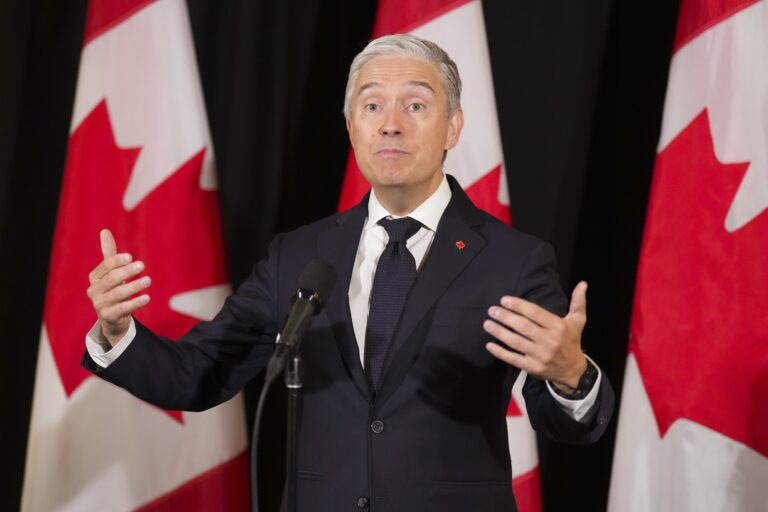
Minister Mark Carney responds to a question during Question Period, Wednesday, May 28, 2025 in Ottawa. Photo: The Canadian Press/Adrian Wyld
OTTAWA — The Liberal government slapped counter-tariffs on nearly $60 billion worth of U.S. goods and then more on autos this spring—an Elbows Up move that defied President Donald Trump’s threats to escalate his trade war against any country that retaliated.
Then, bit by bit, partly in response to significant carve-outs from the White House, Ottawa began easing off.
Talking Points
- Canada granted a six-month reprieve from counter-tariffs on U.S. goods used for manufacturing and other key sectors, but Finance Minister François-Philippe Champagne says 70 per cent of them remain in place
- A report from Oxford Economics said carve-outs from Canada’s counter-tariffs were so broad they reduced the effective tariff-rate increase on U.S. imports to “nearly zero”
That partial—and likely temporary—retreat was cheered by manufacturers struggling to find alternative sources of materials. It was a disappointment to the steel industry, which had urged Ottawa to level the playing field. And it was largely unnoticed by everyone else amid the daily chaos of the trade war and the federal election campaign trail until a report from a U.K. firm suggested Canada had given up its fight.
That report, released this month by Oxford Economics, said the carve-outs from Canada’s counter-tariffs were so broad they reduced the effective tariff-rate increase on U.S. imports to “nearly zero.”
Conservative Leader Pierre Poilievre accused Prime Minister Mark Carney of dropping the retaliatory tariffs “without telling anyone” during the election campaign. This had implications beyond transparency. The Liberals had included $20 billion in revenue to be generated by counter-tariffs this year in their campaign platform, which also projected a $62.3-billion deficit.
Audrey Milette, a spokesperson for Finance Minister François-Philippe Champagne, said 70 per cent of the counter-tariffs remain. It is hard to be precise about the value given fluctuations in trade flows, but it amounts to about $42 billion worth of U.S. goods. That figure does not include autos. “We temporarily and publicly paused tariffs on goods for health [and] public safety reasons,” Champagne replied to Poilievre on social media.
Related Articles

That is only part of the story.
Canada’s retaliation against the U.S. trade actions played out over three periods.
First: “We will not back down from a fight, not when our country and the well-being of everyone in it is at stake,” then-prime minister Justin Trudeau said on March 4 after Trump imposed universal tariffs that he linked to concerns over fentanyl. The federal government then slapped retaliatory tariffs on $30 billion worth of U.S. goods as varied as toilet paper, orange juice and refrigerators.
Second: “We will not stand idly by while our iconic steel and aluminum industries are being unfairly targeted,” Dominic LeBlanc, who was finance minister at the time, said on March 12 after Trump restored tariffs on steel and aluminum, removing an exemption that was granted to Canada in 2019. Ottawa then retaliated with matching 25 per cent tariffs on $12.6 billion of steel and $3 billion of aluminum products from the U.S., plus another $14.2 billion worth of U.S. products.
Third: “We must respond with both purpose and force,” Prime Minister Mark Carney said on April 3 as he announced Canada’s response to Trump’s auto tariffs. Ottawa then placed 25 per cent tariffs on vehicles made in the U.S. that do not comply with the U.S.-Mexico-Canada Agreement (USMCA). Those that do comply with the trilateral trade pact face 25 per cent duties on any content that does not originate in Canada or Mexico. There are no counter-tariffs on auto parts.
Less than two weeks later, with a federal election campaign then underway, Champagne announced two significant exemptions to Canada’s offensive strategy. They received little attention at the time, given that the government was in caretaker mode.
Automakers producing vehicles in Canada, such as General Motors and Honda, could import some vehicles free of counter-tariffs if they keep those operations going and stick with planned investments. Carney had already made clear a carve-out of this kind was in the works when he announced the retaliatory tariffs on autos.
The second bit of news on April 15 was more of a surprise. Ottawa gave relief from counter-tariffs—lasting six months—to companies importing U.S. goods used in Canadian manufacturing or processing, packaging food or beverages, as well as for health care, public health, public safety and national security. Businesses were already able to ask for remission from counter-tariffs if they could not find a non-U.S. source of supplies, which the government would consider on a case-by-case basis. The government has received more than 700 such requests, Champagne’s spokesperson said on Wednesday. The change makes that relief automatic for the wide range of goods in those categories until Oct. 16.
The Canadian manufacturing industry welcomed the move. Dennis Darby, president and CEO of Canadian Manufacturers and Exporters (CME), said the counter-tariffs were painful for businesses producing goods in Canada, especially since many of their customers are in the U.S. They were paying 25 per cent duties when importing U.S. materials and then again when exporting manufactured goods to the U.S., especially if made with steel or aluminum. “It took some of the inflationary pressure off inputs,” Darby said of the six-month reprieve, although he understood the political reasons for launching retaliatory tariffs. “Anything that causes inflation for Canadian consumers, or potential slowdowns in the economy, isn’t good for manufacturers.”
The Canadian steel industry, on the other hand, did not appreciate Ottawa softening its blow while Trump’s tariffs wreak havoc. Catherine Cobden, president and CEO of the Canadian Steel Producers Association, said she understands the decision to grant carve-outs for goods related to health and safety, but she thinks the relief goes too far. “What we take issue with, and what we never would have agreed to, is a broad-based, blanket remission on U.S. steel coming into our country untariffed in the middle of a trade war where all of our steel is going to the United States tariffed,” she said. “All in all, I have to say, we’re very disappointed.”
It was not the first time the federal government eased off. After the fentanyl-related tariffs first took effect, the Finance Department began consultations on proposed counter-tariffs on another $125 billion worth of U.S. imports. When Trump granted a carve-out for Canadian goods deemed compliant with the USMCA, Ottawa delayed its planned implementation date to ensure its response was proportionate—and that Trump would keep talking. The government has since removed any mention of a timeline—and scrubbed the list from its website—but says it could still go ahead if Trump continues the trade war or announces new tariffs.
The Liberals have repeatedly said Canada’s retaliation was designed to inflict damage on the U.S., with some products chosen specifically to catch the attention of influential Republicans, while minimizing the harm to Canadian businesses. Adjustments were to be expected. LeBlanc likes to mention companies in his New Brunswick riding that make doors and windows with glass panes that are fully sourced from the U.S. and cannot be made domestically. He had worked to avoid retaliatory tariffs that would only “raise the price of a window or door made in Port Elgin or in Scoudouc,” LeBlanc told a local radio show on April 14.
Joy Nott, a partner at KPMG who focuses on trade and customs practice, said the remission order was “welcome news” for businesses that needed some breathing room to figure out how to position themselves in this new reality. Still, it is not easy to contend with ever-changing rules.
She has one client who imports dried food products in two different ways. One is fully packaged and ready to hit the store shelves, so it is hit with a 25 per cent counter-tariff. The other is imported in bulk and packaged here, so it is covered by the six-month relief. She said they are thinking about changing their operations to have more of their products covered by the carve-out. “Companies that are caught are looking to see if there’s any way that they can become uncaught and take advantage of the remission,” she said.
Matthew Kronby, a trade lawyer at Osler, Hoskin & Harcourt in Toronto, said businesses appreciate that Ottawa seems to understand how complicated it can be to adjust supply chains and has taken a “pragmatic” approach that gives them more time to adjust. The amount of revenue from counter-tariffs is not yet publicly available, but Kronby suggests it will not be zero. “They’re still in place. They’re still affecting clients,” he said.



Loading...
Thanks for sharing!
You have shared 5 articles this month and reached the maximum amount of shares available.
CloseThis account has reached its share limit.
If you would like to purchase a sharing license please contact The Logic support at [email protected].
CloseGift the full article!
You have gifted 0 article(s) this month and have 5 remaining.
Recipients will be able to read the full text of the article after submitting their email address. They will not have access to other articles or subscriber benefits.
Photo: The Canadian Press/Adrian Wyld
Most Popular This Week



In-depth, agenda-setting reporting
Great journalism delivered straight to your inbox.
Commentary
Carmichael: Canadian ignorance about India is a strategic weakness
Briefing
Aritzia shares pop after earnings rise 204%
First Nation in Alberta goes to court over fast-tracked oil pipeline
Chinese EV maker Geely Auto Group to launch in Canadian market in 2027
Best business newsletter in Canada
Get up to speed in minutes with insights and analysis on the most important stories of the day, every weekday.
Exclusive events
See the bigger picture with reporters and industry experts in subscriber-exclusive events.
Membership in The Logic Council
Membership provides access to our popular Slack channel, participation in subscriber surveys and invitations to exclusive events with our journalists and special guests.