No one has done more to galvanize Canada’s stand against President Donald Trump’s assault on our economy than Doug Ford. The Ontario premier’s willingness to match Trump’s wild rhetoric with some of his own stoked the “we’re-in-this-together” mentality, which, in turn, stoked an upsurge of demand for Canadian goods and services. Ford might be one of the reasons we’ve so far avoided the recession that so many predicted at the start of the year.
Skip to content


Commentary
Carmichael: Doug Ford’s rah-rah routine masks an inconvenient truth
Too much focus on protecting an economy that bottles whisky for Americans could see Canada blow a golden opportunity
Ontario Premier Doug Ford speaks at a transit event in Toronto on June 17. Photo: Toronto Star/Andrew Francis Wallace
No one has done more to galvanize Canada’s stand against President Donald Trump’s assault on our economy than Doug Ford. The Ontario premier’s willingness to match Trump’s wild rhetoric with some of his own stoked the “we’re-in-this-together” mentality, which, in turn, stoked an upsurge of demand for Canadian goods and services. Ford might be one of the reasons we’ve so far avoided the recession that so many predicted at the start of the year.
But I wonder if there’s an unseen risk in Ford-style rallying cries. They could be making it harder to develop a trade strategy that will let Canada escape the U.S.’s tractor beam. It’s subtle, but by romanticizing the present, Ford and others might be compromising the future.
Here’s why I think that.
Ford inspires resolve by seizing symbols that excite the physical senses—those “Canada Is Not for Sale” hats, the Liquor Control Board of Ontario’s ban on U.S. wine and liquor, the threats to cut off American importers of Ontario electricity.
Tangibility is important when we’re all suffering from cognitive overload. Robert Cialdini published the first edition of his bestseller Influence: The Psychology of Persuasion in 1984. When the most recent update landed in 2021, Cialdini wrote that while all his original observations about persuasion still applied, modern life would cause people to replace careful analysis with mental shortcuts. He reckons we now make flash decisions on “the basis of a single, usually reliable piece of information.”
Related Articles

When Ford pours out a bottle of Crown Royal at a press conference—as he did last week to protest Diageo’s decision to close its bottling plant in Amherstburg, Ont.—he’s leveraging what marketing Cialdini calls “we”-ness, a powerful form of influence. Ford has brought us together to defend our economy. But the economy we’re protecting is one that bottles whisky for Americans.
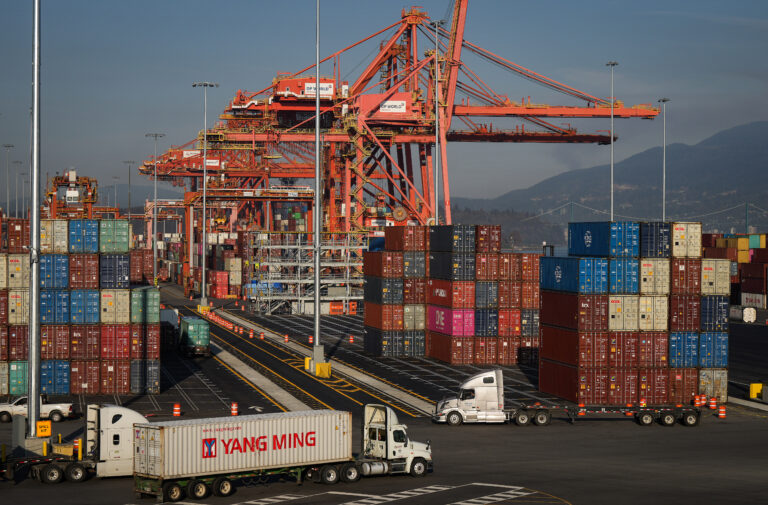
This is why Ford’s approach to storytelling is problematic. It reinforces the heuristic that trade is only about the stuff that we can touch, smell, see and taste, creating sympathy for those involved in making such things. Those people deserve our sympathy. But so do the people who export ideas and expertise, and so do those who accumulate foreign currency by taking care of tourists and educating international students.
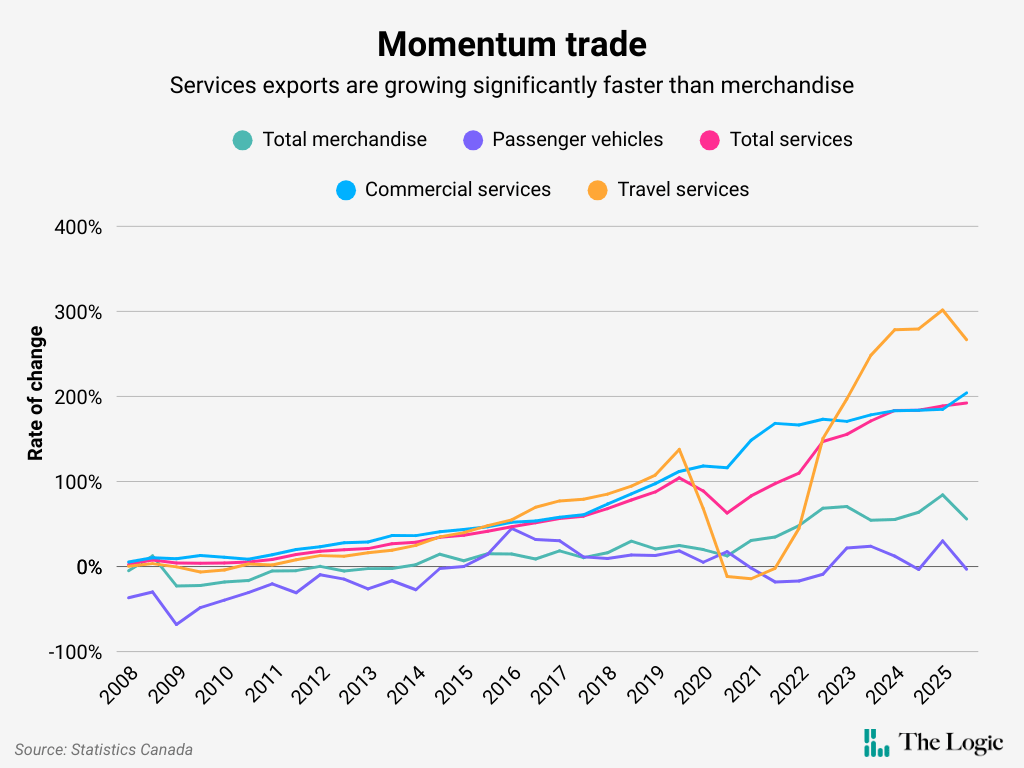
In fact, the group that Ford and others tend to ignore might deserve extra attention if the point of all of this is to make the economy more resilient. Data suggest that Canada has peaked as a vendor of merchandise. The value of goods exports has flatlined in recent years, while the value of services exports keeps pushing higher, according to Statistics Canada data. The latter also are more resilient to Trump’s pre-internet notion of international trade—services exports climbed to a record in July while merchandise exports floundered.
“It’s really important to pay attention to where there are new opportunities,” said Danielle Goldfarb, an economist who published two studies this summer that show services trade warrants far more attention than it receives. “It’s not that goods trade isn’t important. It’s hugely important. In overall numbers, it’s more important. But what is changeable? What is growable? How do we hedge and de-risk our [export] portfolio? These are all really important questions to be asking.”
The visuals wouldn’t matter if Canada were enjoying an era of abundance. But it’s not. The economy is labouring and resources are constrained by elevated levels of debt. There won’t be enough financial support to go around. What happens if the public develops a romantic attachment to the idea of bottling liquor for multinationals, instead of developing a carefully considered appreciation for the startup that has an idea about how to use artificial intelligence to make the world’s bottlers more efficient? It’s a rhetorical question. Precious resources will be used to save the bottler.
Some of Ford’s greatest acts of showmanship show what happens when romance crowds out reality. The creators of the baseball cap that Ford made famous discovered that Canada no longer has the capacity to make baseball caps in large numbers. The maker of Jack Daniel’s is feeling the pain of being cut off by Canada’s provincial liquor monopolies, but so were segments of the hospitality industry that had built followings around their supplies of California Chardonnay, Oregon Pinot Noir and Kentucky bourbon. Ford has stopped talking about leaving parts of the U.S. in the dark, perhaps because he realized the threat was somewhat hollow: exports of electricity have been trending down since 2023 as domestic needs pick up. It might not be the hammer he thought it was.
Economies change. Australia famously gave up on its automotive industry. The thing about change is that it keeps happening. A certain amount of manufacturing capacity is an asset when geopolitics starts slicing supply lines. There’s also a better appreciation now that innovators benefit from being close to the factories where their ideas are executed. A successful economy will make sure goods and services complement each other.
“The only way to be strong as a Canadian economy against the U.S. and tariffs is working together,” said Hugues Foltz, executive vice-president at Quebec City’s Vooban, a firm that uses AI to make factories more productive. “It’s been said many times during the last six months, but we don’t understand it very well, or well enough. We have to showcase… what very neat projects have been done by Canadian companies to integrate AI and automate their processes and everything.”
Goldfarb showed in one of her papers that despite Canada’s lead in AI research, the country’s share of digital services exports is less than three per cent, “well behind” peers such as the U.K., France and the Netherlands. That’s what happens when you assume a comparative advantage is all you need for success in global markets. Policy matters, too, and policy is determined by narrative.
The Trump shock is an opportunity to reset. Let’s avoid drifting into fantasy.
Kevin Carmichael is The Logic’s economics columnist and editor-at-large. He has spent more than two decades covering economics, business and finance for outlets including Bloomberg News, The Globe and Mail and the Financial Post, where he also served as editor-in-chief.



Loading...
Thanks for sharing!
You have shared 5 articles this month and reached the maximum amount of shares available.
CloseThis account has reached its share limit.
If you would like to purchase a sharing license please contact The Logic support at [email protected].
CloseGift the full article!
You have gifted 0 article(s) this month and have 5 remaining.
Recipients will be able to read the full text of the article after submitting their email address. They will not have access to other articles or subscriber benefits.
Photo: Toronto Star/Andrew Francis Wallace
Most Popular This Week




In-depth, agenda-setting reporting
Great journalism delivered straight to your inbox.
News
Canada faces a satellite-launch crunch as SpaceX retires its workhorse rocket
Briefing
North Vector Dynamics raises over US$20M for anti-drone missile development
Rio Tinto gets nearly $165M in additional federal funds for Quebec aluminum
U.S. to lift tariffs on some Canadian products crucial to Maine: Collins
Best business newsletter in Canada
Get up to speed in minutes with insights and analysis on the most important stories of the day, every weekday.
Exclusive events
See the bigger picture with reporters and industry experts in subscriber-exclusive events.
Membership in The Logic Council
Membership provides access to our popular Slack channel, participation in subscriber surveys and invitations to exclusive events with our journalists and special guests.