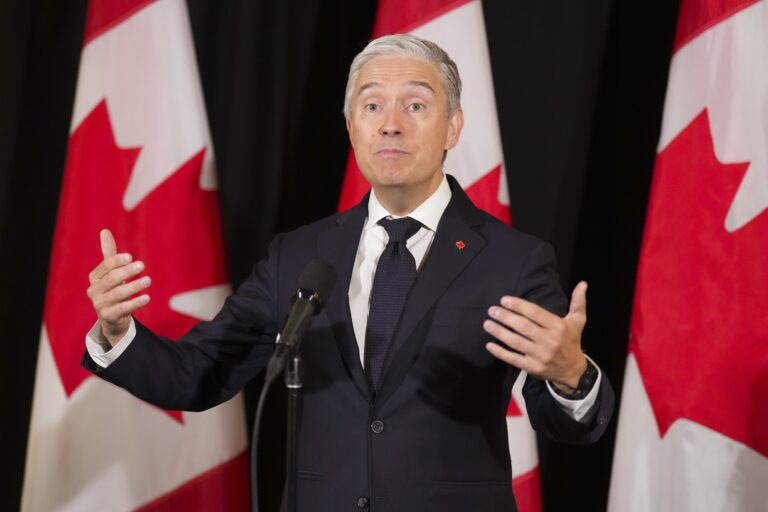
Foreign Affairs Minister Anita Anand and Finance Minister François Philippe-Champagne were dressed for success, Anand in a pink suit, Champagne’s tie perfectly dimpled. The background for their video call from Mexico City last week was less sharp.
Skip to content

Commentary
Carmichael: Canada can’t be a serious trading nation until it makes some new friends
Mexicans ‘don’t drink Molson’ because we never invite them over for a beer
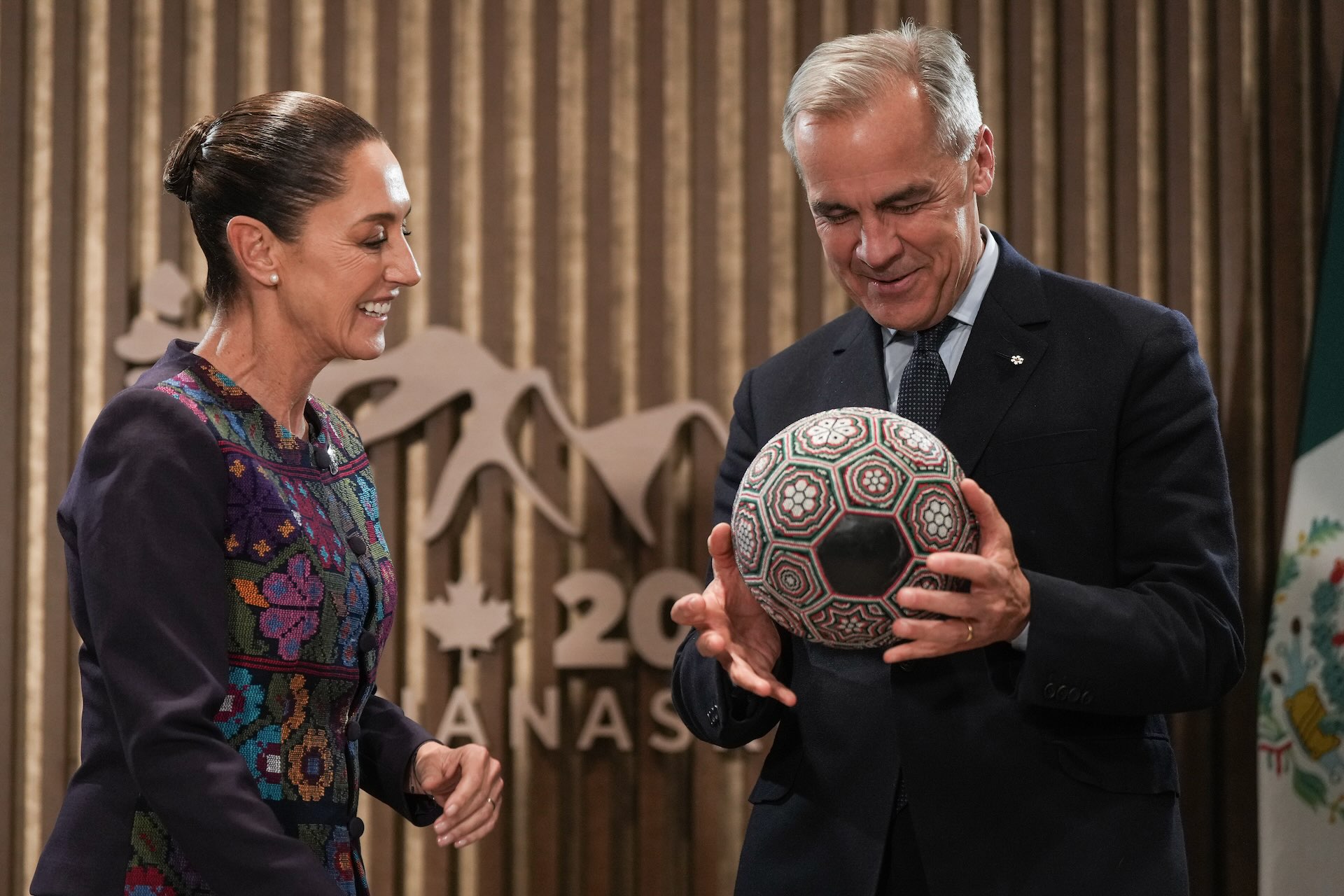
Canadian Prime Minister Mark Carney spins a soccer ball with beaded Huichol art on it after being gifted it by Mexican President Claudia Sheinbaum before a meeting at the G7 Summit in Kananaskis, Alta., on June 17. Photo: The Canadian Press/Darryl Dyck
Foreign Affairs Minister Anita Anand and Finance Minister François Philippe-Champagne were dressed for success, Anand in a pink suit, Champagne’s tie perfectly dimpled. The background for their video call from Mexico City last week was less sharp.
The ministers were framed by a door handle and the corner of a chair on which someone had dropped what looked like a carry bag. The flags of Canada and Mexico were displayed haphazardly behind them. Maybe a new set of handlers were learning on the job. Or maybe the MacGyvered press theatre was a sign that after decades of drift, the federal government is getting serious. I was left with the impression that messaging was an afterthought, not the objective. If true, that would be a change from the vainglory of the Trudeau years and the loyal opposition’s stylized propaganda videos. Maybe substance is finally replacing performance.
The substance of the trip to Mexico City was the simple, yet highly effective, business of knocking on doors. “We have been neighbours by geography and I think we gain from knowing each other a little bit better,” Champagne said.
Related Articles


It’s remarkable that after three decades of sharing one of the original free-trade agreements, and 158 years of sharing a continent, the governments of Canada and Mexico are still getting to know one another. That’s on us and our obsession with America. The assembled reporters demonstrated little interest in how this critical moment in world history might change the Canada-Mexico relationship. Most of the questions were on the theme of why Mexico got a 90-day reprieve from the latest round of U.S. tariffs and Canada didn’t, and the prime minister’s future plans for dealing with Trump. The gravitational pull of America sucks up more than three-quarters of our exports and an even greater percentage of our attention. Mexicans “don’t drink Molson” because we never invite them over for a beer.
Trade diversification is something people like me have been writing about since printing presses arrived in the colonies, but it’s rarely been an issue for voters as it was in the most recent election. Given that we’re starting from a long way back, we’re going to have to be strategic. It seems to me trade diversification will require three things: a reappraisal of Canada’s place in the world; an approach to international affairs that shows we’re willing to put some skin in the game; and a trade policy that anticipates where commerce is headed, not one focused on protecting the recent past.
Let’s save trade policy for another time and talk about the first two. In 2004, Jennifer Welsh, now director of McGill University’s Max Bell School of Public Policy, published a book that argued that Canada could be sleepwalking towards a future that looks a lot like where we are now—a situation that I’ve described as being alone.
Welsh said Canada was fooling itself if it thought it was America’s “best friend,” because a hyperpower like the U.S. has no friends, only associates that can help it achieve its goals. Welsh also said Canada had been overcome by “middle power syndrome,” an affliction that puts a ceiling on ambition—the origin of “middle power” is the Italian potenze mediocre; second best, mediocre. It puts process—serial joining and constant coalition building—over doing things that others in the world might find helpful. “We find ourselves at a significant crossroads,” Welsh wrote two decades ago. “Either we make the choices that will allow us to thrive on the North American continent and contribute actively in creating a better world, or we will cease to exist—in anything but name—as a sovereign country.”
When I wrote that Canada was alone in its fight against U.S. President Donald Trump’s economic warfare, I didn’t mean that we had become a pariah. We’d do well in a popularity contest. But as the Macdonald-Laurier Institute’s Stephen Nagy observed recently, likability is a weak currency when the question is, what have you done for me lately? The middle powers are looking out for themselves in their interactions with Trump, not each other, because the incentives to look out for themselves first far outweigh what they could gain by forming a common front. South Korea isn’t going to back Canadian retaliation when it needs the U.S. to help it keep North Korea in check.
It will be difficult to lessen our dependence on the U.S. if we keep obsessing over Trump’s tariffs. It’s a minority opinion, but I think former prime minister Justin Trudeau made a mistake by treating the renegotiation of the North American Free Trade Agreement as an existential event. Ottawa let the first Trump administration jerk it around for the better part of two years. What message did that send to the rest of the world? Maybe that we’re little more than the 51st state.
Two decades ago, Welsh argued that Canada could avoid irrelevancy by turning itself into a model global citizen. As with individual citizenship, that would require something other than living in fear of being rejected by the country next door. It would mean standing for something, and backing it up by making difficult decisions. It would require venturing outside our backyard, getting to know others on the street and being useful.
Good things happen when you meet new people. Anand said that after she and Champagne met Mexican President Claudia Sheinbaum, the two countries added more meetings to the schedule. “What we’d really like to see is a full-court press on ministers engaging with their counterparts across government,” she said.
Agriculture Minister Heath MacDonald is already pressing. When I met him in Charlottetown last month, he shared that he and his Mexican counterpart have exchanged phone numbers and have been texting. “They’re upset with the U.S.,” MacDonald said. “So there’s an opportunity.”
Texting. It sounds so simple. Canada’s long-standing trade deficit with countries other than the U.S. suggests that it’s not. But maybe that’s finally starting to change.



Loading...
Thanks for sharing!
You have shared 5 articles this month and reached the maximum amount of shares available.
CloseThis account has reached its share limit.
If you would like to purchase a sharing license please contact The Logic support at [email protected].
CloseGift the full article!
You have gifted 0 article(s) this month and have 5 remaining.
Recipients will be able to read the full text of the article after submitting their email address. They will not have access to other articles or subscriber benefits.
Photo: The Canadian Press/Darryl Dyck
Most Popular This Week



In-depth, agenda-setting reporting
Great journalism delivered straight to your inbox.
News
A tech firm born from post-Brexit trade chaos sets its sights on Canada
Briefing
Aritzia shares pop after earnings rise 204%
First Nation in Alberta goes to court over fast-tracked oil pipeline
Chinese EV maker Geely Auto Group to launch in Canadian market in 2027
Best business newsletter in Canada
Get up to speed in minutes with insights and analysis on the most important stories of the day, every weekday.
Exclusive events
See the bigger picture with reporters and industry experts in subscriber-exclusive events.
Membership in The Logic Council
Membership provides access to our popular Slack channel, participation in subscriber surveys and invitations to exclusive events with our journalists and special guests.