Prime Minister Mark Carney called the sweep of the industrial measures he announced Friday historic. If that’s true, the enormity of the occasion was more than the journalists in attendance were ready to absorb.
Skip to content

Commentary
Carmichael: Carney signals that Canada’s boy scout years are over
As economic nationalism overtakes free trade, Canada tries to carve out a place in the new world order
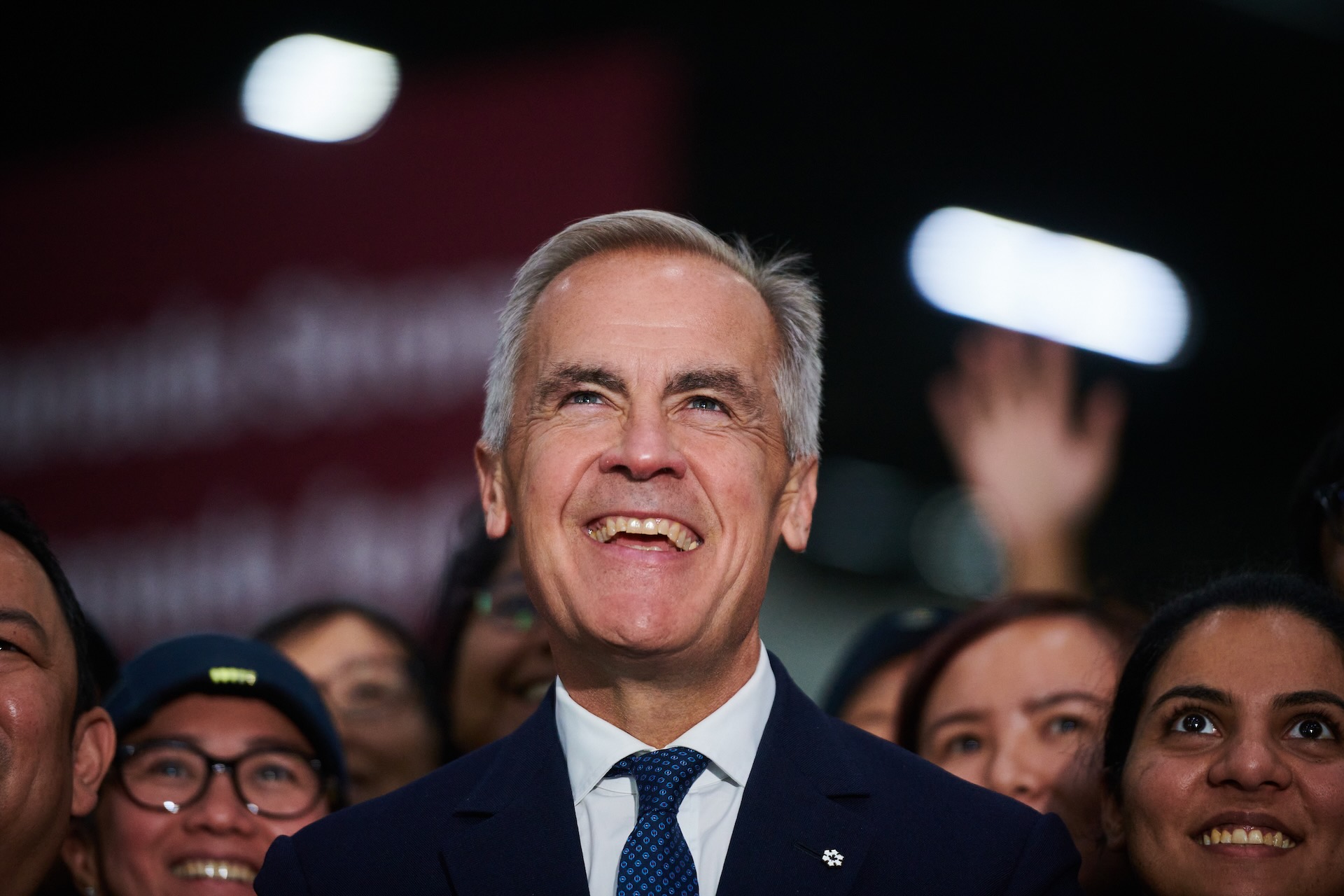
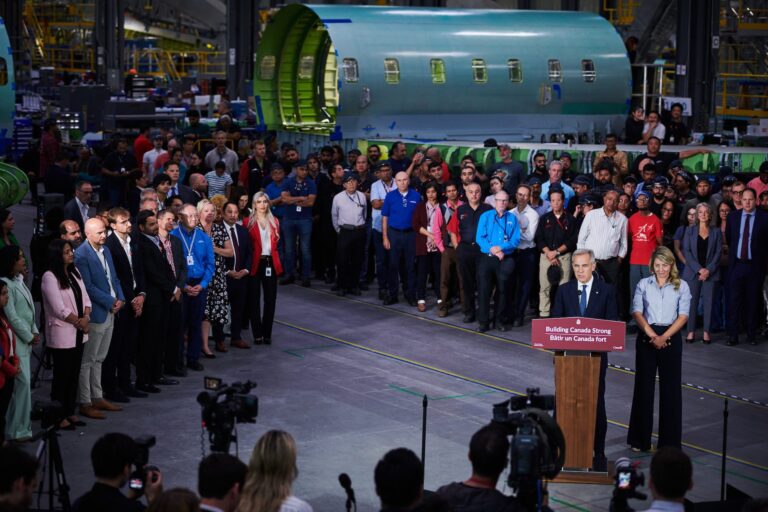
Prime Minister Mark Carney takes photos with workers at a manufacturing facility after announcing an industrial strategy in Mississauga, Ont., on Friday, Sept. 5, 2025. Photo: The Canadian Press/Sammy Kogan
Prime Minister Mark Carney called the sweep of the industrial measures he announced Friday historic. If that’s true, the enormity of the occasion was more than the journalists in attendance were ready to absorb.
Carney talked about a “rupture” in Canada’s understanding of how the world works, as a global consensus about the merits of freer trade is replaced by a “new age, an age of economic nationalism and mercantilism” in which access to the world’s largest market must be purchased via duties and investment commitments.
After hearing that, more than one reporter wanted to nitpick over electric vehicle mandates. Other questions were totally unrelated to the day’s announcement. The one that got closest to matching the moment the prime minister was describing was about Russian President Vladimir Putin’s threat to kill any foreign soldiers who join Ukraine’s side on the battlefield. “He’s the reason for the killing,” Carney said. “He is not going to dictate the terms of the peace.”
Democratic capitalism—the foundation on which Canadian society rests—is in real trouble, yet polls are starting to show that Canadians are more concerned about the cost of living than these changes to the established world order. The window to do big things seems already to be closing. So add complacency to the list of challenges Carney faces. He’ll need political oxygen to keep up the pace he appears to want to set, but the public is behaving like it’s already running out of enthusiasm for an extended struggle.
Related Articles

Yet Carney keeps showing up with a seriousness that has been lacking in Canadian politics for a long time. There was none of former Conservative prime minister Stephen Harper’s ideological rigidity in Carney’s remarks. He said the federal government would go out of its way to favour Canadian suppliers, so much so that any procurement officer who wants to source from outside the country will need approval from a cabinet minister. If doing so harms Canada’s reputation as a boy scout of free trade, so be it.
“Canada’s public procurement is following outdated rules of that old free-trade order that no longer exists,” Carney said. “For years, we’ve been buying as a government significantly from foreign suppliers for short-term gain. Now, we need to use government procurement, using Canadian taxpayer dollars, to spur Canadian businesses for longer-term prosperity.”
There was also a break from the way Liberals governed for much of the previous decade. Gone was any of the vainglory that so often came with former prime minister Justin Trudeau’s announcements. Carney didn’t roll up previous announcements into a big number to impress headline writers and tweeters.
The lead item announced Friday was the $5-billion “strategic response fund,” a cash reserve to help important companies and industries survive the Trump shock. That’s real money, but nothing a government with a credit rating as solid as Canada’s can’t handle.
This relative fiscal restraint will lend credibility to Carney’s oxymoronic commitment to both fiscal austerity and public investment, which is another storytelling challenge that the government will have to find a way to overcome. There’s a reason to cut spending as much as reasonably possible. U.S. President Donald Trump’s disregard for the institutions that underpin global finance means international investors will be looking for new havens. Canada could gather some of that capital if it maintains its reputation for stability, making it cheaper to finance the building it will need to overhaul an economy wired to do little more than trade with Americans.
Bond investors will be equipped to assess how a government can simultaneously implement austerity and ramp up public investment. The rest of us will likely struggle with cognitive dissonance. For decades, it’s been one or the other. Carney insists we can do both, and the latest announcement offers more guidance on what he means.
Carney avoided the trap of calling what he’s doing “industrial policy,” a loaded term that excites many think-tankers and academics, but comes with so much political and theoretical baggage that going there would have been weighted with risk.
Instead, Carney calls what he’s doing an “industrial strategy,” a recognition (I think) that Ottawa has plenty of policies on the books, but has been damagingly unstrategic in implementing them. Trudeau frustrated so many business people because his only answer to the productivity crisis was to spend more money—but money wrapped in red tape. Carney went out of his way to state that an important part of his strategy is reducing regulation, offsetting paralyzing uncertainty by reducing the mental load of running a business.
“When our builders, our entrepreneurs face calculated risks rather than unknowable uncertainty, that’s when Canadian builders and innovators thrive,” Carney said.
It’s past time to state that all Carney did on Friday was give a speech. Politics is hard, he’s untested in the electoral arena and there are many other cliches people like me deploy to show that we’re sufficiently skeptical about any politician’s ability to deliver on anything. If there’s a vulnerability, it could be the heavy emphasis on “reskilling” victims of the rupture. That has the feeling of an advanced economy that embraced free trade asking for a do-over. Few got it right as industrial jobs moved en masse to Asia and Mexico. Maybe Canada will do better this time. There should be lots of lessons out there about what doesn’t work.
But I’m not really interested in obvious critiques. There were more examples on Friday of a government that is doing things differently than there were obvious mistakes. Instead of simply compensating canola growers for losses from Chinese tariffs, the federal government intends to spend $370 million supporting biofuel producers. That’s smart. It helps entrepreneurs who are trying to do something more than simply ship bulk commodities abroad. In doing so, the government is creating new buyers of canola at home, while also increasing our capacity to produce higher-value products.
Will Carney’s strategy work? It could. Given the circumstances we’re in, I’ll take a bet on something that might work over more of the same.
Kevin Carmichael is The Logic’s economics columnist and editor-at-large. He has spent more than two decades covering economics, business and finance for outlets including Bloomberg News, The Globe and Mail and the Financial Post, where he also served as editor-in-chief.



Loading...
Thanks for sharing!
You have shared 5 articles this month and reached the maximum amount of shares available.
CloseThis account has reached its share limit.
If you would like to purchase a sharing license please contact The Logic support at [email protected].
CloseGift the full article!
You have gifted 0 article(s) this month and have 5 remaining.
Recipients will be able to read the full text of the article after submitting their email address. They will not have access to other articles or subscriber benefits.
Photo: The Canadian Press/Sammy Kogan
Most Popular This Week




In-depth, agenda-setting reporting
Great journalism delivered straight to your inbox.
News
Canada faces a satellite-launch crunch as SpaceX retires its workhorse rocket
Briefing
Churchill port owner Arctic Gateway Group to work with Dubai’s DP World on expansion plans
North Vector Dynamics raises over US$20M for anti-drone missile development
Rio Tinto gets nearly $165M in additional federal funds for Quebec aluminum
Best business newsletter in Canada
Get up to speed in minutes with insights and analysis on the most important stories of the day, every weekday.
Exclusive events
See the bigger picture with reporters and industry experts in subscriber-exclusive events.
Membership in The Logic Council
Membership provides access to our popular Slack channel, participation in subscriber surveys and invitations to exclusive events with our journalists and special guests.