OTTAWA — U.S. President Donald Trump warned Canada against retaliating in response to the 25 per cent tariffs he is imposing on all Canadian goods besides energy, which will be subject to a 10 per cent tariff, until the U.S. is satisfied with action to address the fentanyl crisis.
Skip to content

 The tariffs are expected to affect Canadian-based manufacturers such as Honda Canada, which has an extensive factory complex in Alliston, Ont. Photo: The Canadian Press/Cole Burston
 The suggestion Canada could retaliate against Trump's tariffs by restricting oil shipments to the U.S. prompted warnings from Alberta Premier Danielle Smith. Photo: The Canadian Press/Amber Bracken

News
Trump opens trade war on Canada with crushing tariffs, threats of escalation
White House cites the U.S. fentanyl crisis as reason for 25% tariffs on goods, 10% levy on energy
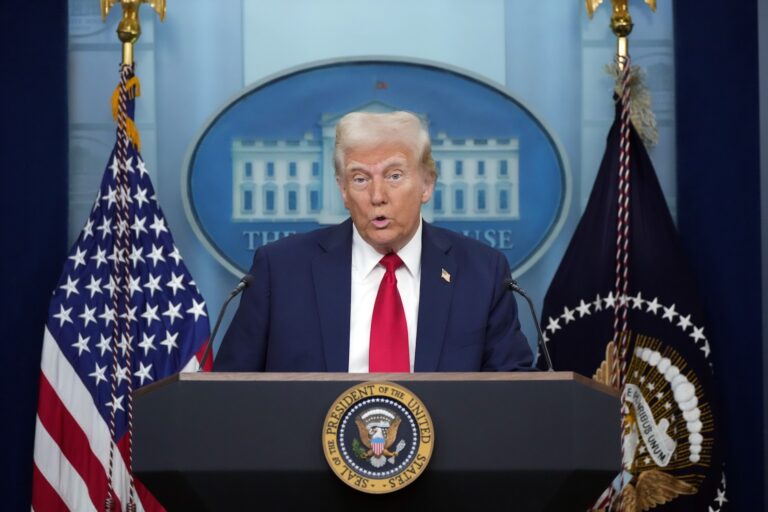
President Donald Trump has pushed ahead with tariffs on goods the U.S. imports from Canada, Mexico and China. Photo: AP Photo/Evan Vucci
OTTAWA — U.S. President Donald Trump warned Canada against retaliating in response to the 25 per cent tariffs he is imposing on all Canadian goods besides energy, which will be subject to a 10 per cent tariff, until the U.S. is satisfied with action to address the fentanyl crisis.
Talking Points
- The Trump administration announced Saturday it will impose 25 per cent tariffs on this country’s goods except energy, which will be tariffed at 10 per cent
- The White House order said the measures will take effect Tuesday, and stay until the administration is satisfied with Canada’s actions on the fentanyl crisis
- The order also said the U.S. may raise the tariff rates if Canada retaliates, which Ottawa announced it will do with 25 per cent tariffs on $30 billion worth of U.S. products Tuesday
“Should Canada retaliate against the United States in response to this action through import duties on United States exports to Canada or similar measures, the president may increase or expand in scope the duties imposed under this order to ensure the efficacy of this action,” said an executive order from the White House on Saturday.
The executive order, which invoked presidential emergency powers, said the tariffs will take effect at 12:01 a.m. ET on Tuesday and would apply on top of any other existing duties. The White House also said Saturday the U.S. is bringing in across-the-board tariffs of 25 per cent on Mexico and 10 per cent on China over illegal drugs and migrants entering the U.S.
“We’re now going to find out how much pain people can tolerate,” Goldy Hyder, president and CEO of the Business Council of Canada, said in an interview after details were first reported by CTV. “To me, this is not just an opening salvo, but it is a very serious opening salvo with serious consequences.”
Related Articles


On Friday night, Trump told reporters in the Oval Office the tariffs are not a negotiating tool, saying they are about economics and that he might “substantially increase” the tariff rate.
“We’re not looking for a concession,” Trump said. “We’ll just see what happens.”
In spelling out his desire to build “a tariff wall” around the United States, it was clear Trump meant to keep Canada, long considered one of its greatest partners and allies, on the other side of it. In so doing, he has overturned the trade relationship between two countries with highly integrated economies—including auto manufacturing and energy—while raising questions about other shared priorities in defence, national security and what used to be a common, if not identical, view of the world and their place in it together.
Prime Minister Justin Trudeau leaned heavily on that shared history as he appealed to the American people during a Saturday night news conference on Parliament Hill, even though he also said he had been unable to speak directly to their president since his inauguration.
“We were always there, standing with you, grieving with you, the American people,” Trudeau said, invoking everything from the countries’ alliances in the Second World War and Korean War to the water bombers Canada sent last month to help fight the wildfires in California. “Together, we built the most successful economic, military and security partnership the world has ever seen—a relationship that has been the envy of the world. Yes, we’ve had our differences in the past, but we’ve always found a way to get past them.”
About $3.6 billion in goods moves back and forth across the border every day. That level of tariffs—combined with potential retaliatory tariffs by Canada—are expected to have a devastating impact on the Canadian economy. It is likely to cost the American one dearly too. The Canadian Chamber of Commerce estimates that such a trade war between both countries will shrink Canada’s GDP by 2.6 per cent, or about $78 billion. The organization said the U.S. would see its GDP decrease by 1.6 per cent, or about US$467 billion.
Candace Laing, president and CEO of the Canadian Chamber of Commerce, said supply chains are so integrated that Trump would be doing more for Americans if he strengthened them further. “This decision makes no sense when the majority of Americans oppose tariffs, when it harms businesses and workers on both sides of the border, and when the U.S. stock market is signaling that there’s no appetite for disruption,” she said in a statement Saturday.
Canada will respond Tuesday with $30 billion worth of 25 per cent countertariffs on American products ranging from household appliances and perfume to lumber and plastics, and another $125 billion worth after a 21-day public consultation period. “The coming weeks will be difficult for Canadians, and they’ll be difficult for Americans,” Trudeau said Saturday. “We don’t want to be here. We didn’t ask for this, but we will not back down in standing up both for Canadians and for the incredible, successful relationship and partnership between Canada and the United States.”
Conservative Leader Pierre Poilievre demanded the Liberal government recall Parliament to pass legislation on the Canada-U.S. response instead.
Dennis Darby, CEO of Canadian Manufacturers & Exporters, said companies have been preparing for these tariffs as best they can, including by pre-selling goods and holding off on hiring and investment.
He suggested Ottawa reach out to potential investors about how to offset the tariffs and make investing in Canada more attractive, perhaps even mirroring some of Trump’s stances on taxes and de-regulation.
“We’ve heard from our members. Many of them said if these tariffs persist across the board, they’ll look at moving production to the U.S.,” Darby said. “That increases the potential for unemployment.”
While Canada has other trade partners besides the U.S., it would be a long process to build shipping routes and pipelines that would rival what already exists on the U.S.-Canada border.
Hyder has been among those calling on Canada to take this opportunity to get its own economic house in order, including by reducing internal trade barriers. The tariffs, he said, put pressure on Canada “to control its controllables.”
A statement from the Canadian Federation of Independent Business, which represents small and medium-sized enterprises, called on Canadian governments “to make sure our small businesses are well-equipped to stay competitive with their American and global counterparts,” adding: “Now is the time to reduce taxes and red tape and implement a mutual recognition agreement to address internal trade barriers.”
Trump had campaigned on a promise to bring in across-the-board tariffs when he was the Republican presidential nominee. Weeks after winning the Nov. 5 election, he specifically threatened Canada and Mexico with 25 per cent tariffs, plus 10 per cent on China.
He also started talking about Canada becoming the 51st state, referring to Trudeau as “Governor Justin Trudeau.”
On Friday night, Trump repeated his claim that the U.S. has a $200-billion trade deficit with Canada. The U.S. Census Bureau said the trade deficit with Canada was about US$64.3 billion in 2023. A recent analysis by TD Economics showed that if energy exports were removed from the equation, the U.S. would actually have a trade surplus of about US$45 billion.
The pipeline system running between the countries means much Canadian crude oil heads to U.S. refineries—at a discount—before it is then exported back to Canada. In 2023, 60 per cent of crude oil imported to the U.S. came from Canada.
Trump has repeatedly said the tariffs were tied to concerns over the flow of illegal drugs and migration into the U.S. from across both its borders.
“Canada has played a central role in these challenges, including by failing to devote sufficient attention and resources or meaningfully coordinate with United States law enforcement partners to effectively stem the tide of illicit drugs,” said Saturday’s executive order. It said Canada’s “failure to act” on this constituted a national security threat that justified the use of emergency powers.
Data from U.S. Customs and Border Protection shows about 275,000 pounds of illegal drugs were seized at the border between the U.S. and Mexico between October 2023 and September 2024. Just 11,600 pounds were intercepted at the Canadian border during that same period.
When it comes to fentanyl in particular, 21,100 pounds were seized at the U.S.-Mexico border between October 2023 and September 2024. Just 43 pounds of fentanyl were seized at the Canadian border during that period.
“It’s not fair that Canada is being held to that bar,” Hyder said. “We’re hardly the problem on fentanyl to the extent that other countries are.”
In response to Trump, Canada’s federal government moved quickly to earmark $1.3 billion for border security measures. Trump also turned to his oft-repeated criticism that Canada does not meet a NATO commitment to spend two per cent of its GDP on defence. That prompted Defence Minister Bill Blair to say Canada would accelerate its plan to get there.
Sen. Hassan Yussuff, who was briefed on the details Saturday because he is on the prime minister’s Council on Canada-U.S. Relations, said Canada should remain undeterred by Trump’s threat to meet retaliation with even more in return. “We have to respond to the tariff. We are a sovereign and independent country.”
Ottawa also promised financial support to businesses and individuals suffering losses in the trade war, including by redistributing any revenue from retaliatory tariffs.
The White House released a memo on Jan. 20 outlining an “America First” trade policy. It directs the U.S. trade representative to prepare for next year’s review of the U.S.-Mexico-Canada agreement. It also asked agencies to recommend “appropriate trade and national security measures” to stem illegal migration and the flow of fentanyl into the U.S., mentioning Canada, Mexico and China by name.
The memo also launched a more sweeping investigation into what is causing the U.S. to have “large and persistent annual trade deficits in goods, as well as the economic and national security implications and risks resulting from such deficits.” It asked for recommendations on how to fix it, such as a “global supplemental tariff.” It also directed federal agencies to look into setting up an “external revenue service” to collect tariffs and other funds from foreign trade.
With files from Anita Balakrishnan in Toronto



Loading...
Thanks for sharing!
You have shared 5 articles this month and reached the maximum amount of shares available.
CloseThis account has reached its share limit.
If you would like to purchase a sharing license please contact The Logic support at [email protected].
CloseGift the full article!
You have gifted 0 article(s) this month and have 5 remaining.
Recipients will be able to read the full text of the article after submitting their email address. They will not have access to other articles or subscriber benefits.
Photo: AP Photo/Evan Vucci
The tariffs are expected to affect Canadian-based manufacturers such as Honda Canada, which has an extensive factory complex in Alliston, Ont.
The suggestion Canada could retaliate against Trump's tariffs by restricting oil shipments to the U.S. prompted warnings from Alberta Premier Danielle Smith.
Most Popular This Week




In-depth, agenda-setting reporting
Great journalism delivered straight to your inbox.
Commentary
Carmichael: Canadian ignorance about India is a strategic weakness
Briefing
Aritzia shares pop after earnings rise 204%
First Nation in Alberta goes to court over fast-tracked oil pipeline
Chinese EV maker Geely Auto Group to launch in Canadian market in 2027
Best business newsletter in Canada
Get up to speed in minutes with insights and analysis on the most important stories of the day, every weekday.
Exclusive events
See the bigger picture with reporters and industry experts in subscriber-exclusive events.
Membership in The Logic Council
Membership provides access to our popular Slack channel, participation in subscriber surveys and invitations to exclusive events with our journalists and special guests.




