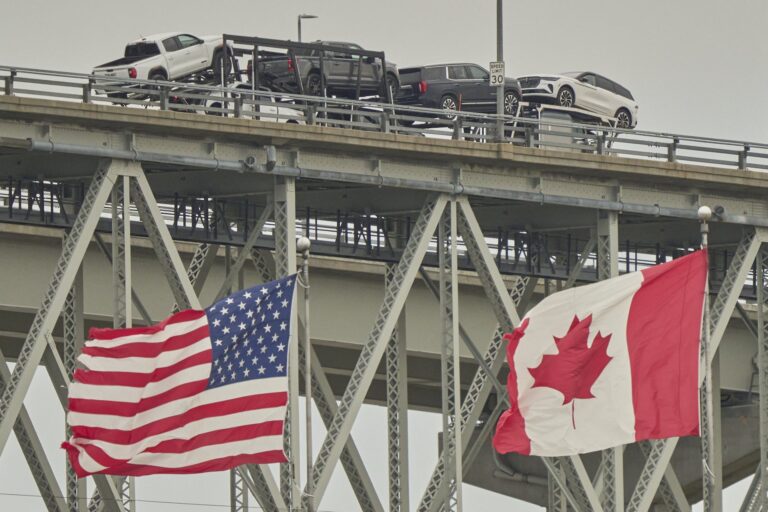
OTTAWA — The Liberal government’s effort to show U.S. president-elect Donald Trump that it takes drug smuggling and illegal migration seriously includes a promise to create a new “North American Joint Strike Force” to attack cross-border crime and a fleet of drones and helicopters to patrol the Canada-U.S. border.
Skip to content


News
‘Joint strike force’ with U.S. part of Ottawa’s bid to beef up border
Many elements of feds’ $1.3B plan won’t be immediate, and some unrelated to Trump’s tariff threats
A U.S. Customs and Border Protection officer speaks to a motorist at the Peace Arch border crossing in Blaine, Wash., just across the Canada-U.S. border from Surrey, B.C., in November 2021. Photo: The Canadian Press/Darryl Dyck
OTTAWA — The Liberal government’s effort to show U.S. president-elect Donald Trump that it takes drug smuggling and illegal migration seriously includes a promise to create a new “North American Joint Strike Force” to attack cross-border crime and a fleet of drones and helicopters to patrol the Canada-U.S. border.
Talking Points
- Cross-border police cooperation, new aerial surveillance and a new lab to track the sources of illegal drugs are key features of the Liberals’ effort to head off U.S. president-elect Donald Trump’s threat to tariff Canadian goods over his border security complaints
- Dominic LeBlanc, the minister of both finance and public safety, said he’s pitched some of the plan to Donald Trump’s intended border czar, Tom Homan, who received it well; but LeBlanc said there’s a lot of work yet to do
The measures Finance and Public Safety Minister Dominic LeBlanc announced Tuesday are “an important step to show Canadians and our American partners that we share their concern around border security and border integrity,” he said.
The Liberals began putting together the measures after Trump threatened 25 per cent tariffs on all imports from Canada and Mexico unless the two countries stopped the flows of illegal drugs and migrants into the United States. He said he plans to impose those tariffs on his first day in office, Jan. 20, and maintain them for as long as it takes to get the results he wants.
Much of what the government intends to do with the $1.3 billion that Monday’s fall economic statement booked for border security measures will take time. For example, it plans to recruit new RCMP and border officers, pass legislation allowing border officers to examine goods on their way out of the country (not just those on their way in) and open a new lab to test and trace illicit drugs.
The money is set to be spent over six years, with relatively small portions of it to go out this year and next.
Related Articles

Assembling the aerial surveillance force won’t be done in a day, RCMP Commissioner Mike Duheme said at LeBlanc’s side.
“I can’t just buy a helicopter tomorrow, but there are processes where you can rent a helicopter, and we’re exploring every facet that we can,” he said.
Details on the idea of a joint strike force are still scant, but LeBlanc said its work could include “support in operational surges, dedicated synthetic drug units, expanded combined forces, special enforcement units, binational integrated border enforcement teams and new technical operations capacity and related infrastructure.”
Some of the plans encompassed in the $1.3-billion spending plan also have little to do with answering Trump.
Another cabinet member at the announcement, Immigration Minister Marc Miller, had a warning for migrants coming from the United States: “As we head into the coldest months of the winter, we want to make it clear that trying to cross Canada between our official border points of entry is dangerous, and it will, in almost cases, render any subsequent asylum claim unsuccessful.”
LeBlanc said he’s had a preliminary conversation with Trump’s intended border czar, Tom Homan, and that exchange was encouraging, but it’s too soon to say whether the measures will be enough to get Trump to back off on the threat to tariff Canadian goods on his first day in office.
“I’m optimistic,” LeBlanc said. Then he retreated a little: “We have a lot of work ahead of us.”
Correction: The $1.3 billion budgeted for the border measures is to be spent over six years. This story has been updated.



Loading...
Thanks for sharing!
You have shared 5 articles this month and reached the maximum amount of shares available.
CloseThis account has reached its share limit.
If you would like to purchase a sharing license please contact The Logic support at [email protected].
CloseGift the full article!
You have gifted 0 article(s) this month and have 5 remaining.
Recipients will be able to read the full text of the article after submitting their email address. They will not have access to other articles or subscriber benefits.
Photo: The Canadian Press/Darryl Dyck
Most Popular This Week



In-depth, agenda-setting reporting
Great journalism delivered straight to your inbox.
The Big Read
Beacon is building an AI empire by fixing Main Street’s software
Briefing
Inovia raises US$200M for new VC fund as it eyes AI’s impact
43% of eligible Albertans voted ahead of Monday’s referendum
AI chip company Tenstorrent raises US$1.5B, valuing it at US$6.2B
Best business newsletter in Canada
Get up to speed in minutes with insights and analysis on the most important stories of the day, every weekday.
Exclusive events
See the bigger picture with reporters and industry experts in subscriber-exclusive events.
Membership in The Logic Council
Membership provides access to our popular Slack channel, participation in subscriber surveys and invitations to exclusive events with our journalists and special guests.







