Listen Now
0:00
EDMONTON — In an industrial park in south Edmonton, some of the most extreme engineering in the world is being done to make quantum computers work.
Zero Point Cryogenics, tucked away in a back corner of the property—you’ll find it if you follow the signs for Foam Fighters, which puts on Nerf-gun fights for kids’ parties next door—sells freezers at prices that approach $1 million each.
Quantum computers, sensors and communication devices typically need profound cold to work precisely with the tiniest amounts of energy known to physics. If the quantum sector is in a gold rush, Zero Point is in the picks-and-shovels business.
Talking Points
- Quantum devices need extreme cold to stop “thermal noise” from wrecking them, and Zero Point Cryogenics can’t make its hyper-chilled freezers fast enough
- Alberta turns out to be a fantastic place to start a cryogenics business, co-founder Christopher Cassin says, with many of the skills needed for the oilpatch being easy to transfer
“If you want to explore tiny things at a fundamental level, you need to slow them down. Our job is to remove what’s called thermal noise,” says Zero Point CEO Christopher Cassin. “Cold is quiet. The colder you are, the quieter it is.”
Zero Point’s freezers are capable of chilling to a few thousandths of a degree above absolute zero, where atomic motion all but stops.
The company sells as many as it can make. That’s about 10 a year in its current digs, which are overstuffed.
The front door opens directly into a spartan meeting room, with a warren of tiny offices to one side; there’s no room for nice-to-haves like a reception desk. Through a heavy door at the back are two workshops, which are just as crowded but much noisier, as parts are crafted, fixed together and tested.
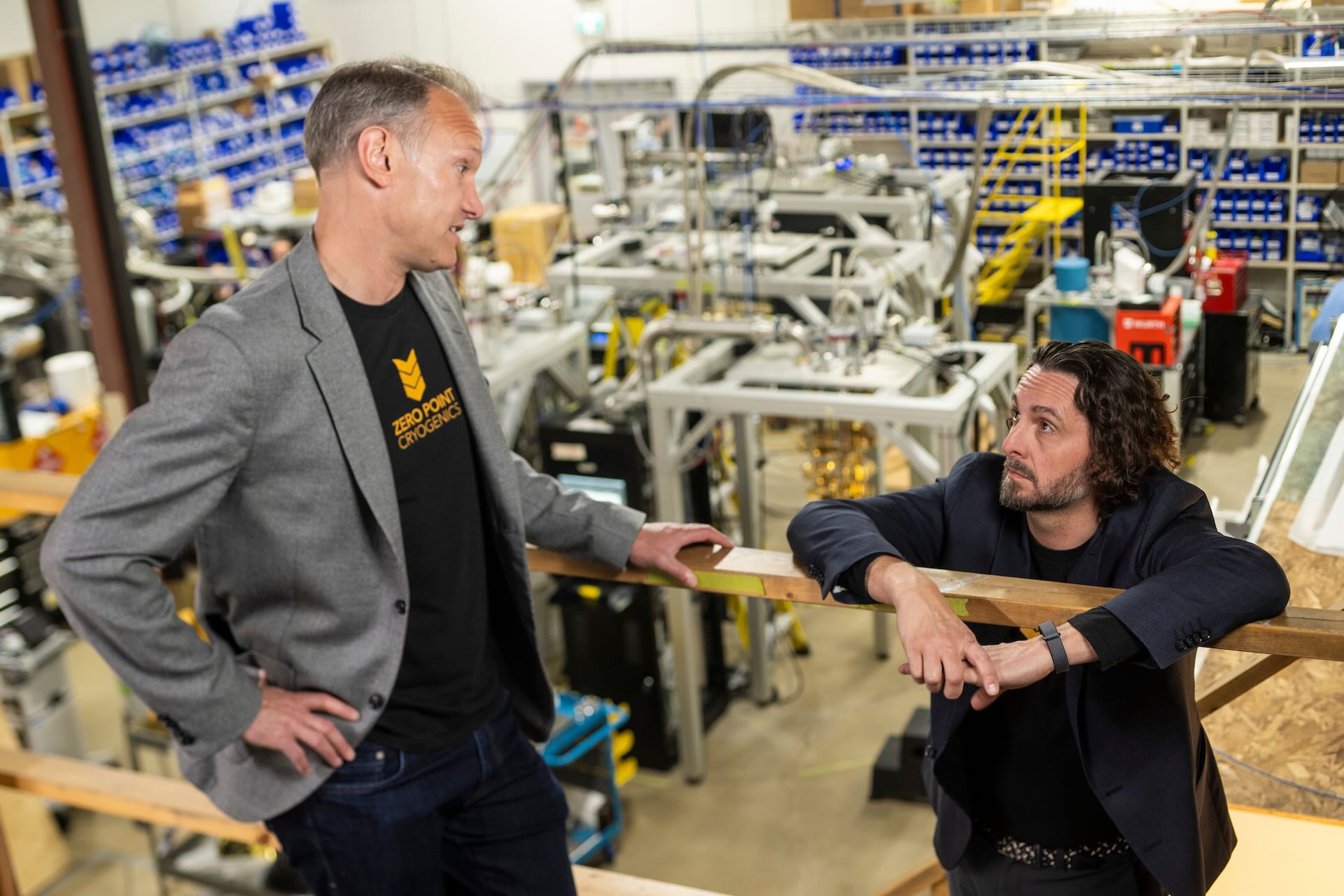
Just to the left of the door is a fume hood for working with dangerous chemicals—when The Logic visited, caution tape separated that space from the rest of the factory area because the task underway involved melt-your-face-off nitric acid.
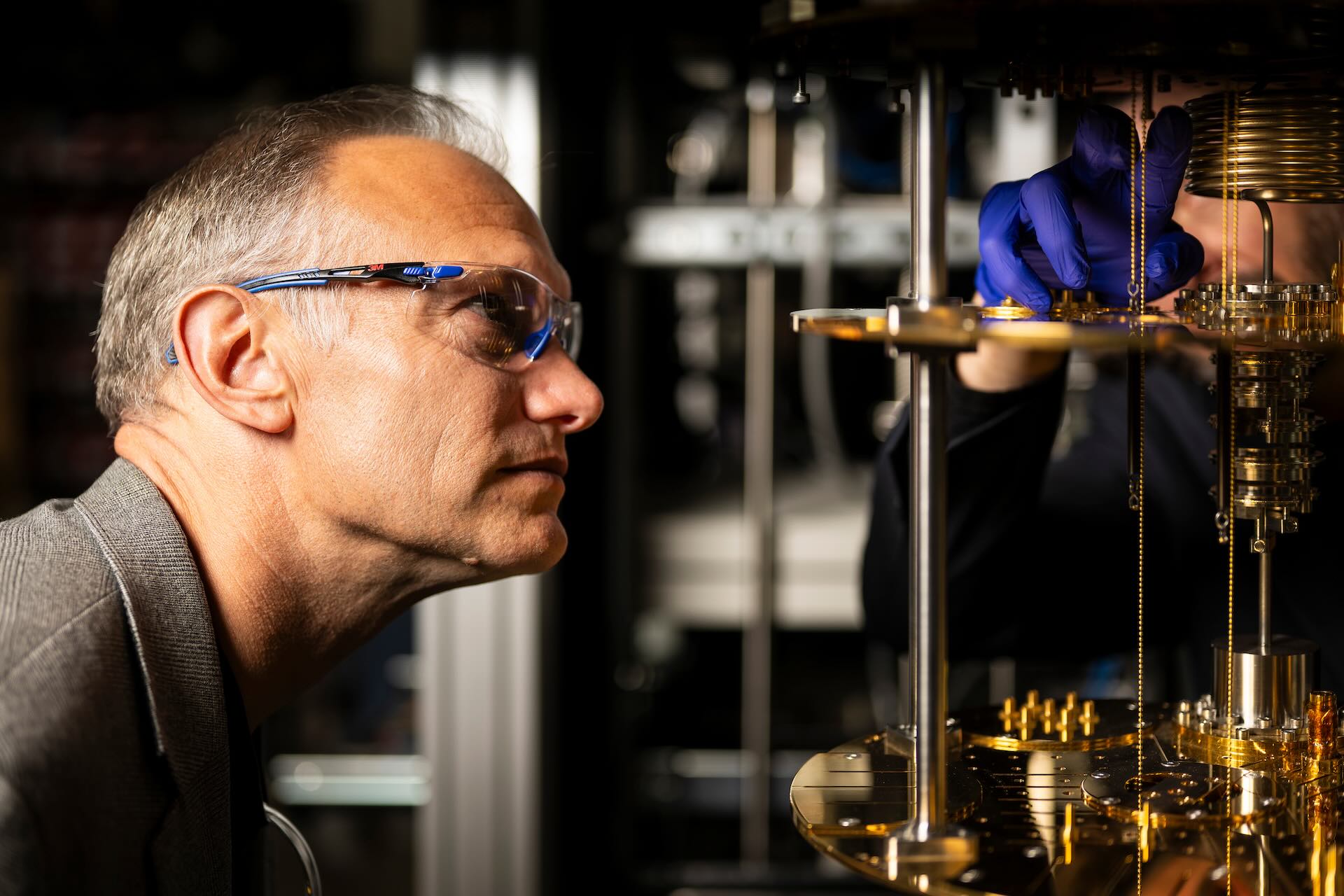
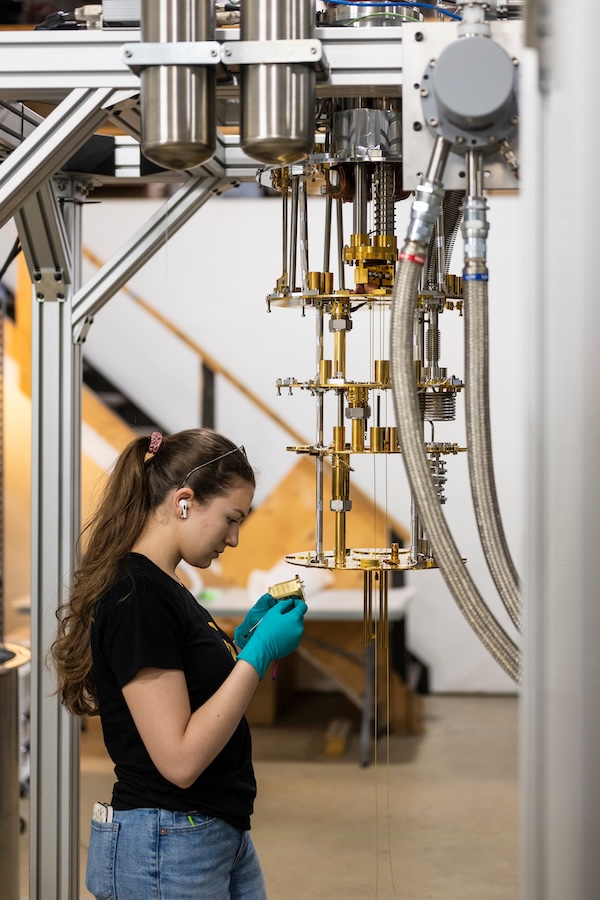
Zero Point’s freezers hang like upside-down wedding cakes, each layer achieving colder temperatures than the one above it. In the trade, they’re called “chandeliers.”
The physics principles of these devices, formally called dilution refrigerators, aren’t that weird. They use a combination of compression (like a household air conditioner) and evaporative cooling (like your body when you perspire). The trick is in the engineering, to make the familiar physics work at temperatures that are nearly as cold as anything in the universe can be.
Related Articles


In Zero Point’s factory, a repeated metallic squeak, like the call of some kind of cyborg bird, sounds over the regular workshop racket. That’s the sound of a helium pump. “The only thing that is still a liquid at these temperatures is helium,” says Cassin. “Everything else is a solid.”
The key to a dilution refrigerator is helium-3, a rare but stable form of the noble gas that comes from the decay of radioactive tritium. Force it to mix with helium-4, the more ordinary version that fills party balloons, and helium-3 sucks out heat as it naturally separates again—like sweat evaporating off your skin.
A customer will hang a quantum device off the bottom tier of a Zero Point chandelier and encase the whole thing in a vacuum cylinder.
“As soon as you pump all the air out, there’s no longer any convection, and without convection, it’s just like a thermos that keeps coffee really warm or a beer really cold,” Cassin says.
“Our job is to remove what’s called thermal noise. Cold is quiet.”
The company spun out of the University of Alberta, where co-founder John P. Davis is a professor who specializes in low-temperature science. His research is a long way from commercialization, but Zero Point is the product of a decision to try to commercialize his research tools.
Cassin made some money in oilpatch logistics—mostly trucking big things from site to site, particularly infrastructure for work camps—before the COVID-19 pandemic buried that business.
“When COVID started, unfortunately, it all of a sudden was a really bad idea to house a bunch of construction workers in close quarters, so our business model really evaporated overnight,” Cassin says. He sold the company’s equipment at auction for 30 cents on the dollar. “It was a really hard time.”
So when Davis was looking for an experienced manager to get Zero Point off the ground in 2021, Cassin happened to be looking for his next thing. They hooked up through Edmonton angel investor group Startup TNT.
Provincial granting agency Alberta Innovates had backed Davis’s early work on his own cryostat—the technical term for one of the chandeliers. The company has been supported by the National Research Council, the Innovative Solutions Canada program and with funding through the national quantum strategy, and with government contracts; in February, the federal government lent Zero Point $5 million to boost its capacity as a defence supplier.
It’s also taken unspecified investments from the University of Alberta’s venture capital fund and U.S.-based Transpose Platform Management, a VC firm that also backed Canadian quantum computing star Xanadu.
Alberta turns out to be an excellent place to build super-cold freezers, Cassin says, because the technical skills people learn for oilpatch work are very transferable.
“We can open the side of a gas-handling system and they’re like, ‘Oh, this is a programmable logic controller, and oh, these parts are from Swagelok, and this is just bent stainless tubing,’ and fundamentally, they see what’s going on,” he says. “We need to train vacuum and we need to train cryogenics, and that’s something that we can manage.”
The property next to the Nerf battleground was a rare find when Cassin and Davis were looking, with a heavy-duty power supply and not too much space—though it still had more room than they needed at the time.
Zero Point will soon be moving to a new facility nearby that’s more than five times as big, Cassin says. The company just took possession and there’s a lot of work to do to fit it up, but Cassin says it will let Zero Point increase its production from about 10 freezers a year to more like 100.
“Quantum computing is nascent,” Cassin says. “It’s where AI was 10 years ago… It’s coming, and it’s coming quick.” He expects the industry to demand hundreds of the kinds of devices Zero Point makes, every year.
The company intends to scale up and sell more abroad, which will mean opening offices in the United States, Europe and Asia. But Cassin says Zero Point’s head office and most of its manufacturing will always be in its home country. “We have to have presence in those places, and we also have to stay inherently Canadian, because that is deeply important to me.”