Listen Now
0:00
TORONTO — Xanadu plans to grow its capacity to produce quantum computing hardware with public funding, as the firm works to capitalize on the potentially disruptive technology.
“No one has mass-manufactured in quantum before,” CEO Christian Weedbrook told The Logic. Xanadu aims to be among the first, and it’s currently negotiating with the federal and Ontario governments for $390 million in financing to help pay for new equipment and staff.
Talking Points
- Xanadu plans to expand its manufacturing capacity as the quantum computing company prepares to build a data centre and start selling its hardware to government customers
- The firm already processes chips for its machines in the basement of its Toronto office building, but it’s now seeking $390 million in federal and provincial funding to scale production
The firm’s flagship Aurora system, unveiled in January 2025, consists of 35 photonic or light-based chips spread across four server racks. The processors are connected by miles of fibre optic cables. Xanadu plans to make much of its revenue by renting out cloud capacity, powered by a US$1-billion data centre it aims to build in Toronto by 2029.
The facility is designed to produce up to 500 logical qubits, the base unit of quantum computing—enough to detect and correct errors in the flow of information through the machines. Each server rack generates one qubit, so Xanadu will need to manufacture several hundred over the next few years. The firm also plans to sell full quantum computers to clients such as government departments, militaries and research labs that want to control their own hardware.
To make all those machines, Xanadu will need to significantly expand its operations. Last June, the firm opened a $10-million chip packaging line in Toronto. The late-stage manufacturing process adds fibre optics and electrical links to the processors to connect them to other components. Xanadu previously outsourced the work to a U.S. firm, which could take up to three months to send them back, Weedbrook said. Workers on the new in-house line can do it in eight hours.
Related Articles
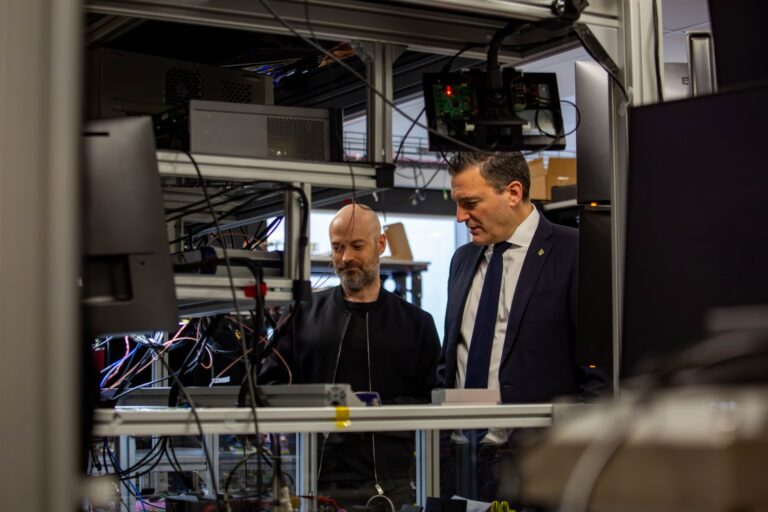
Xanadu is also now prepping and testing photonic chips and assembling server racks itself. Project Optimism, as the firm has dubbed the expansion effort, is designed to scale up each of those processes to hundreds of machines instead of the singles it’s producing today. “It’s about securing the supply chain,” Weedbrook said.
Manufacturing operations will eventually need to move out of their current location, in the basement of Xanadu’s office building, sandwiched between the bakery for a Farm Boy grocery store and the stockroom of a Dollarama in downtown Toronto. The firm aims to have a new “qubit factory” up and running in the city by the end of next year.
The firm has yet to sign final agreements with the federal and provincial governments for the money, of which each would contribute half. Weedbrook declined to say whether the financing would be a loan or a grant, or how much Xanadu itself is investing in the project, citing the ongoing negotiations. “All of this money goes into building everything that’s needed to populate the final data centre that we will build,” he said.
Xanadu is one of four Canadian quantum computing firms set to get $23 million each from Ottawa’s new program to keep technology champions in the country. Xanadu was previously awarded $40 million from the federal Strategic Innovation Fund in January 2023, which helped pay for the new packaging line.
The company is also enrolled in a U.S. Defense Advanced Research Projects Agency initiative that promises up to US$316 million to developers that prove their machines can solve real-world commercial and industrial problems at a reasonable cost by 2033.
Xanadu is currently preparing to go public via a merger with a special-purpose acquisition company, or SPAC. The deal values the combined company at US$3.1 billion, and could bring in up to US$500 million in new capital. That includes US$275 million in private investments from the likes of AMD, the asset management arms of BMO and CIBC, and previous backers Georgian, OMERS Ventures and Bessemer Venture Partners.
Xanadu could also receive up to US$225 million from Crane Harbor Acquisition, the Philadelphia-headquartered SPAC. Exactly how much it gets will depend on how many of Crane’s shareholders decide to take back their money. Shareholders are scheduled to vote on the deal next week. In the meantime, Xanadu has kept up a steady stream of announcements, including R&D partnerships with the likes of Lockheed Martin, Mitsubishi Chemical and Tower Semiconductor.
The firm’s growth plans and manufacturing expansion could also benefit other players in Canada’s emerging quantum industries, Weedbrook said. For example, Xanadu is in talks with Zero Point Cryogenics about possibly using its equipment in its own operations. The Edmonton-based startup makes dilution refrigerators and cryostats to keep quantum computers cold. While Xanadu’s Aurora mostly operates at room temperature, its system for detecting light particles does need to be cooled.
Canada can play a significant role in the quantum supply chain, Quantum Industry Canada CEO Lisa Lambert said in a recent interview with The Logic, partly thanks to its research and commercial strengths in fields like telecommunications, photonics and cryogenics. “There’s key parts of it that can be built here,” she added.