VC Quarterly is The Logic’s recurring series on the state of venture capital in Canada, including the latest financing trends and deals that are shaping the startup landscape.
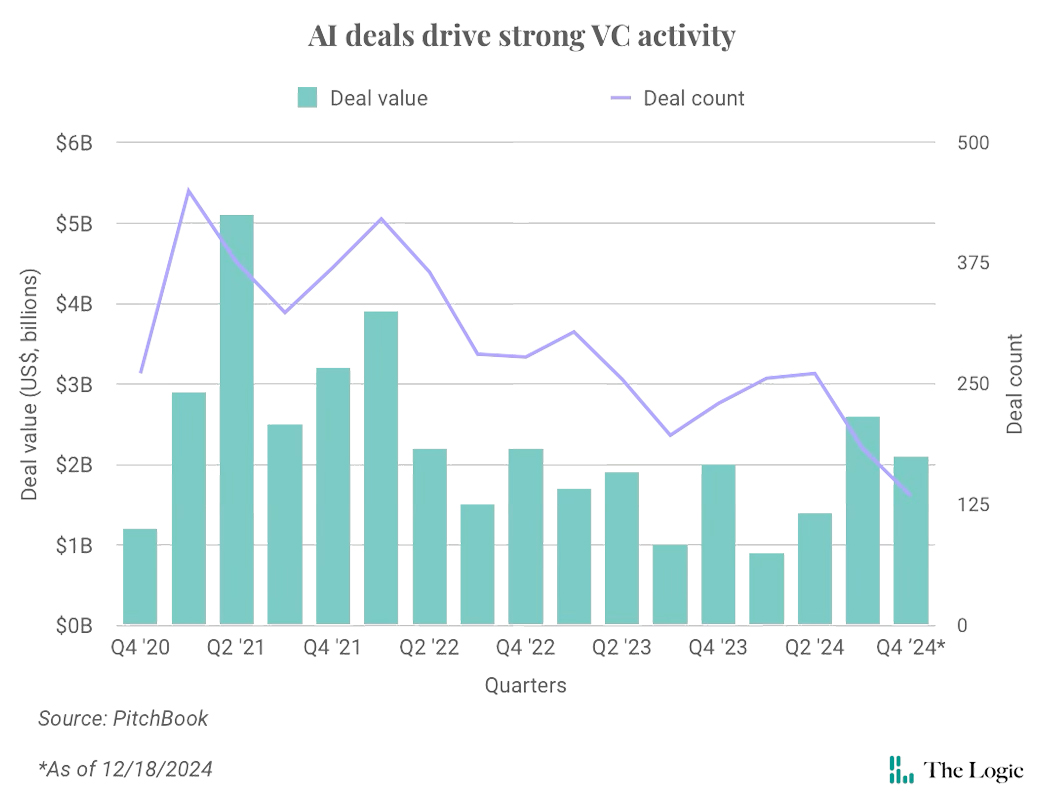
Canadian startups raised about US$2.1 billion in venture capital across 134 deals in the last three months of the year, with artificial intelligence companies clinching about 40 per cent of those dollars.
Total venture investments for the year were about US$7 billion, up slightly from last year’s US$6.6 billion, according to PitchBook data. But challenges remain for certain sectors, like cleantech, and as VC firms struggle to raise their next funds.
Talking Points
- Total venture investments for 2024 were about US$7 billion, up slightly from last year’s US$6.6 billion, with AI startups leading the way
- The year’s deal-making paints a complicated picture of a VC market that’s remained inaccessible for many startups and incredibly generous to others
- Investors expect investment activity to continue improving in 2025
The 2024 deal activity paints a complicated picture of a VC market that’s remained inaccessible for many startups and incredibly generous to others.
Venture investing has been limping along since early 2022, when interest rates started rising and tech stocks plummeted. Startups in 2024 raised about half the money they did in 2021 when the market peaked at US$13.7 billion invested in private Canadian firms.
Over the last three years, VC investors have reserved much of their cash for helping existing portfolio companies through difficult economic conditions, cutting far fewer cheques in new companies.
While investment dollars have increased since the start of 2024, the number of deals has continued to decline in the latter half of the year, as investors made bigger bets on fewer companies.
Beatrice Couture, principal at Teralys Capital, a Montreal-based investment firm, said that many of the companies that startups would typically sell their products to have trimmed their budgets in the post zero-interest-rate economy. Pre-revenue startups are now having more trouble raising money than they would have three or more years ago.
Startups that already have strong market demand—those that have proven their tech is indispensable even when cash is tight—are better positioned to raise, said Couture.
That’s one reason AI startups have done so well in the down market. Many of these companies promise to help customers boost their productivity and save money. Canadian AI and machine learning firms raised US$824.2 million across 36 deals in the last quarter of the year, the most since the third quarter of 2021. Toronto-based AI chipmaker Tenstorrent’s nearly US$700-million series D eclipsed other deals in the quarter. The next biggest investment was US$350 million raised by Montreal-based biopharmaceutical startup 35Pharma.
The life science sector fared well overall in the fourth quarter, raising US$460.5 million, the most since at least the start of 2019, PitchBook data shows. Investments were concentrated in relatively few companies, with just 14 deals closed in the last quarter. For the same period last year, life science firms raised just US$55.4 million but across 24 deals.
Fintech was another bright spot, with at least US$507.6 million invested across 13 deals. Two of the five largest investments in the fourth quarter went to fintech startups, Neo and Koho, which raised about US$260 million and US$140.2 million, respectively.
Investments in cleantech, meanwhile, declined. The sector had been resilient throughout the slow VC market, with investments peaking in 2022 at around US$2.2 billion. Unlike most industries, cleantech and climate tech firms raised more money in 2023 (US$1.72 billion) than they did in 2021 (US$1.5 billion). In 2024, however, investments dropped to about US$894 million. In the fourth quarter, they logged the fewest deals since at least the start of 2019, with just 19 investments.
The rise in cleantech investing coincided with the U.S. Inflation Reduction Act announced in August 2022, which earmarked US$369 billion to help address the climate crisis. Ottawa responded with its own climate-tech and clean-energy incentives, including the $15 billion Canada Growth Fund and nearly $17 billion in tax credits over five years.
The decline in Canadian cleantech deals followed a pause in financing from Sustainable Development Technology Canada (SDTC), an arm’s-length federal cleantech granting agency. In October 2023, the government barred SDTC from investing for eight months as it investigated conflict of interest claims and until it was absorbed by the National Research Council, another government agency.
The venture market certainly had its share of challenges in 2024, including a liquidity crunch that made it difficult for VC firms to raise new funds. But investors say conditions are improving. “I’m pretty optimistic that we’re seeing a turn and 2025 is going to be much stronger for everybody,” said Rick Nathan, managing director at Toronto-based Kensington Capital Partners, who said falling interest rates and rising stock markets will spur deals, including exits that could generate long-awaited returns to investors.
Couture said Ottawa’s pledge to renew its VC fund-matching program, with $1 billion for the Venture Capital Catalyst Initiative, also sends a good sign to startups and investors. Forthcoming incentives for pension funds to cut more venture cheques—something VC investors have been recommending for years—could help, too, she said.
Senia Rapisarda, managing director at venture capital and private equity investment firm HarbourVest, agreed. “The market is turning,” she said. “2025, in my opinion, is going to be much better than 2024.”