CALGARY — Tenstorrent says it’s planning to keep growing its Canadian operations, despite recently redomiciling to the U.S. The promise comes after the artificial intelligence hardware startup raised a US$693-million funding round featuring several prominent Canadian investors.
Skip to content


News
Tenstorrent says U.S. move was investor-driven part of US$693M fundraise
AI chip startup says its recent relocation to the U.S. was prompted by investor needs, but its latest fundraise includes promise to grow Toronto workforce and leadership
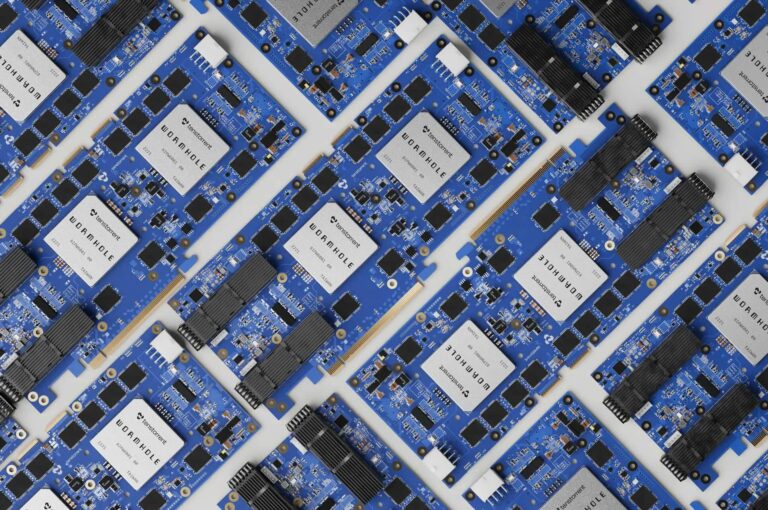
Tenstorrent re-incorporated in the U.S. in November 2023, and moved its headquarters from founding city Toronto to Santa Clara, Calif. Photo: Tenstorrent/Handout
CALGARY — Tenstorrent says it’s planning to keep growing its Canadian operations, despite recently redomiciling to the U.S. The promise comes after the artificial intelligence hardware startup raised a US$693-million funding round featuring several prominent Canadian investors.
As The Logic first reported last month, Tenstorrent re-incorporated in the United States in November 2023, and also moved its headquarters from founding city Toronto to Santa Clara, Calif. It later wound up its federally incorporated Canadian corporate entity.
Talking Points
- Tenstorrent, the AI chip startup, has committed to growing its Canadian headcount and hiring more senior leaders here as part of a US$693-million Series D round
- The firm redomiciled to the U.S. last November in order to secure a major investor, but has agreed to expand Canadian operations in part thanks to the backing of Ottawa’s export promotion agency
That move was tied to a US$100-million raise of convertible notes in August 2023, Bob Grim, vice-president of investor relations, said on Monday. At the time, one of Tenstorrent’s backers wanted to take a larger stake in the startup, but its internal rules limited its shareholding in a foreign-based firm. “We wanted to encourage them to invest more, so we did redomicile,” Grim said. He declined to name the investor.
The notes are part of a US$693-million Series D funding round at a US$2.7-billion valuation, which Tenstorrent announced Monday. Korean firms Samsung Securities and AFW Partners led the financing. Canadian investors included Export Development Canada (EDC), the Healthcare of Ontario Pension Plan (HOOPP) and Georgian.
“We have a long-term commitment there,” Grim said of Tenstorrent’s Canadian presence.
Ljubisa Bajic, a former executive at semiconductor giant AMD, founded Tenstorrent in Toronto in March 2016. The startup makes chips designed to run AI models, selling hardware to data centre operators and licensing its intellectual property to companies that want to create their own. In January 2023, Jim Keller—a well-known chip designer—replaced Bajic as CEO.
Related Articles
Tenstorrent now lists its headquarters as Santa Clara, while many of the startup’s other senior leaders are based in Austin. The firm’s management expects being based in the U.S. to be advantageous if the company goes public, Grim said.
Still, the startup plans to continue to expand in Canada partly thanks to new backer EDC, a federal Crown corporation with a mandate of financing Canadian firms selling into international markets.
As a condition of the agency’s investment, Tenstorrent agreed to grow its workforce in Canada, hire company leaders here and participate in the local technology ecosystem, according to Grim—actions he said the firm would have taken anyway. He declined to provide details, citing commercial confidentiality.
Tenstorrent’s headcount in Canada has increased from 107 people at the start of the year to 140 today. “The Toronto office is our No. 1 spot where our AI hardware is developed,” Grim said. The company’s product line also includes designs for the RISC-V architecture, sets of instructions that guide where processors go and data flows.
The news that Tenstorrent had relocated last year played into long-standing fears about Canada’s ability to retain promising startups as they grow, and that other countries benefit from the profits from ideas generated on Canadian soil. But Tenstorrent holds much of its intellectual property in Canada, and doesn’t currently plan to move it to the U.S., according to Grim.
“Unfortunately, the redomiciling is really just a mechanical thing we needed to do,” he said. “It represents no intent of de-prioritizing the Canada office.”



Loading...
Thanks for sharing!
You have shared 5 articles this month and reached the maximum amount of shares available.
CloseThis account has reached its share limit.
If you would like to purchase a sharing license please contact The Logic support at [email protected].
CloseGift the full article!
You have gifted 0 article(s) this month and have 5 remaining.
Recipients will be able to read the full text of the article after submitting their email address. They will not have access to other articles or subscriber benefits.
Photo: Tenstorrent/Handout
Most Popular This Week




In-depth, agenda-setting reporting
Great journalism delivered straight to your inbox.
Analysis
Flaws in CPP legislation have left billions of dollars at stake ahead of Alberta’s referendum
Briefing
RBC pledges $70M to support young entrepreneurs
Banks should have kill switches, IDs for AI agents, says global finance watchdog
B.C. First Nations decry rushed consultations as Major Projects Office CEO promises to do better
Best business newsletter in Canada
Get up to speed in minutes with insights and analysis on the most important stories of the day, every weekday.
Exclusive events
See the bigger picture with reporters and industry experts in subscriber-exclusive events.
Membership in The Logic Council
Membership provides access to our popular Slack channel, participation in subscriber surveys and invitations to exclusive events with our journalists and special guests.






