Canadian startups underperform against their international rivals on key metrics like exits and growth-stage funding, according to the findings of a new report.
The report, written by Charles Plant, a startup adviser and researcher, looked at how well Canadian startups founded in 2014 had done in the years since. In total, the report covers 5,545 companies in Canada, the U.S., the U.K., France, Germany and Israel that were founded in 2014 and raised at least US$500,000. Here’s what the data reveals:
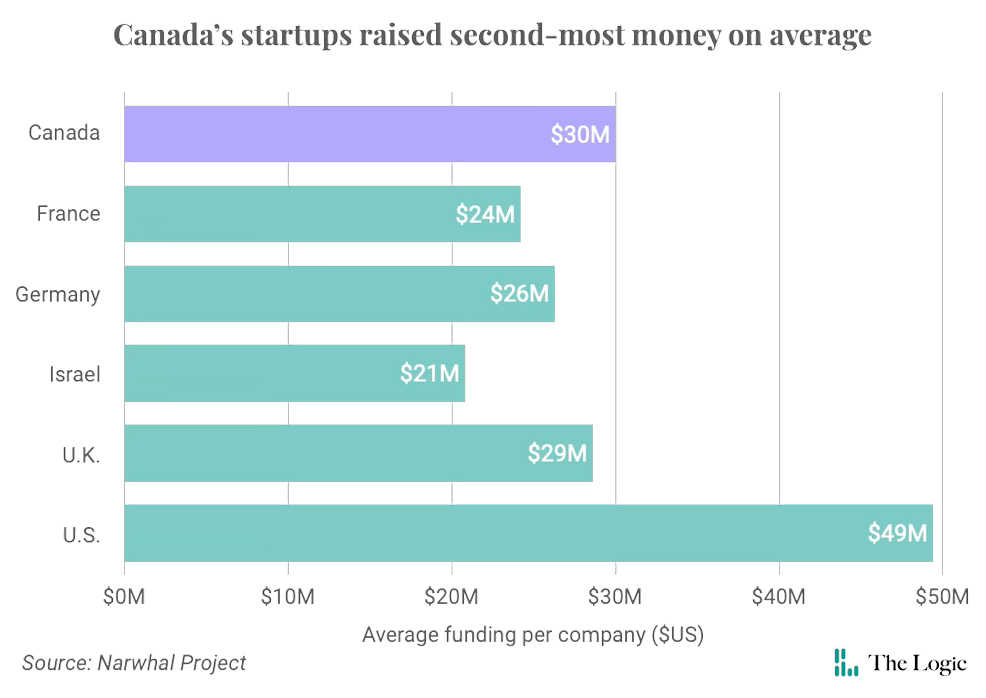
Startups are raising money: Canadian startups raised an average of US$30 million, second only to the U.S., where companies raised US$49.4 million on average. These dollars, however, were skewed upward by a handful of companies, Plant found, specifically five that went public and about 13 that raised over US$100 million each.
IPO woes: Canada ranks first for the rate of 2014-founded companies that have gone public, with 21 initial public offerings, representing 8.1 per cent of the class. But these companies generally raised less money (US$57 million) than those that went public in all other countries except Israel. Most of those IPOs were on junior exchanges, like the TSX Venture Exchange. Just five companies, or 2.2 per cent, went public on larger stock exchanges, behind the U.S., Israel and the U.K.
The acquisition myth: Canada had the lowest rate of startup acquisitions—just 10.4 per cent of companies founded in 2014 have since been bought. On average, Canadian companies raised US$12.8 million before an acquisition, compared to the US$37 million international companies received on average before being bought. “There’s this myth in Canada that we have companies coming up and being snatched out from under our feet,” said Plant. “That isn’t seen in the data.” Plant said the companies that are being acquired may be selling out of desperation, and not because their business is particularly attractive. “They run out of headroom from financing, and they have to get sold.”
A scaleup problem: Canada also ranked last for the share of companies that have reached a Series B funding round since launching 10 years ago, at 8.4 per cent. “It blew me away when I saw how few had gotten to a Series B and beyond,” said Plant. He found that 95 per cent of Canadian companies raised earlier-stage seed funding, which he said shows they don’t have a problem creating a viable product, but the challenge is marketing the product at scale. “It’s a go-to-market problem,” he said, adding that many startups don’t have the right marketing people or strategies to grow efficiently. He suggested government money, much of which funds early-stage research and development, could better serve companies at later stages to help bridge the gap.
Canada’s got potential: Canadian startups may be slow to grow, but Plant said success isn’t hopeless. He looked at companies that raised money in the last four years and found that their workforces had grown far more than companies that had stopped fundraising. Using that as a proxy for future success, he found Canada had the greatest share of companies with potential, at 36.5 per cent, just above the U.S. These companies raised less money than their global peers, showing they likely start raising money later, raise less in general, grow more slowly and rely more on government grants.