OTTAWA — As Canada starts pouring money into its military, investors have been pouring money into Ontario’s Volatus Aerospace to help get its drones on the Canadian Forces’ shopping list.
Skip to content

News
Investors flock to drone firms after Carney promises defence splurge
One Ontario-based drone company has raised $26M and seen its share price triple. Its CEO foresees a golden moment for the industry.
A drone carrying lidar gear sits on its landing pad during an August 2024 demonstration organized by Volatus Aerospace in Quebec City. Photo: YellowScan/Volatus/LinkedIn
OTTAWA — As Canada starts pouring money into its military, investors have been pouring money into Ontario’s Volatus Aerospace to help get its drones on the Canadian Forces’ shopping list.
“What’s happened since November of last year is what’s changed the face of the company,” said CEO Glen Lynch, in an interview with The Logic. U.S. President Donald Trump has forced countries—not just Canada, but definitely Canada—to confront their economic and security dependence on the United States, he said.
The combination of that realization, and the advent of major drone warfare between Ukraine and Russia, make for what Lynch hopes will be a golden moment for a Canadian drone company.
Volatus is leaning into “a changing geopolitical backdrop and Canada’s historic commitment to higher defence spending,” the company said in announcing its latest quarterly results last week.
Talking Points
- Ontario’s Volatus Aerospace, an aerial drone company, has been seeking a path to profitability for years and the federal government’s new focus on the military might be it
- Investors have put millions of dollars into Volatus over the past several months and its share price has soared as it pursues Canadian defence contracts
Investors seem to see the same opportunity: Volatus, publicly traded since a reverse takeover a few years ago, has seen its share price soar even as it has sold blocks of new shares to private buyers to bring in millions of dollars at a time. The company has raised nearly $26 million since May.
Volatus is still a penny stock, trading at around 60 cents a share on the TSX Venture exchange, but that price has more than tripled just since June.
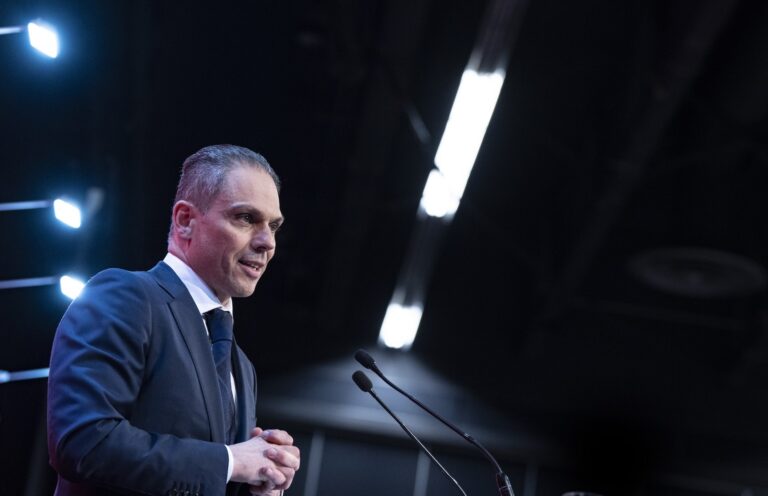
Another publicly traded Canadian drone company, Kraken Robotics of St. John’s, N.L.—which works in the water, not the air—has seen a less dramatic but still marked rise in its share price, from about $2.40 a share in early June to about $3.50 recently. Meanwhile, Kraken raised $115 million by issuing new stock.
Related Articles

Kraken doesn’t sell whole drones but rather batteries and sensors for undersea work, and security is its biggest market. Canada is hungry for such devices and “we are excited about our defence market prospects,” Kraken CEO Greg Reid said in an earnings release Aug. 21.
Back in the air, Quebec institutions like Investissement Québec have become interested in Volatus as a potential force in the province’s substantial aerospace industry, Lynch said. As an investor, Investissement Québec has a seat on Volatus’s board.
Not that long ago, Lynch himself wouldn’t have believed any of it.
“He said, ‘Glen, drones are the future.’ My response was, ‘What are you smoking?’”
His background was in conventional aviation. He was a pilot who branched out into aircraft management in the 1980s, running companies that flew, maintained and resupplied planes, such as business jets.
One day in 2018, Lynch’s longtime businesses partner Ian McDougall—now Volatus’s chair—took in a drone demonstration.
“He called me and he said, ‘Glen, drones are the future.’ And my response to that was, ‘What are you smoking?’” Lynch said. He thought of drones as either toys or weapons, neither of which was their specialty.
But McDougall insisted, and they set up a side hustle with the idea that they’d use their experience to help drone-oriented startups become sustainable businesses. Soon they had their first customer, a Winnipeg company called M3 Aerial that had begun as a drone videography company before turning to aerial surveys for industries like farming and mining.
Then Lynch had his own conversion experience.
“I dove in and started working on the strategic plan, and the lights went on,” he said. “I called back our chairman and I said, ‘You know what? Drones are the future.’”
They bought M3 Aerial. More acquisitions followed, plus the reverse takeover of a private-jet management company and a merger with a drone-delivery startup, as Volatus tried to find its groove.
As a result, Volatus is a bit ungainly, with subsidiaries sprinkled across Canada and the U.S., several in the United Kingdom and one in Norway—its foothold in the European market. It has three main business lines: flying both piloted and drone aircraft for customers who want those services but don’t want their own fleets; selling drone hardware to customers who do; and training clients to use them.
“The Canadian investor community and government have not been big supporters of things that go boom.”
The company loses money, though Lynch’s goal is to be “EBITDA-positive,” accounting-speak for turning an operating profit, by the end of 2025 and to have free cash flow a year after that.
Last week’s earnings showed a sharp improvement on that front, with Volatus’s adjusted EBITDA (earnings before interest, taxes, depreciation and amortization) going from a $1.85-million quarterly loss last year to a $276,259 loss. Revenue rose nearly 50 per cent, from about $7.1 million to nearly $10.6 million.
Lynch hopes military work will boost the numbers further.
The company has always had a foot in defence, he said, but primarily through training, counter-drone technology and gathering images for intelligence, not selling hardware. “We do not develop weaponized drones, but we do develop and sell drones that are capable of being weaponized,” said Lynch. “That’s not to say that we’re not interested in developing that expertise.”
Volatus’s previous defence work was enough to get Lynch and two of its other executives on a Russian sanctions list in late 2022, in retaliation for Canadian sanctions over the Ukraine war.
But there hasn’t been much of a market for it on Volatus’s home turf, he said: “The Canadian investor and institutional investor community and the government have not been big supporters of things that go boom.”
That’s changing. To take advantage, the company hired an Ottawa lobbyist: David Pratt, who was Paul Martin’s defence minister before a Conservative upstart named Pierre Poilievre unseated him in the 2004 election. Last winter, Pratt began pitching Volatus for border security and other surveillance-related jobs.
The firm has a standing-offer arrangement with federal procurement authorities—pre-approval for departments to buy from it, essentially—and public records show Volatus has had four federal contracts in all. The most recent is a $46,000 deal signed last September, pre-Trump, with the Department of Fisheries and Oceans.
So the government is saying things Volatus and its investors like to hear, but the defence money hasn’t really started to flow yet. What will matter is whether Prime Minister Mark Carney’s words committing to demanding NATO spending targets turn into government purchases.
“I think it’ll become a primary driver for us in due course,” Lynch said. “It’s just a question of how fast that will happen.”



Loading...
Thanks for sharing!
You have shared 5 articles this month and reached the maximum amount of shares available.
CloseThis account has reached its share limit.
If you would like to purchase a sharing license please contact The Logic support at [email protected].
CloseGift the full article!
You have gifted 0 article(s) this month and have 5 remaining.
Recipients will be able to read the full text of the article after submitting their email address. They will not have access to other articles or subscriber benefits.
Photo: YellowScan/Volatus/LinkedIn
Most Popular This Week




In-depth, agenda-setting reporting
Great journalism delivered straight to your inbox.
News
National Bank CEO warns AI alone won’t give banks a lasting edge
Briefing
Canada and Ontario commit over $5B to support tariff-hit steel sector
Hackers will see cars as major targets in next 3 years, 83% of car-tech workers say
EA shutting down Edmonton studio BioWare
Best business newsletter in Canada
Get up to speed in minutes with insights and analysis on the most important stories of the day, every weekday.
Exclusive events
See the bigger picture with reporters and industry experts in subscriber-exclusive events.
Membership in The Logic Council
Membership provides access to our popular Slack channel, participation in subscriber surveys and invitations to exclusive events with our journalists and special guests.





