OTTAWA — Canada’s military worries that climate change will mean its planes won’t fly as far or carry as much, its buildings and infrastructure will fail and its troops will wear out on endless domestic missions helping fight fires and floods.
Skip to content


News
Being green won’t be easy—or cheap—for Canada’s military
Climate change will damage buildings, degrade equipment and even limit how far planes can fly, warns Defence Department memo
The army has tested an electric-drive prototype of its light-armoured vehicle at CFB Gagetown in New Brunswick. Photo: DND/Facebook
OTTAWA — Canada’s military worries that climate change will mean its planes won’t fly as far or carry as much, its buildings and infrastructure will fail and its troops will wear out on endless domestic missions helping fight fires and floods.
Preparing the military for a hotter planet and stopping its own contributions to the problem will cost billions of dollars, according to the Department of National Defence—the government’s biggest building operator, and the owner of its dirtiest vehicles. But there are early signs that some of that spending could be good for Canadian industry.
Talking Points
- Climate change will degrade the Canadian military’s equipment and buildings and diminish its ability to fight, the Department of National Defence warned in a memo last year
- Reducing the Canadian Forces’ own greenhouse gas emissions will be difficult and expensive, but there’s hope that that spending can go to Canadian industry
The concerns are laid out in a 2024 memo to Finance Canada, which compiles periodic reports on how well the federal government is readying for climate change. The long document, obtained by The Logic through an access-to-information request, was condensed into a few mentions in the latest government-wide report, released in February.
Strategists and academics have looked at climate change as a global security threat, but here DND was intent on the practical. All the things the military says it needs in order to prepare could, in a way, be useful to the federal Liberals, as they look for ways to meet NATO defence spending targets beyond this year.
“As the climate changes, otherwise long-lived infrastructure and equipment assets will face different operating conditions than those for which they were designed,” the department warned. They’ll cost more to maintain and sustain more damage, and they might not work as well.
For instance, airplanes fly better in cooler air. It’s just physics: warmer air is less dense, and that affects lift forces. Civilian airlines are already getting a taste of what this means, sometimes bumping passengers and even cancelling flights when heat makes it dangerous to take off as planned.
Related Articles

For the Canadian Forces, the DND memo said, “increased air temperatures reduce the weight limit on flights, affecting range or payload capacity. The result is more resources will be required to remain operationally responsive.”
In plain language: they’ll need more planes or more trips to carry the same people and gear.
And the people are tired. The Canadian Forces have been sounding this alarm for years. Troops deployed to fill sandbags and help fight fires can’t be projecting Canadian power abroad, or training to do it.
“Transitioning to a reality impacted by climate change will bear significant costs, however, these costs have yet to be fully quantified,” the DND memo said.
The department is anticipating big expenses to keep its buildings in working condition. That’s a common theme in governments, but this department owns more buildings than any other federal entity—14,215 of them, according to the official index, which is almost three times as many as the No. 2 on the list, Parks Canada. That’s a lot of roofs and foundations.
Preventing damage, while still expensive, would be cheaper than repairing, the submission said.
Just how big the bill might be is to be determined. When it published a climate strategy in 2023, the department aimed to do climate risk assessments on 20 per cent of its critical real estate assets by 2027.
“Increased air temperatures reduce the weight limit on flights, affecting range or payload capacity.”
When The Logic asked how many have been completed so far, National Defence spokesperson Cheryl Forrest didn’t answer directly. The department did “vulnerability assessments” of 35 properties in 2024, which “sets the stage for future assessment of critical and priority assets and the continuous advancement of the resilience of our defence infrastructure,” she wrote. The department is working up a methodology.
Meanwhile, if the military wants to do its part by slashing emissions, the internal document said, the cost for its buildings alone to reach net-zero will be “in the billions.” National Defence’s buildings account for more federal emissions from buildings than any other source by far: about 466 kilotonnes of carbon dioxide equivalents, or roughly half of the total from all government structures.
It’s made some efficiency improvements that have paid for themselves over time, but the paybacks for deep retrofits and totally changing heating systems, for instance, are too poor to justify the expense using ordinary cost-benefit standards.
National Defence military vehicles, meanwhile, emitted 547 kilotonnes of greenhouse gases in 2023–24, also the most by far of any department. Its civilian vehicles added another 19 kilotonnes.
National Defence has been switching its civilian vehicles over to hybrid and electric propulsion, but doesn’t have a lot of options for low-emissions military hardware. “Most defence equipment runs on fossil fuels and will do so for decades,” the document said.
“Most defence equipment runs on fossil fuels and will do so for decades.”
The army’s current light armoured vehicles (LAVs) burn 0.8 litres of diesel per kilometre, but there’s work in progress to change that with future versions.
Industry Canada gave $49.9 million in 2022 to General Dynamics Land Systems’ Canadian subsidary—a factory in London, Ont., that makes LAVs. Among the efforts the government backed at the defence contractor was a project to devise a LAV with an electric drive and an onboard power plant capable of generating a megawatt of electricity.
Intended to conclude in 2024, the project has been extended until 2026, a spokesperson for the Industry Department told The Logic. General Dynamics has produced a prototype that the army has tested at CFB Gagetown in New Brunswick.
Despite some reservations, the army liked it, Forrest told The Logic. The machine’s hybrid functionality caught soldiers’ attention, and “the nearly silent operation of the 100 per cent electric function impressed users,” she wrote. “There was also feedback for future development regarding power, charging while driving and the user interface.”
Elsewhere, General Motors’ defence division is working on a hybrid tactical truck that can run on batteries alone. It’s built on a Chevy Silverado base, a model made at GM’s plant in Oshawa, Ont. All-electric mode is much quieter than combustion power and doesn’t produce the same heat signature—useful for “stealthy ingress and egress through high threat zones,” the company boasts.
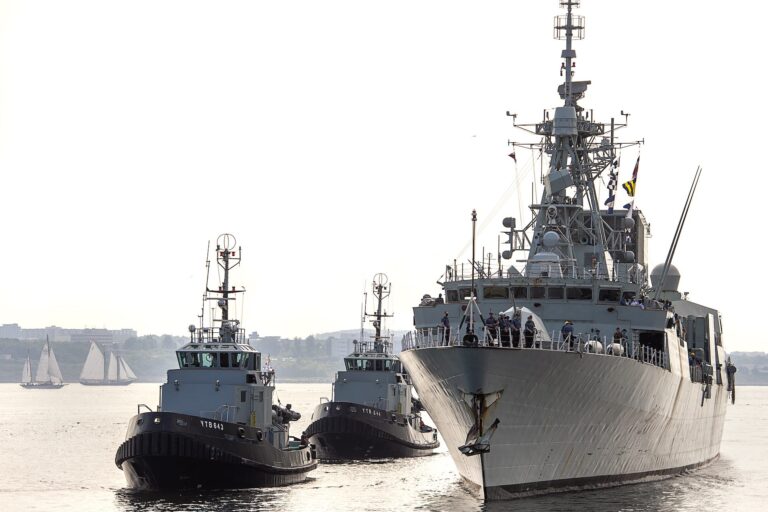
The military’s LAVs and tanks emit trifling amounts of greenhouse gases, however, compared to its ships and especially its planes. In the 2023–24 fiscal year, National Defence’s military land vehicles accounted for one per cent of its fleet emissions. Marine vessels accounted for 20 per cent and aircraft accounted for 79 per cent.
Electric planes and helicopters exist but right now they’re the flying equivalents of scooters—you wouldn’t want to take one into a dogfight or on a bombing run.
Sustainable aviation fuels exist, largely made from biological feedstocks, and the air force’s planes can run on a 50–50 mix of those and traditional fuels. But they’re more expensive and the supply is limited.
“To date, the RCAF fleet has used some [sustainable fuel] from international partners, when available, while operating out of country,” Forrest wrote.
Canada doesn’t have a ready domestic source (the civilian airline industry is trying to put one together). The government has sought suppliers for millions of litres of lower-carbon aviation fuel for bases at Trenton, Ont., Cold Lake, Alta., and Comox, B.C., however, and Forrest wrote that the military has bought four million litres of “neat” sustainable fuel, ready to be mixed with the regular kind.



Loading...
Thanks for sharing!
You have shared 5 articles this month and reached the maximum amount of shares available.
CloseThis account has reached its share limit.
If you would like to purchase a sharing license please contact The Logic support at [email protected].
CloseGift the full article!
You have gifted 0 article(s) this month and have 5 remaining.
Recipients will be able to read the full text of the article after submitting their email address. They will not have access to other articles or subscriber benefits.
Photo: DND/Facebook
Most Popular This Week




In-depth, agenda-setting reporting
Great journalism delivered straight to your inbox.
Commentary
Carmichael: Canadian ignorance about India is a strategic weakness
Briefing
Aritzia shares pop after earnings rise 204%
First Nation in Alberta goes to court over fast-tracked oil pipeline
Chinese EV maker Geely Auto Group to launch in Canadian market in 2027
Best business newsletter in Canada
Get up to speed in minutes with insights and analysis on the most important stories of the day, every weekday.
Exclusive events
See the bigger picture with reporters and industry experts in subscriber-exclusive events.
Membership in The Logic Council
Membership provides access to our popular Slack channel, participation in subscriber surveys and invitations to exclusive events with our journalists and special guests.





