Donald Trump wants to trigger the “total collapse of the Canadian economy because that’ll make it easier to annex us,” Prime Minister Justin Trudeau charged Tuesday, after promising the federal government would spare no effort—or cost—to prevent the U.S. president’s trade war from achieving that goal.
Skip to content

News
Ottawa and provinces promise support for Canadians as trade war begins
Trudeau says Canada will be there for workers and businesses as provinces start setting aside money for relief
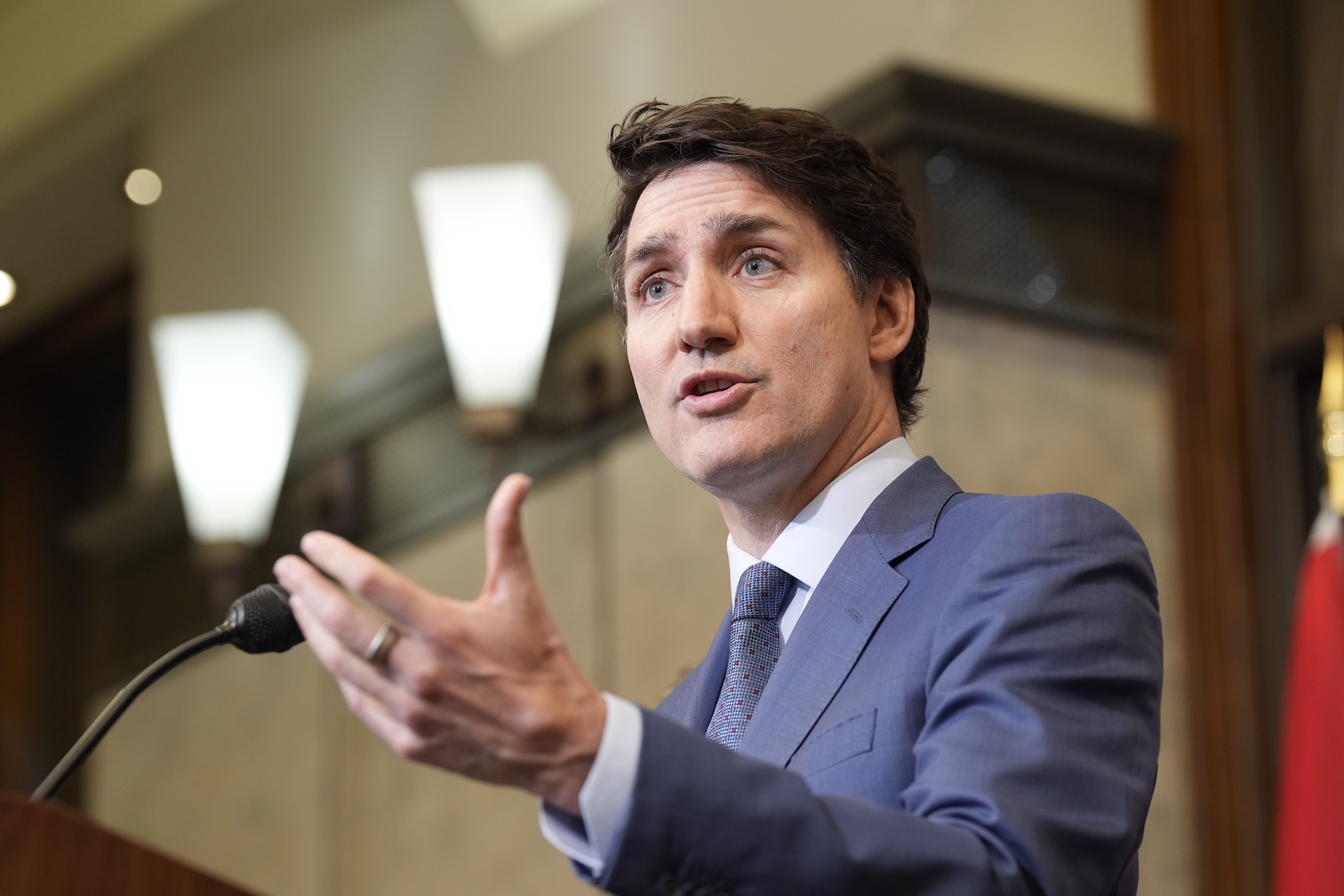
Prime Minister Justin Trudeau warned Canadians on Tuesday that the impact of U.S. tariffs is "going to be tough." Photo: The Canadian Press/Adrian Wyld
Donald Trump wants to trigger the “total collapse of the Canadian economy because that’ll make it easier to annex us,” Prime Minister Justin Trudeau charged Tuesday, after promising the federal government would spare no effort—or cost—to prevent the U.S. president’s trade war from achieving that goal.
“I won’t sugar-coat it: this is going to be tough,” Trudeau told a news conference on Parliament Hill hours after Trump’s executive order to slap 25 per cent tariffs on all Canadian goods aside from energy products, which are subject to a 10 per cent levy, came into effect.
Talking Points
- Prime Minister Justin Trudeau said Canada is ready to “use every tool” to support those harmed by U.S. tariffs and Canada’s retaliatory tariffs, such as expanded EI benefits and direct support for businesses
- Trudeau did not announce specific relief measures or timelines, saying ending the tariffs is Ottawa’s top priority
- Provinces are rolling out their own relief measures, from tax deferrals to direct spending plans
The U.S. tariffs were already expected to hurt workers and companies in the highly integrated North American economy. Canada has decided to up what it hopes to be short-term pain for long-term gain by moving ahead with the first wave of its retaliation plan: counter-tariffs on $30 billion worth of U.S. goods, mainly consumer products chosen for maximum impact. Another $125 billion worth of retaliatory tariffs are set to come in after a 21-day consultation.
Retaliation could shorten the trade war, but it will increase the risk, and severity, of the battle wounds. Ottawa and the provinces are now coming up with ways to soften the blows.
“Canada, make no mistake: no matter how long this lasts, no matter what the cost, the federal government and other orders of government will be there for you,” Trudeau said.
Not quite yet
Trudeau said the federal government would “use every tool at [its] disposal” to support Canadian businesses and workers harmed by the trade war, but stopped short of announcing specific relief measures or timelines.
Related Articles



“Our priority has to be not on figuring out how to manage through these tariffs over the coming days and weeks and months, but on doing everything we can to get them lifted and put an end to this unjustified trade war that hurts American families and Canadian families,” he said. Trudeau later said Ottawa has been working “over the past month” on measures to roll out “if these tariffs last longer than a few hours, or a few days.”
Potential relief
Trudeau said Ottawa would be “looking at” expanding employment insurance benefits, as well as making them more flexible. He also mentioned “providing direct support to businesses,” without naming sectors or amounts. He also said Canada “will take measures to prevent predatory behavior that threatens Canadian companies because of the impacts of this trade war, leaving them open to takeovers.”
As The Logic previously reported, the Business Development Bank of Canada is allocating nearly $1 billion to Canadian companies threatened by trade uncertainty or general economic uncertainty. Other, smaller federal measures were already popping up. On Tuesday, Prairies Economic Development Canada awarded $1 million to Edmonton-based New Harvest Canada, a research institute, “to advance a more resilient food production system.”
Revenue from counter-tariffs
After Trudeau met with premiers in Ottawa on Jan. 15, a statement from the Prime Minister’s Office said support for businesses and individuals harmed by the trade war could include redistributing any revenue generated by retaliatory tariffs.
Conservative Leader Pierre Poilievre said that money should be used carefully. “Counter-tariffs must not be a cash cow for the government,” he said Tuesday. “Almost every penny of the tariffs collected should go to tax cuts, with a small sum set aside for targeted relief to workers hardest hit by the trade war. None of the money should go to new government spending programs.”
Options are limited
Redistributing revenue from counter-tariffs and easing or expediting access to employment insurance benefits are both measures the Liberal government can take in the short term. But there is only so much it can do without recalling Parliament, which is scheduled to resume March 24.
Any new programs or spending, such as a pandemic-style stimulus package, would require new legislation. Unless Trudeau moves to recall Parliament this week, it will be up to the next prime minister. Who that is may be known as early as Sunday, when the Liberals are set to choose their next leader.
What businesses want
Dan Kelly, president of the Canadian Federation of Independent Business, does not want to wait. “The federal government should recall Parliament immediately to ensure that Canadian businesses have the support they need and that every dollar Canada collects in tariffs is returned to affected businesses as quickly as possible,” he wrote in a statement Tuesday.
Dennis Darby, CEO of Canadian Manufacturers & Exporters, called on the “federal government to act swiftly to protect jobs and provide relief to manufacturers most affected by these tariffs,” in a written statement. “We cannot afford to let these punitive measures weaken Canada’s industrial base.”
Ontario responds
In Ontario, Premier Doug Ford has promised as part of his Progressive Conservative platform to allocate $5 billion to a “Protect Ontario Account” to support industries and workers harmed by the tariffs. His government is also deferring business taxes for six months, and offering up to $3 billion in “tax and payroll premium” relief for employers.
Fresh off his third election victory in the province, Ford said the federal and provincial governments will work together, as they did amid the COVID-19 pandemic, to support people and companies with immediate relief—with details to be decided. In a news conference, Ford said Ontario is prepared to dig in for an extended trade battle with the U.S.
“We’ll retrain impacted workers for new jobs. We’ll retool companies for new customers and new markets. We’ll reshore supply chains to bring good jobs back home, and we’ll rebuild roads, highways, bridges to keep people working,” he said.
Provincial rainy day funds
Several other provinces are likewise setting aside relief funds or tax cuts to soften the blow from tariffs. In Alberta’s budget earlier this week, Finance Minister Nate Horner introduced a $1.2-billion income tax cut for Albertans making under $60,000. The province, which RBC estimates is the one most exposed to U.S. trade threats given its dependence on oil and gas, set aside a $4-billion contingency fund for potential relief spending.
Nova Scotia Premier Tim Houston, who has led the push among the provinces to remove interprovincial trade barriers, has created a reserve fund to support workers and businesses. In its latest budget, the province also introduced $500 million in tax cuts, including a one per cent cut to its harmonized sales tax, down to 14 per cent.
Quebec Premier François Legault held a special cabinet meeting on Tuesday, and later announced that Quebec firms vulnerable to tariffs could apply for up to $50 million in government-backed loans. The debt will be spread over maturity periods of up to seven years, the province said, with an initial grace period on interest payments of up to 24 months.
“We want to be very clear: we will not let ourselves be intimidated by Donald Trump,” Legault told reporters on Tuesday. “It’s time to roll up our sleeves.”
Also on Tuesday, British Columbia’s government tabled budget that included a $4-billion fund for contingencies including tariff relief. Premier David Eby’s government had already promised to fast-track $20 billion worth of projects, including nine proposed wind farms and the coastal Cedar LNG export facility.
This story was updated to include details of provincial relief plans.
With files from Laura Osman and David Reevely in Ottawa



Loading...
Thanks for sharing!
You have shared 5 articles this month and reached the maximum amount of shares available.
CloseThis account has reached its share limit.
If you would like to purchase a sharing license please contact The Logic support at [email protected].
CloseGift the full article!
You have gifted 0 article(s) this month and have 5 remaining.
Recipients will be able to read the full text of the article after submitting their email address. They will not have access to other articles or subscriber benefits.
Photo: The Canadian Press/Adrian Wyld
Most Popular This Week




In-depth, agenda-setting reporting
Great journalism delivered straight to your inbox.
News
Panel decries Canada’s chaotic way of funding world-class science
Briefing
AI is pushing insurers to become asset managers, Canadian CEOs say
Trump administration faces lawsuit over 50% tariffs on Canadian goods
Canada-U.S. trade war to reduce real GDP by 1.4% over 2024 levels after five years: PBO
Best business newsletter in Canada
Get up to speed in minutes with insights and analysis on the most important stories of the day, every weekday.
Exclusive events
See the bigger picture with reporters and industry experts in subscriber-exclusive events.
Membership in The Logic Council
Membership provides access to our popular Slack channel, participation in subscriber surveys and invitations to exclusive events with our journalists and special guests.





