The federal government should make sure emergency funding to support businesses through a trade war with the U.S. doesn’t undermine longer-term goals of boosting productivity and internal trade, says the Canadian Chamber of Commerce.
Skip to content


News
Emergency funding to fight tariffs could further dent Canadian productivity, business groups warn
A dollar-for-dollar response to Trump’s tariff threats could cost Canada’s economy
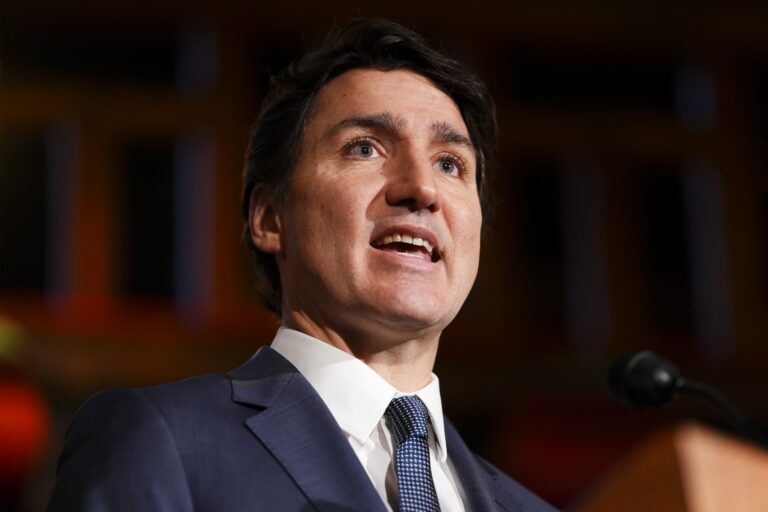
Prime Minister Justin Trudeau has said Ottawa is ready to support businesses and individuals harmed by U.S. tariffs on Canadian goods, and to mitigate losses from any retaliatory moves Canada makes. Photo: The Canadian Press/Sean Kilpatrick
The federal government should make sure emergency funding to support businesses through a trade war with the U.S. doesn’t undermine longer-term goals of boosting productivity and internal trade, says the Canadian Chamber of Commerce.
Matthew Holmes, chief of public policy at the business lobby group, said he told officials at the Department of Finance that he is concerned the federal government is in “reaction mode” over the 25 per cent tariffs that U.S. President Donald Trump has threatened to impose on Canada as soon as Saturday. Meanwhile, “Trump’s going to be cutting red tape and [corporate tax rates], and so we’re going to be four steps behind in terms of how competitive we are as a market,” he said. “It’s that gap, it’s that widening delta, that I wanted them to be looking at.”
Talking Points
- The Canadian Chamber of Commerce says the federal government needs to think beyond emergency funding to keep the economy competitive with the U.S.
- The CFIB says businesses might need broad-based government support in the face of U.S. tariffs, but the emergency tax cut floated by the Conservatives could also help
Prime Minister Justin Trudeau has said Ottawa is ready to support businesses and individuals harmed by U.S. tariffs on Canadian goods, and to mitigate losses from any retaliatory moves Canada makes. A statement released after his Jan. 15 meeting with provincial and territorial premiers said that could include redistributing any revenue generated by retaliatory tariffs. In a call Wednesday, the first ministers again discussed options to cushion the blow for workers, families and businesses, the Prime Minister’s Office said.
Sen. Hassan Yussuff, who is on a new council advising Trudeau on Canada-U.S. relations, suggested the federal and provincial governments look to the kind of relief that supported businesses and workers through the COVID-19 pandemic. In March 2020, the federal government announced $82 billion in support for businesses and workers affected by lockdowns, including wage subsidies, tax deferrals and income support.
“If we should face the same degree of pain that will come when the tariff is implemented, I think the government needs to be generous,” Yussuff said last week at a federal cabinet retreat.
Related Articles

A senior government official, whom The Logic agreed not to name so they could discuss matters not yet made public, said the government can distribute revenue it generates from retaliatory tariffs against the U.S. without recalling Parliament, which the Liberals have prorogued until March 24. It could also ease or expedite access to employment insurance benefits without needing Parliament to pass legislation. Any new programs or spending—such as a pandemic-style stimulus package—would require Parliament to reconvene to pass new legislation.
Dan Kelly, president and CEO of the Canadian Federation of Independent Business, said that a dollar-for-dollar response by Canada would have a “massive” impact on the economy. “Just as was the case during the pandemic, we may need broad wage support to help businesses keep workers as well as extra supports for those who lose their jobs,” Kelly wrote in an email. He added that “many small firms still carry significant pandemic debt that will make their ability to withstand shocks even weaker than normal.”
He also said businesses would likely support an emergency tax cut the Conservatives have proposed as another way to stimulate the economy.
“Many small firms still carry significant pandemic debt that will make their ability to withstand shocks even weaker.”
An online survey of 250 Canadian business leaders by accounting firm KPMG found 80 per cent of respondents agreed the federal government should roll out income support akin to what was offered during the pandemic. Seventy-nine per cent of them, however, said they were concerned that it could fuel inflation.
Holmes said the pandemic relief package created volatility in supply chains, the workforce and the cost of living. Another such package would affect the country’s fiscal outlook, as well as overall productivity. “We’re not well served if we continue to just flood the economy with government money,” he said.
Mostafa Askari, chief economist at the Institute of Fiscal Studies and Democracy at the University of Ottawa, said “significant and widespread” tariffs would leave the government “no choice” but to roll out support, even if it increases the budget deficit.
“We’re not well served if we continue to just flood the economy with government money.”
He does not think a support package would need to be as sweeping as what the government provided during the pandemic. “While the impact of a large tariff on the economy would be significant it would not be even close to what happened during the [COVID-19] necessary lockdown,” he wrote in an email.
Unless the Liberal government recalls Parliament, the question of whether to introduce that level of support will be up to the person the Liberals choose on March 9 to replace Trudeau as party leader, as that person will become prime minister before Parliament is set to resume.
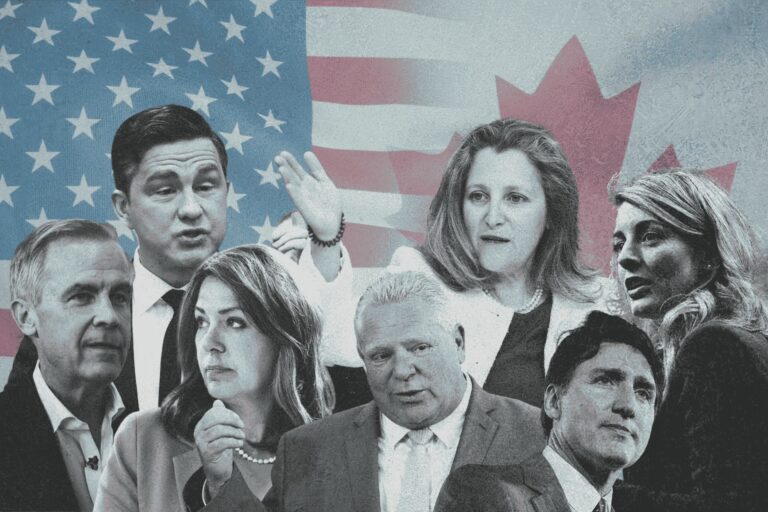
Both Chrystia Freeland and Mark Carney, considered the frontrunners in the Liberal leadership race, have proposed delivering support tied to revenues from dollar-for-dollar retaliatory tariffs. Neither campaign would say Wednesday whether they would introduce legislation for new spending.
The Conservatives and NDP both say they want Parliament to return earlier than scheduled so they can have a say in the response.
— With files from Laura Osman



Loading...
Thanks for sharing!
You have shared 5 articles this month and reached the maximum amount of shares available.
CloseThis account has reached its share limit.
If you would like to purchase a sharing license please contact The Logic support at [email protected].
CloseGift the full article!
You have gifted 0 article(s) this month and have 5 remaining.
Recipients will be able to read the full text of the article after submitting their email address. They will not have access to other articles or subscriber benefits.
Photo: The Canadian Press/Sean Kilpatrick
Most Popular This Week



In-depth, agenda-setting reporting
Great journalism delivered straight to your inbox.
News
EDC wants to help sell the full stack of Canadian technology abroad
Briefing
Mecka raises US$60M to gather data for robot training
Businesses should expect AI to get better, but not necessarily cheaper
Weston family and Fairfax agree to buy drugstore Boots for US$8.9B
Best business newsletter in Canada
Get up to speed in minutes with insights and analysis on the most important stories of the day, every weekday.
Exclusive events
See the bigger picture with reporters and industry experts in subscriber-exclusive events.
Membership in The Logic Council
Membership provides access to our popular Slack channel, participation in subscriber surveys and invitations to exclusive events with our journalists and special guests.





