OTTAWA — Prime Minister Justin Trudeau promised not to back down from the potentially devastating tariff war Donald Trump has started with Canada, even as the U.S. president threatens to escalate it further.
Skip to content

News
Trump wants to destroy Canada’s economy so he can annex it, Trudeau warns
Ottawa and the provinces unveil their first countermoves as North American trade war begins
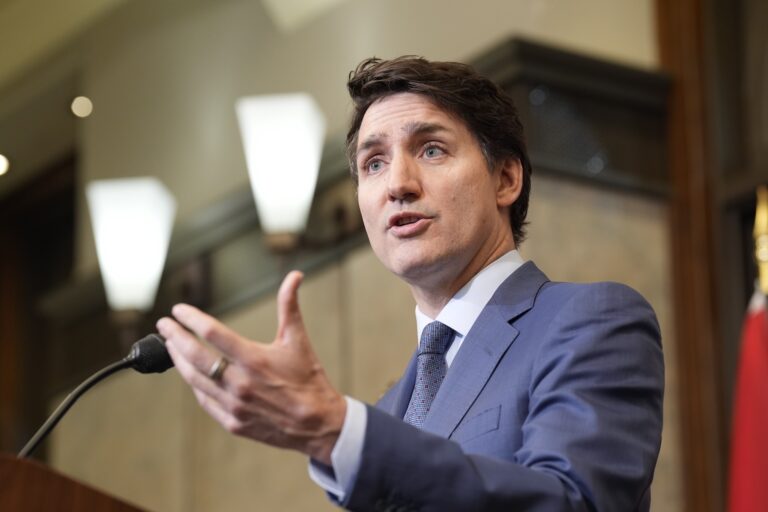
Prime Minister Justin Trudeau holds a news conference in Ottawa Tuesday after the U.S. imposed tariffs. Foreign Affairs Minister Melanie Joly, Finance Minister Dominic LeBlanc and Public Safety Minister David McGuinty look on. Photo: The Canadian Press/Adrian Wyld
OTTAWA — Prime Minister Justin Trudeau promised not to back down from the potentially devastating tariff war Donald Trump has started with Canada, even as the U.S. president threatens to escalate it further.
Federal and provincial governments have spent weeks building an arsenal of countermeasures to respond to Trump’s 25 per cent tariff on Canadian goods. One minute after midnight Tuesday morning, Canada launched its first wave of counter tariffs in a bid to maximize the impact on Americans with as little pain for Canadians as possible.
Talking Points
- As the federal government imposed countertariffs on $30 billion worth of American goods, with more to follow, provincial leaders said they’re looking to get out of contracts with American vendors
- Ontario’s Doug Ford and Quebec’s François Legault said they’re prepared to deploy billions of provincial dollars to redesign their economies away from dependence on the United States
Federal and provincial governments have spent weeks building an arsenal of countermeasures to respond to Trump’s 25 per cent tariff on Canadian goods. One minute after midnight Tuesday morning, Canada launched its first wave of counter tariffs in a bid to maximize the impact on Americans with as little pain for Canadians as possible.
“The excuse he’s giving for these tariffs today of fentanyl is completely bogus, completely unjustified, completely false,” Prime Minister Justin Trudeau said of Trump’s motives at a press conference on Parliament Hill Tuesday. “The one thing he has said repeatedly [is] that what he wants is to see a total collapse of the Canadian economy, because that will make it easier to annex us.”
Trudeau addressed Americans directly as he laid out the rest of Canada’s reprisal plans. “We don’t want to see you hurt,” he said. “Your government has chosen to do this to you.”
Ottawa’s first salvo includes 25 per cent tariffs on $30 billion worth of goods coming from the U.S., including orange juice, other groceries, cosmetics, alcohol and motorcycles. The federal government plans to follow that up with tariffs on another $125 billion worth of goods after a 21-day consultation period. That list targets more foods, electronics, steel, aluminum, electric vehicles, trucks and buses.
Less than an hour after Trudeau’s speech, Trump threatened to escalate the conflict.
Related Articles

“Please explain to Governor Trudeau, of Canada, that when he puts on a retaliatory tariff on the U.S., our reciprocal tariff will immediately increase by a like amount!” Trump said in a social media post, a reference to his repeated jab about making Canada the 51st state. The threat of escalation was also built into Trump’s Feb. 1 executive order related to the Canada-U.S. border.
Later Tuesday, in an interview with Fox Business, Commerce Secretary Howard Lutnick floated the possibility of some kind of settlement with Canada and Mexico, against which the U.S. also imposed tariffs Tuesday. “Both the Mexicans and the Canadians were on the phone with me all day today trying to show that they’ll do better. And the president’s listening, because he’s very, very fair and very reasonable,” Lutnick said. “So I think he’s going to work something out with them. It’s not going to be a pause—none of that pause stuff—but I think he’s going to figure out, you do more and I’ll meet you in the middle some way. And we’re going to probably be announcing that tomorrow.”
Lutnick cited the United States-Mexico-Canada Agreement (USMCA), the trade agreement Trump signed with Canada and Mexico in 2018, during his first term as president. “If you live under those rules, then the president is considering giving you relief. If you haven’t lived under those rules, well then you’ve got to pay the tariff.”
He also repeatedly invoked fentanyl, saying Trump would “give the Canadians and Mexicans something, but they’ve got to do more. They’ve got to end fentanyl deaths.” The U.S., Lutnick said, is fighting “a drug war. It’s not a trade war, it’s not a tariff war.”
“We won’t award contracts to people who enable and encourage economic attacks on our province and our country.”
Trudeau said he’s already in talks with provinces to pursue “non-tariff measures” if Trump won’t relent. Though he wouldn’t offer any specifics about what those might be, he said they would “demonstrate there are no winners in a trade war.”
“We will not back down from a fight, not when our country and the well-being of everyone in it is at stake,” he said.
In the meantime, Canada contends the U.S. tariffs violate the USMCA. Trudeau said his government will challenge the U.S. actions by filing dispute resolution claims at the World Trade Organization and through mechanisms outlined in USMCA.
Alberta Premier Danielle Smith, whose province’s oil flows mainly to American refineries and is subject to 10 per cent tariffs instead of 25 per cent, condemned the U.S. move. “This policy is both foolish and a failure in every regard,” she wrote on X. She offered support for the federal response, but is withholding any provincial action until tomorrow.
Other premiers did not hold back.
Canada and the United States could be working together to make themselves the richest and most secure countries on Earth, said Ontario Premier Doug Ford. “Unfortunately, one man, President Trump, has chosen chaos instead. Now we have no choice. We have to respond.”
Measures Ford promised a month ago, which he had paused, will kick in immediately, he said, in a news conference that veered between sadness and fury. Provincial liquor stores will not sell American alcohol and Ontario is again cancelling its $100-million contract with Elon Musk’s Starlink for internet services in remote areas.
“We won’t award contracts to people who enable and encourage economic attacks on our province and our country,” Ford said.
“We understand who is attacking us. We understand where this is coming from.”
Beyond that, he said U.S. companies are barred from Ontario government procurements, and he’s asked government officials to look for other contracts with American vendors the province can cancel.
“If they come at us—sue us—so be it,” Ford said.
Retailers should label Canadian and American products on their shelves so Canadians can make informed choices at a glance, and if they don’t do that voluntarily, the Ontario government will pass a law requiring it, he said.
Ontario is also ready to escalate, Ford warned. If the United States adds more tariffs on Canadian goods—as Trump and his cabinet have said they plan to—Ontario will add surcharges on electricity it exports to U.S. states. It’s also willing to do the same on critical mineral exports, and even to put “outright restrictions” on those exports, he said.
The province isn’t doing those things right away because “this is going to be a long battle, and we have to keep our ammunition dry for the next round,” he said.
In an interview with CNBC Tuesday, Smith ruled out retaliating using Alberta oil and gas, saying energy exports were essential for American consumers and businesses. In January, the federal government didn’t rule out restrictions on crude oil exports to the U.S., which Smith warned would spark a “national unity crisis” in Canada. Asked Tuesday whether export taxes on oil, gas or potash are among the non-tariff measures being considered, Trudeau said keeping Canadians united is “the most important thing,” even more than creating “effective pressure points on the United States.”
British Columbia Premier David Eby said public liquor stores in his province will yank American products from Republican states from the shelves. “We understand who is attacking us. We understand where this is coming from. We want to send a message particularly to those governors, to those congresspeople,” he said. He’s also directed the B.C. government and Crown corporations to buy from companies in Canada or outside the U.S.
In Quebec, Premier François Legault said American booze is coming off government stores’ shelves, too. U.S. companies will be allowed to bid on government contracts but will have their bids’ scores penalized by 25 per cent, in keeping with the U.S. tariff rates, Government Administration Minister Sonia LeBel said at Legault’s side.
“This is going to be a long battle, and we have to keep our ammunition dry for the next round.”
Legault talked less about provincial retaliation than Ford did—American companies depend on Quebec-made aluminum, he pointed out, and tariffs on such goods will hurt the U.S. plenty all by themselves, he said.
Quebec’s response will focus on rebuilding its economy away from U.S. customers. Economic players like Investissement Québec, the Caisse de dépôt et placement du Québec and Hydro-Québec give the province firepower it’s ready to use, he said.
In the end, there will be some kind of settlement, he believes.
“Our objective is still to try to reach a deal that is good for both—that is good for the Quebecois-Canadians and good for the Americans,” Legault said. Lots of Americans are worried about the tariffs, he said, and that’s something to work with.
Nova Scotia Premier Tim Houston took to the same microphone in Toronto after Ford finished (the Ontario premier warned him not to drink from the same water glass). The two have been a double act in the tariff fight lately, including travelling to governors’ meetings in Washington together.
Like Ontario and Quebec, Nova Scotia is pulling American alcohol from its liquor stores, banning American companies from bidding on new provincial contracts and looking to cancel existing ones. It’s also doubling tolls for U.S. commercial vehicles on the highway between New Brunswick (which has the nearest land border with the United States) and Halifax.
Trump’s policy is senselessly destructive, Houston posted earlier in the day. “Unfortunately, some people need to touch the hot stove to learn, and while we cannot control or predict their behaviour, we can control how we respond.”
With files from Joanna Smith in Ottawa



Loading...
Thanks for sharing!
You have shared 5 articles this month and reached the maximum amount of shares available.
CloseThis account has reached its share limit.
If you would like to purchase a sharing license please contact The Logic support at [email protected].
CloseGift the full article!
You have gifted 0 article(s) this month and have 5 remaining.
Recipients will be able to read the full text of the article after submitting their email address. They will not have access to other articles or subscriber benefits.
Photo: The Canadian Press/Adrian Wyld
Most Popular This Week




In-depth, agenda-setting reporting
Great journalism delivered straight to your inbox.
News
Coinbase wants to put bots on the blockchain
Briefing
Canadian businesses want Ottawa to hold out for a better U.S. trade deal: KPMG survey
Online banks are attracting younger Canadians, report shows
Lightspeed cuts 250 jobs through layoffs and attrition
Best business newsletter in Canada
Get up to speed in minutes with insights and analysis on the most important stories of the day, every weekday.
Exclusive events
See the bigger picture with reporters and industry experts in subscriber-exclusive events.
Membership in The Logic Council
Membership provides access to our popular Slack channel, participation in subscriber surveys and invitations to exclusive events with our journalists and special guests.