Automotive leaders have warned that U.S. tariffs on Canadian goods could be as bad or worse for autoworkers than the COVID-19 pandemic, which left plants completely idle.
Skip to content

Analysis
Here’s how tariffs will bring North America’s auto industry to a standstill
Insiders warn car plants could start shutting down within five days, doing more damage than COVID-19
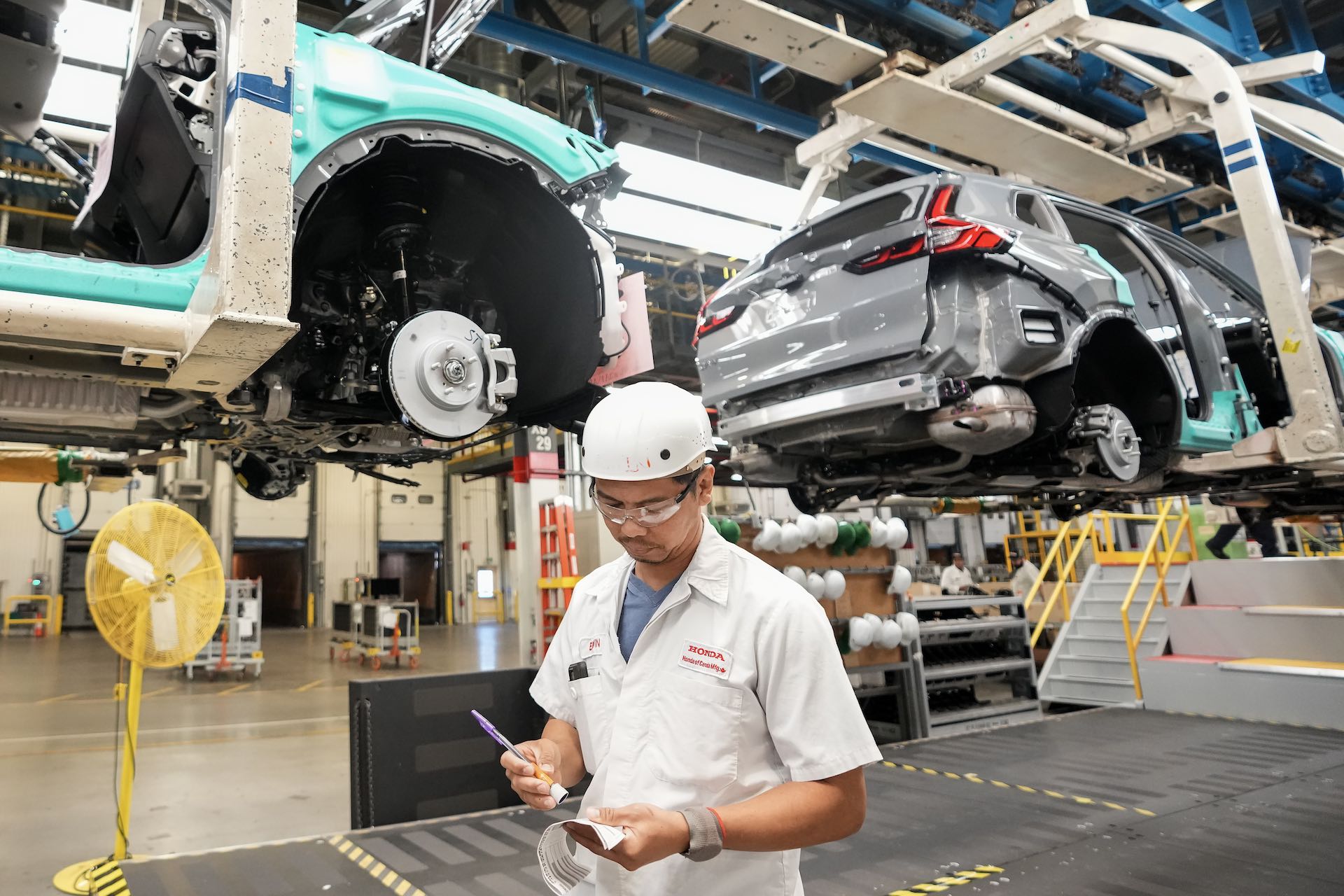
A Honda worker at the company's assembly plant in Alliston, Ont. Honda denied White House claims it changed manufacturing plans to account for U.S. tariffs. Photo: The Canadian Press/Nathan Denette
Automotive leaders have warned that U.S. tariffs on Canadian goods could be as bad or worse for autoworkers than the COVID-19 pandemic, which left plants completely idle.
That’s because bumping up costs by 25 per cent at each step of the automotive supply chain would wipe out thin margins typical in the industry and exceed the budgets to purchase necessary parts.
Talking Points
- The auto industry has been singled out as a vulnerable field that could be all but shut down by tariffs due to its deep cross-border integration and reliance on just-in-time manufacturing
- Leaders in the sector have called for Canada to remove internal trade barriers and redundant regulations as a form of relief
The White House has claimed the mere threat of universal tariffs on goods sold to Americans from Canada and Mexico—a threat it made good on Tuesday—has already prompted repatriation of automotive manufacturing to the U.S. The auto industry, though, isn’t so sure it can bear the cost of retooling all its plants while paying the steep new levies.
“These tariffs must be removed as quickly as possible if we are to avoid permanent and significant damage to the North American automotive sector,” said David Adams, president and CEO of Global Automakers of Canada on Tuesday. That group counts Volkswagen, Toyota and Honda as members.
“This will undo over 60 years of integration,” said Brian Kingston, president and CEO of the Canadian Vehicle Manufacturers’ Association, which represents Ford, Stellantis and General Motors.
Here is why a shutdown in the auto industry could be a unique economic blow for North America—and what Canada can do to soften it.
Over a century to set up. A month to tear down?
Related Articles


On Monday, the White House touted Trump’s policies in convincing Honda to make its next hybrid Civic in Indiana instead of Mexico, as well as new U.S. investments by Clarios, a battery maker owned by Brookfield and backed by the Caisse de dépôt et placement du Québec.
Honda Canada, which has said since at least January that it would build the vehicle in both Alliston, Ont. and Greensburg, Ind., refused to comment on the claim, saying it had announced no changes to its Civic manufacturing plans, and that Honda has “the flexibility to produce products in each region based on customer needs and market conditions.”
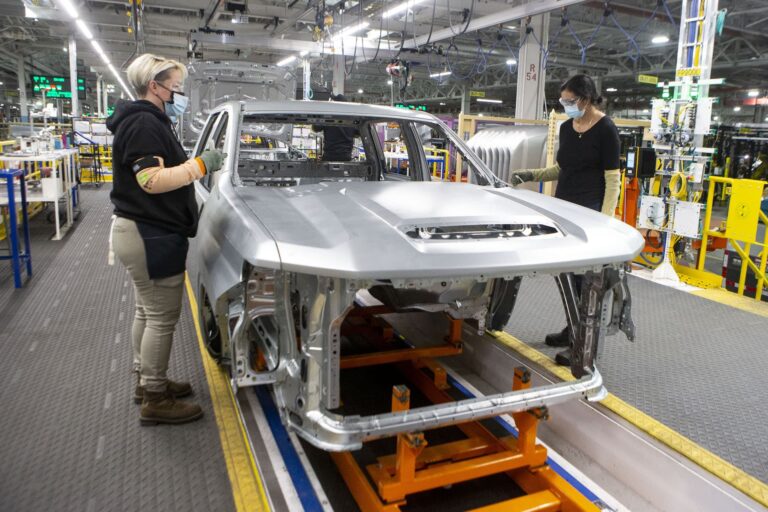
Moving manufacturing is easier said than done. General Motors first entered Canada in 1907 when it bought an all-Canadian car company, McLaughlins, and today makes Silverado trucks, V8 engines and BrightDrop electric vans here. To unravel the supply chain it has built since would require billions of dollars, said GM’s chief financial officer, Paul Jacobson, at a conference last month. The automaker has already cut 30 per cent of its inventories at international plants since November to stay lean in the face of tariffs. But its fastest retool ever, which was here in Canada, took nearly two years.
“If they become permanent, then there’s a whole bunch of different things that you have to think about in terms of where do you allocate plants? And do you move plants?” he said. “As the market is pricing in a big impact of tariffs and lost profitability, think about a world where, on top of that, we’re spending billions of capital—and then it ends. So we can’t be whipsawing the business back and forth.”
Complicating things has been mixed messaging toward the industry from the White House. Earlier suggestions there could be a tariff carve-out for cars were dashed after meetings last week between U.S. automakers and Commerce Secretary Howard Lutnick, who reportedly left the companies unsure what the administration planned to do.
Economic shock
Ontario Premier Doug Ford warned Monday that the tariffs would hurt both the U.S. and Canadian economies, especially in the auto industry, while promising countermeasures.
“You come at us, we aren’t rolling over,” Ford said in a press conference. “Sure, we’re gonna get hurt. There’s no doubt. But they’re gonna get hurt just as much when they start closing the auto plants. The supply will last five days before plants close on both sides of the border.”
The trade relationship between the U.S. and Canada is pretty balanced when it comes to vehicles. And a big reason for the expected near-immediate shutdown is just-in-time manufacturing, according to Kingston.
Since manufacturers must buy materials before they can make a product for market, they minimize inventory during uncertain times—and those supply-chain decisions have already been “paralyzed by concerns over the applicability and size of tariffs in the coming months,” according to economists at S&P Global Market Intelligence, which released its monthly reading of manufacturing purchasing data on Monday.
However carmakers respond, the impact will be widely felt due to the powerful multiplier effect in auto-factory towns. Auto plants, after all, must be big in order to be profitable: the 78 in North America produce about 20 million vehicles when running at 85 per cent capacity, requiring large numbers of nearby residents as employees.
“Consider an auto plant that experiences reduced demand and is forced to lay off workers. These workers, in turn, are less likely to then go to restaurants, movie theatres,” RBC economists Frances Donald and Nathan Janzen wrote in a research note last month. “This ripple effect leaves a variety of non-tariffed industries exposed to the broader economic shock.”
Damage control
Lobbyists representing Canada’s auto industry have pushed for a variety of supports, starting with eliminating requirements that a certain percentage of their sales be zero-emissions vehicles.
Kingston has previously said that automakers face multiple levels of emissions rules and “producer responsibility” environmental regulations at the provincial and national levels that could be harmonized. He also said it is difficult for many skilled trades to move to different provinces, and that more east-west delivery of electricity would improve manufacturing conditions.
Tensions on the ground
Canadian companies that have been bracing for the tariffs say their relationships with local communities in the U.S. and Mexico are strong. But Rob Wildeboer, the executive chair of Vaughan, Ont.,-based auto-parts supplier Martinrea, said in an interview last month that “a lot of Americans are not happy with the way Canadians have acted in a lot of ways.” The Canadian government has blocked foreign investments and asked companies from other countries to do a lot of legwork on environment, social and governance issues, while appearing to make little progress on those issues within its own borders, Wildeboer said. “We’ve got to stop preaching to the world,” he said, “because quite frankly, we got a lot to fix ourselves.”
Still, Wildeboer said, many of Martinrea’s operations are close to the biggest manufacturing hubs in the U.S. because it’s costly to ship the large parts it makes over long distances. So if auto manufacturers start shuffling where they make various models, the company can adjust to serve them, he said. “I think it will change less than you would think,” Wildeboer said, adding, “I think we’ll be in pretty good shape.”



Loading...
Thanks for sharing!
You have shared 5 articles this month and reached the maximum amount of shares available.
CloseThis account has reached its share limit.
If you would like to purchase a sharing license please contact The Logic support at [email protected].
CloseGift the full article!
You have gifted 0 article(s) this month and have 5 remaining.
Recipients will be able to read the full text of the article after submitting their email address. They will not have access to other articles or subscriber benefits.
Photo: The Canadian Press/Nathan Denette
Most Popular This Week




In-depth, agenda-setting reporting
Great journalism delivered straight to your inbox.
News
Canada faces a satellite-launch crunch as SpaceX retires its workhorse rocket
Briefing
Rio Tinto gets nearly $165M in additional federal funds for Quebec aluminum
U.S. to lift tariffs on some Canadian products crucial to Maine: Collins
Carney warns of tech dependence after Starlink disruptions in Ukraine
Best business newsletter in Canada
Get up to speed in minutes with insights and analysis on the most important stories of the day, every weekday.
Exclusive events
See the bigger picture with reporters and industry experts in subscriber-exclusive events.
Membership in The Logic Council
Membership provides access to our popular Slack channel, participation in subscriber surveys and invitations to exclusive events with our journalists and special guests.