OTTAWA—Prime Minister Mark Carney unveiled his new team of cabinet ministers, intended to signal a sea-change on major economic files and a departure from former prime minister Justin Trudeau’s version of the Liberal government.
Skip to content


Special Report
What Mark Carney’s cabinet picks say about his plans for Canada’s economy
PM brings fresh faces to natural resources, immigration and AI, but hangs on to mainstays like Freeland and Champagne
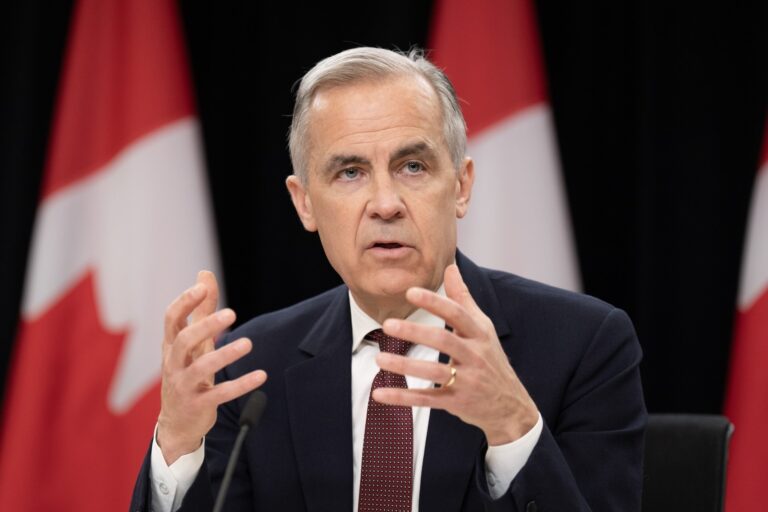
Prime Minister Mark Carney appointed 15 new faces to his inner cabinet, but kept on Liberal stalwarts such as Anita Anand and François-Philippe Champagne. Photo: The Canadian Press/Christinne Muschi
OTTAWA—Prime Minister Mark Carney unveiled his new team of cabinet ministers, intended to signal a sea-change on major economic files and a departure from former prime minister Justin Trudeau’s version of the Liberal government.
Carney appointed 15 new faces to his inner cabinet circle of 28 ministers, and created 10 new roles for junior ministers that he calls “secretaries of state”—a convention not used since Stephen Harper was prime minister. Several of the appointees are new not only to cabinet but to federal politics. Many of Trudeau’s stalwart ministers remain in, however, including Trudeau’s former deputy prime minister Chrystia Freeland.
Talking Points
- Mark Carney’s new cabinet keeps Trudeau-era ministers in some key positions, especially when it comes to dealing with the United States, but puts rookie ministers—even rookie MPs—on many economic files, such as natural resources
- Mélanie Joly moves from Foreign Affairs to Innovation, and despite Carney’s decision to create a second tier of junior “secretaries of state,” ex-journalist Evan Solomon becomes a full minister in charge of artificial intelligence and digital innovation
“Our government will deliver its mandate for change with urgency and determination,” Carney said at a press conference outside of Rideau Hall in Ottawa. “We’re going to deliver that mandate with a new team, purpose built for this hinge moment in Canada’s history.”
Long-time cabinet ministers like Jonathan Wilkinson, who served on Trudeau’s front bench since 2018 (most recently as natural resources minister), departed. Also out: former defence minister Bill Blair, former housing minister Nathaniel Erskine-Smith (who changed his mind about quitting federal politics when Trudeau offered him that post), and Ginette Petitpas Taylor, a utility player from New Brunswick.
Carney set an ambitious agenda for his new team during the election campaign, promising nothing less than the “biggest transformation” of Canada’s economy since the Second World War, with a focus on “nation-building” projects and shielding workers and businesses from effects of the trade war.
Here’s what—and who—you need to know.
Canada, the United States and the world
The ministers: Dominic LeBlanc, the latest Liberal “minister for everything,” takes the lead on Canada-U.S. relations. Anita Anand, who reversed her decision to leave politics earlier this year, becomes minister of foreign affairs. Maninder Sidhu, who ran a customs brokerage business before being elected in 2019, is the new international trade minister.
Related Articles

To do: Negotiating a new Canada-U.S. relationship, which dominated the election campaign that kept the Liberals in power, remains a top priority after Carney emerged from the White House with no assurance of additional relief from layers of U.S. tariffs on Canadian goods. Though LeBlanc will lead that file, Carney said he will ultimately be responsible for the relationship with the White House. As for the rest of the world: Anand and Sidhu will need to address ongoing tensions with China, while Sidhu will lead efforts to seek new or expanded markets for Canada’s exports, including by resuming trade talks with the United Kingdom. Next month’s G7 summit in Kananaskis, Alta., could be a chance for Carney and his ministers to make their mark on the world stage at a time of shifting geopolitics. Making Randeep Sarai the secretary of state for international development, rather than giving that portfolio a full minister, hints at shifting priorities, too.
Challenges: The United States-Mexico-Canada Agreement (USMCA) is up for review by July 2026. Trump has been noncommittal about its future, while signalling he will drive a hard bargain on everything from Canada’s supply-managed dairy sector to defence spending. Meanwhile, Canada’s decision to follow the U.S. in slapping steep duties on Chinese electric vehicles, steel and aluminum last year sparked retaliatory tariffs from Beijing that are damaging Saskatchewan’s $20-billion canola industry. Trade talks with India have been on ice for years.
Industry and Artificial intelligence and digital innovation
The ministers: Mélanie Joly, previously on the front lines of the trade war as foreign affairs minister, takes over as industry minister and will be responsible for key innovation programs. Carney also created a new role dedicated to AI and digital innovation, which will be handled by Evan Solomon. He was a regular on Parliament Hill as a journalist for CBC and CTV before working in talk radio and a consultancy role.
To do: Carney’s ambition to transform Canada’s economy extends to the innovation sector, with plans to keep home-grown ideas from migrating abroad and drawing more private-sector investment to Canadian research, development and production. “We are at the start of an industrial transformation, a transformation of this economy,” Carney said. “Madame Joly, as minister of industry, is going to help lead that.”
Challenges: A cornerstone of the industry minister’s job is to make deals, attract foreign investment and jobs to Canada, while nurturing domestic startups. While Joly has plenty of experience as Canada’s chief diplomat, the uncertainty brought on by U.S. tariffs makes her new task especially challenging. Carney has already warned that the private sector typically retreats in a crisis, and the federal government will have to step in with aggressive spending to encourage private investment. The prime minister has promised to see through reforms to signature innovation programs like the scientific research and experimental development tax incentive program, which the Liberals pitched in the last fall economic statement, but have fallen short of the overhaul members of Canada’s tech sector called for.
Carney has bemoaned Canada falling behind on artificial intelligence, and heralded it as a tool to modernize Canada’s economy and create a more productive public service. Past attempts to integrate AI into government operations have sparked warnings that using it to screen immigrants, for example, could infringe on their rights. The previous government was set to implement a new strategy this year. Broader attempts to legislate the use of AI in Canada were shelved in January when Trudeau announced his resignation and prorogued Parliament, but could be revived as part of Solomon’s new portfolio.
Natural resources and energy, and Environment and climate change
The ministers: Tim Hodgson and Julie Dabrusin. Hodgson is a rookie MP from the Toronto suburbs, but he and Carney have known each other for a long time; Hodgson is a former head of Goldman Sachs Canada, where Carney cut his teeth, and advised Carney when the now-prime minister was governor of the Bank of Canada. Dabrusin, a lawyer who represents Toronto-Danforth, was elected with Trudeau’s majority wave in 2015 and is getting her first cabinet post, but she spent more than three years as parliamentary secretary to both the natural resources and environment ministers.
To do: Building a bigger, cleaner, less U.S.-dependent economy while defending what we have from the Trump administration is Carney’s overarching promise. Mining minerals, generating energy, producing goods and shipping them out are key.
Carney scrapped the consumer carbon tax on his first day as prime minister, despite oodles of his own writing laying out why he thinks carbon pricing is the most economically efficient way to reduce greenhouse-gas emissions. The Liberal platform promised to replace the tax with a range of more technical policy pushes, such as requiring climate risk disclosures and imposing a “carbon border adjustment mechanism”—essentially a tariff on goods from dirtier producers.
Challenges: Canada is notoriously slow at approving, or even just definitively rejecting, major resource projects and the reasons for that have not gone away.
Carney said he’ll keep the federal Impact Assessment Act—which the Conservatives derided as the “No More Pipelines Act”—though his government wants to make sure projects require only provincial or federal assessments, not both. The new federal approvals process is supposed to take a maximum of two years, down from five.
Consulting and securing agreements with Indigenous groups on major projects is a constitutional requirement affirmed repeatedly by the Supreme Court, and not easily rushed.
So, here’s the daunting task for the two ministers from the GTA: make decisions faster, see that more of those rulings are yeses and do both in a way that doesn’t spark major protests or court challenges. Also, continue cutting greenhouse gas emissions without using the tool Carney thinks is best.
Finally, don’t give Alberta Premier Danielle Smith or Saskatchewan Premier Scott Moe ammunition for an internal fight while Canada’s trying to present a united front to the rest of the world.
Defence
The minister: David McGuinty. A longtime MP named to cabinet as public safety minister last winter, when Trump said his main beef with Canada was fentanyl, McGuinty brings with him years as chair of the national security and intelligence committee of parliamentarians.
To do: Get defence spending to two per cent of GDP by 2030. Boost the Canadian military presence in the Arctic, including by building new facilities in some of the harshest and most remote places on Earth. Fix recruiting. Fix defence procurement by creating a new agency to oversee it. (McGuinty gets a secretary of state, Stephen Fuhr, to assist with that.) Figure out what to do about the U.S.-made F-35 fighter jets we’re supposed to spend billions on, possibly to negligible domestic benefit.
Challenges: The navy is in a bad state. The air force’s main planes are failing. The army is short of troops and rethinking itself. Increasing defence spending is easy—plenty of people and companies that will be happy to take more federal money. Getting useful things for the dollars is the hard part.
Canada’s slow procurements of military equipment have been a problem that has stymied multiple ministers from both Conservative and Liberal parties. That was when we had a firm ally and supplier to the south, rather than a country whose reliability is in doubt.
Immigration
The minister: Lena Metlege Diab held this portfolio at the provincial level in Nova Scotia. She was also the province’s first woman to serve as justice minister and attorney general. Born in Halifax, Diab moved to Lebanon as a child before returning to Canada due to Lebanon’s civil war. She speaks English, French and Arabic and has represented the federal riding of Halifax West since 2021.
To do: The Liberal platform pledged to cap the number of temporary foreign workers and international students admitted to Canada to under five per cent of the population by 2027. It also aims to keep the number of new permanent residents below one per cent after that year. The Liberals promised to rework the Global Skills Strategy—a fast-track program created in 2017 that allows Canadian employers to hire international candidates—to attract talent from the United States.
Challenges: The number of people claiming asylum at the border crossing at Saint-Bernard-de-Lacolle, Que., south of Montreal, has been rising after Trump moved to revoke the legal status of hundreds of thousands of Cubans, Haitians, Nicaraguans and Venezuelans living in the U.S. Meanwhile, analysis by The Logic suggests profiting from a U.S. brain drain might be harder than anticipated.
Not going anywhere
François-Philippe Champagne will remain as Carney’s finance minister, and must quickly scramble together a spring budget that is likely drastically different from the one the department had been preparing for Justin Trudeau months earlier. While Carney is content to run deficits to buttress the economy in a time of crisis, he has promised to balance the day-to-day cost of running the government within just a few years.
Freeland will remain as minister of both transport and internal trade—roles that Carney gave her in March after he replaced Trudeau as prime minister. She has a lot to do on internal trade and little time to do it, as Carney promised to introduce legislation by July 1 to remove any remaining barriers to internal trade within federal jurisdiction.
Steven Guilbeault keeps the Canadian identity portfolio, which will involve grappling with global tech giants. Meta, Alphabet and their many subsidiaries often fall under the purview of Canadian Heritage due to the department’s oversight of communication and broadcasting. Carney removed Guilbeault from the environment portfolio earlier this year amid resentments in Western Canada about his approach to oil and gas, the transition to renewable energy and other green policies under Trudeau.
Other notables
Joël Lightbound, a Quebec MP who publicly broke with Trudeau over many things but remained in the Liberal caucus, becomes the minister of government transformation, public works and procurement, in charge of making the public service more efficient. This is a big part of Carney’s fiscal plan, which counts on major savings from digitization and applying artificial intelligence to balance the operating budget.
The new health minister, Marjorie Michel, is a rookie MP but was one of Trudeau’s deputy chiefs of staff and was elected in his former riding, Papineau. She gets responsibility for funding health research—perhaps taking advantage of the Trump administration’s cuts—advancing public pharmacare and dental care, and cajoling the provinces into cooperating on digitizing health records.
Housing Minister Gregor Robertson, a former Vancouver mayor, gets responsibility for a new federal agency to build homes itself, after the Liberals have spent years trying to use federal policies and money to get municipal and provincial governments to make building easier for the private sector.



Loading...
Thanks for sharing!
You have shared 5 articles this month and reached the maximum amount of shares available.
CloseThis account has reached its share limit.
If you would like to purchase a sharing license please contact The Logic support at [email protected].
CloseGift the full article!
You have gifted 0 article(s) this month and have 5 remaining.
Recipients will be able to read the full text of the article after submitting their email address. They will not have access to other articles or subscriber benefits.
Photo: The Canadian Press/Christinne Muschi
Most Popular This Week




In-depth, agenda-setting reporting
Great journalism delivered straight to your inbox.
News
Tech firms want AI models to create better versions of themselves
Briefing
Lightspeed cuts 250 jobs through layoffs and attrition
Oil tycoon Adam Waterous aims to build new Canadian energy player with US$1B fund
Data centre infrastructure firms 3C and Datalec merge, plan Calgary expansion
Best business newsletter in Canada
Get up to speed in minutes with insights and analysis on the most important stories of the day, every weekday.
Exclusive events
See the bigger picture with reporters and industry experts in subscriber-exclusive events.
Membership in The Logic Council
Membership provides access to our popular Slack channel, participation in subscriber surveys and invitations to exclusive events with our journalists and special guests.