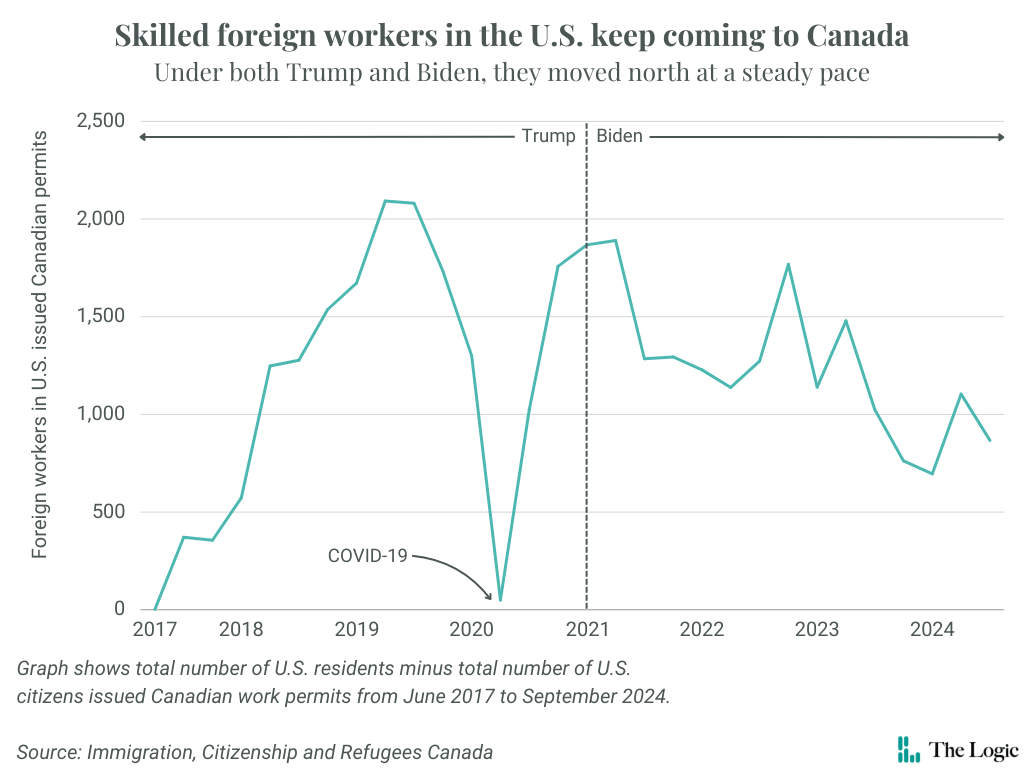
TORONTO — Skilled foreign workers were just as likely to leave the U.S. for Canada under President Joe Biden as they were during the first term of President Donald Trump, according to an analysis of data by The Logic.
Skip to content


News
Canada’s tech sector never actually got a Trump bump
Anti-immigration policies during U.S. President Donald Trump’s first term were predicted to send tech workers pouring into Canada. New data tells a different story.
Immigration lawyers say the trend is driven not by who is in the White House, but by the challenges many foreign workers face to stay in the U.S. Photo: The Canadian Press/Don Denton
TORONTO — Skilled foreign workers were just as likely to leave the U.S. for Canada under President Joe Biden as they were during the first term of President Donald Trump, according to an analysis of data by The Logic.
Trump’s immigration policies during his first term had prompted a slew of predictions and media reports of foreign tech talent moving north. Instead, skilled foreign workers in the U.S. applied to come to Canada at a steady pace over the last four years of the Biden administration.
Talking Points
- Canada attracted as many highly-skilled foreign workers from the U.S. during President Joe Biden’s administration as in the first term of President Donald Trump, The Logic’s analysis of work permit data shows
- The federal immigration department accepted applications from 38,074 U.S. residents but just 2,181 U.S. citizens between June 2017 and September 2024. Immigration lawyers say the trend is driven not by who’s in power in Washington, but challenges with the H-1B and green card programs.
Immigration lawyers say the trend is driven not by who is in the White House, but by the challenges many foreign workers face to stay in the U.S. via oversubscribed visa programs and narrow pathways to permanent status. “The U.S.’s loss with H-1Bs is Canada’s gain,” said Henry Chang, a Toronto-based partner at Dentons.
The data analysed by The Logic focuses on the Global Skills Strategy (GSS) program, a fast-track initiative launched in June 2017 to let Canadian employers hire international candidates for professional roles.
Between June 2017 and September 2024, Canada’s federal Immigration Department issued work permits to 38,074 residents of the U.S., according to figures provided to The Logic. Over the same period, it approved applications for just 2,181 U.S. citizens, meaning the vast majority of those greenlit to move north were foreign workers.
The Immigration Department approved 17,076 such applications between June 2017 and December 2020 in the first Trump term, and 18,817 between January 2021 and September 2024 while Biden was in office. While volumes dropped significantly during the first COVID-19 lockdown in early 2020, they swiftly recovered.
Related Articles


Ottawa established the GSS in response to longstanding complaints from businesses, particularly tech startups, that long work-permit processing times were costing them talent. The program promises two-week turnarounds to issue documents for certain applicants, including those filling in-demand computer engineering and software development roles.
Between June 2017 and September 2024, skilled foreign workers leaving the U.S. for Canada represented about a fifth of the 158,415 people to whom the immigration department issued work permits. Many are likely from India or China, with far more citizens than residents of each country—32,531 and 4,106, respectively—counted in the GSS data. That’s also consistent with the factors sending people north.
Staying in the U.S. long term isn’t easy for foreign workers. “There is a shortage of the most common type of work visa, which is the H-1B,” said Audrea Golding, a San Jose, Calif.-based partner at Fragomen. The program is capped at 65,000 people per fiscal year, and candidates are chosen by lottery.
Silicon Valley firms can recruit international students out of U.S. universities’ science and engineering programs on short-term permits, but must eventually put them up for the H-1B. When workers don’t win visas, employers often try to move them to Canada instead, said Golding. “The primary driver is wanting to be in the same timezone, or at least in the North American market.”
Most foreign workers in the U.S. need employer support to apply for permanent residence, and the immigration system limits citizens of any country to just seven per cent of green cards issued every year. Indian workers can wait over a decade for their chance, while their Chinese peers are also put on hold for several years. Left in limbo, some look to Canada instead. “That’s why there’s a lot of movement of tech workers [from] the U.S.,” Dentons’ Chang said. “They’re getting fed up with the wait.”
Canada has historically offered a shorter and more straightforward path to permanent residency. Tech workers already in the country typically make good candidates under Canada’s points-based system, and don’t need employer backing. There are no nationality-based caps, and people typically qualify within a couple of years. “That’s a real selling point,” said Chang.
Business and political leaders have even gone south to make the sell. “Canada has certainly marketed itself as a great place for people to come as an alternative, as it was seeking to build up its own tech sector,” Goulding said.
Canada’s tech sector made that message loud and clear during Trump’s first term. In January 2017, after Trump imposed a travel ban on people from Muslim-majority countries, hundreds of Canadian tech founders and executives signed an open letter calling for the federal government to give those affected a way to come to Canada. As the Trump administration made immigration harder, they encouraged tech workers to make the move north via social media posts and billboards in Silicon Valley.
The world took notice, with major media outlets publishing a series of similar stories about engineers swapping the U.S. for Canada. The movement continued largely uncovered after Trump left office, as H-1B and green card issues persisted. Canadian attitudes are now shifting, and the federal government is moving to reduce both the number of temporary residents in the country and levels of new permanent residents admitted. Some of the same executives who welcomed foreign workers north a few years ago are now questioning Canada’s immigration policies.
Back in office, Trump is waging a trade war on Canada and taking an even more nationalist approach in his policies. But he has yet to make major moves targeting foreign tech workers in the U.S. The president “has taken almost every possible position on high-skilled immigration,” noted Julia Gelatt, associate director of the U.S. immigration policy program at the Migration Policy Institute, a think tank in Washington, D.C. His advisers, meanwhile, disagree on what to do about the H-1B visa program.



Loading...
Thanks for sharing!
You have shared 5 articles this month and reached the maximum amount of shares available.
CloseThis account has reached its share limit.
If you would like to purchase a sharing license please contact The Logic support at [email protected].
CloseGift the full article!
You have gifted 0 article(s) this month and have 5 remaining.
Recipients will be able to read the full text of the article after submitting their email address. They will not have access to other articles or subscriber benefits.
Photo: The Canadian Press/Don Denton
Most Popular This Week




In-depth, agenda-setting reporting
Great journalism delivered straight to your inbox.
News
A tech firm born from post-Brexit trade chaos sets its sights on Canada
Briefing
Dozens of Canadian researchers join chorus of scientists calling for a global AI oversight
TC Energy strikes deal with Indigenous groups for ownership stake in Coastal GasLink pipeline
Canada’s Tailscale taps Google Moonshot alum to lead sovereign AI push
Best business newsletter in Canada
Get up to speed in minutes with insights and analysis on the most important stories of the day, every weekday.
Exclusive events
See the bigger picture with reporters and industry experts in subscriber-exclusive events.
Membership in The Logic Council
Membership provides access to our popular Slack channel, participation in subscriber surveys and invitations to exclusive events with our journalists and special guests.





