Skip to content


 Sabrina Fiorellino, chief executive and co-founder of Fero International, which makes modular homes and buildings at a factory in Stoney Creek, Ont. Photo: Handout

Special Report
Canada can’t fix its productivity crisis without fixing housing first
The construction industry accounts for about seven per cent of Canada’s GDP. It might also be the country’s least productive industry.
Photo: Paul Kim for The Logic
The polycrisis means Canada’s economic immune system needs a boost as quickly as possible. The prescription could lie in a pattern that Italian polymath Vilfredo Pareto discovered more than 120 years ago, when Wilfrid Laurier was prime minister.
Talking Points
- This story is part of a series by The Logic that aims to advance the productivity debate by sifting through the ideas that are lying around after a year of exhaustive discussion
- The series looks at different parts of Canada’s economy, including the energy and tech sectors, and tackles some big issues, like the competition conundrum
- The series will conclude with a diagnosis of the problem and a sketch of a prescription
In the late 1890s, Pareto, an engineer who by then had impressed his way into a job as chair of political economy at the University of Lausanne, used math to show that 20 per cent of the population tended to own 80 per cent of the country’s wealth. The pattern—sometimes called the law of the vital few—was repurposed in the coming decades, and eventually became known as the Pareto Principle. Some say it’s a power law that applies to everything from the size of insurance claims to the number of baseball players who perform above replacement level. Universities coach students to focus on the 20 per cent of course work that will make up 80 per cent of their exams and course work. The Business Development Bank of Canada advises entrepreneurs to use an 80-20 analysis to get “quick wins.”
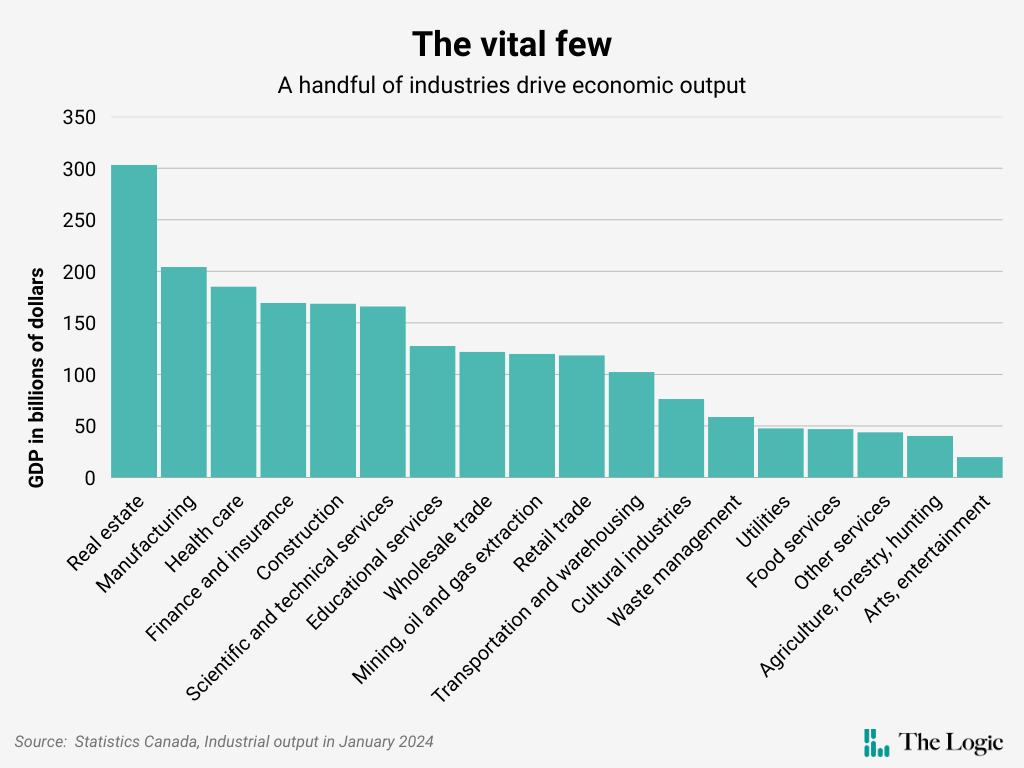
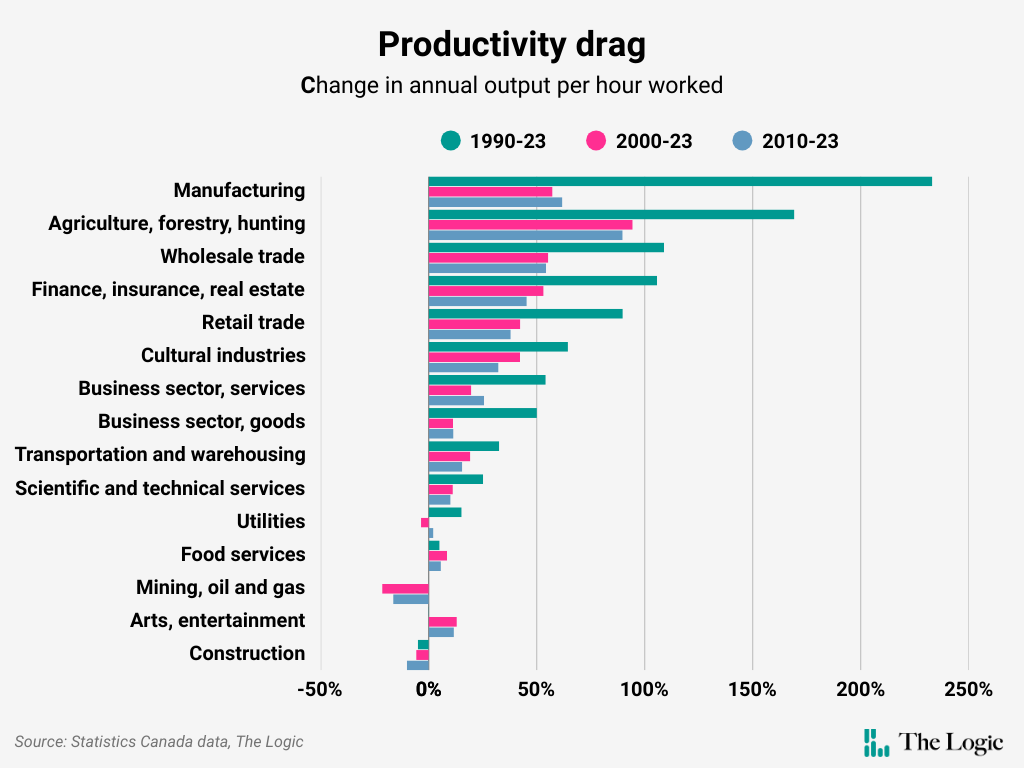
Canada’s productivity crisis has a Pareto distribution. A handful of industries account for an outsized amount of the country’s economic output, and a vital few are responsible for productivity growth going into reverse in recent years. The charts suggest policymakers could orchestrate some quick wins by focusing scarce resources on a few sectors. One stands out: construction, a key driver of the gross domestic product and perhaps the country’s least productive industry.
“Technology has advanced so much in our lifetimes, but the way we build buildings hasn’t changed,” said Sabrina Fiorellino, chief executive and co-founder of Fero International, which makes modular homes and buildings at a factory in Stoney Creek, Ont.
“We built the pyramids before any of us existed on Earth, and we can’t figure out how to do that,” Fiorellino quipped. “So in some ways I would say we’ve regressed in how we build. There is a massive opportunity to do better here.”
Resilient Canada
Canada has a productivity crisis. This series will unpack the problem and point toward solutions—because in a time of turmoil, a more productive Canada will be a more resilient Canada. Don’t miss the rest—follow this page for the upcoming stories.
Read more from the series:
- Most of you think Canada has a productivity crisis—but there’s hope it can be fixed soon
- It’s time to fix our productivity crisis
- Canada’s oil and gas industry is facing its own productivity crisis
- Canada can’t fix its productivity crisis without fixing housing first
- Looking for a reason for Canada’s productivity crisis? Blame Big Tech
- The rest of Canada could learn a thing or two from agriculture’s productivity boom
- Carmichael: Canada needs to unleash its entrepreneurs to fix its productivity crisis
- Event: How to fix Canada’s productivity crisis
One way to apply a Pareto analysis is to lean into what works. Tiger Woods became one of the most dominant golfers in history by perfecting his strengths, rather than using precious practice time to correct his one consistent weakness—hitting out of the rough. More accurate drives kept him away from trouble, and strong putting offset the potential damage from those times when his balls veered off course. Age and distraction caught up with Woods, but it’s hard to argue with the results when he was in his prime.
“You don’t become great by just fixing your weaknesses, you start by doubling down on your strengths,” Bank of Canada governor Tiff Macklem said in an interview with The Logic last year. Economist Bev Dahlby said something similar in a University of Calgary paper this year, insisting that “shifting resources, particularly labour, to higher value sectors is essential for driving productivity growth.”
But what would Woods have done if he sucked at putting? Following the path that Dahlby suggests too closely would risk becoming one dimensional, and maybe not in a good way. The real estate industry generates lots of wealth, but not the goods that will lead to the kind of investment that would make the economy more resistant to the kinds of shocks that will be coming. Charles St-Arnaud, chief economist at Alberta Central, has calculated that Canada spends as much on home renovations and homeownership transfer costs as it does on machinery, equipment and intellectual property.
“We’ve got to address some of our weaknesses,” too, Macklem said in that interview.
When it comes to generating business productivity, Canada’s most glaring weakness is construction; output per hour worked actually decreased between 1990 and 2023—and between 2000 and 2023, and 2010 and 2023, according to Statistics Canada data.
Tim Sargent, director of domestic policy at the Macdonald-Laurier Institute think tank, calculates that productivity growth in construction decelerated between 2020 and 2023, compared with its growth rate between 1998 and 2019. No other major industry suffered such a sizable decline, with the exception of transportation and warehousing.
The pace of productivity growth in manufacturing also dropped, according to Sargent. Combined, the three industries account for about 60 per cent of the drop in productivity over that period. If growth had held constant, overall productivity would have increased between 2020 and 2023, Sargent showed. Instead, it stalled.
Related Articles


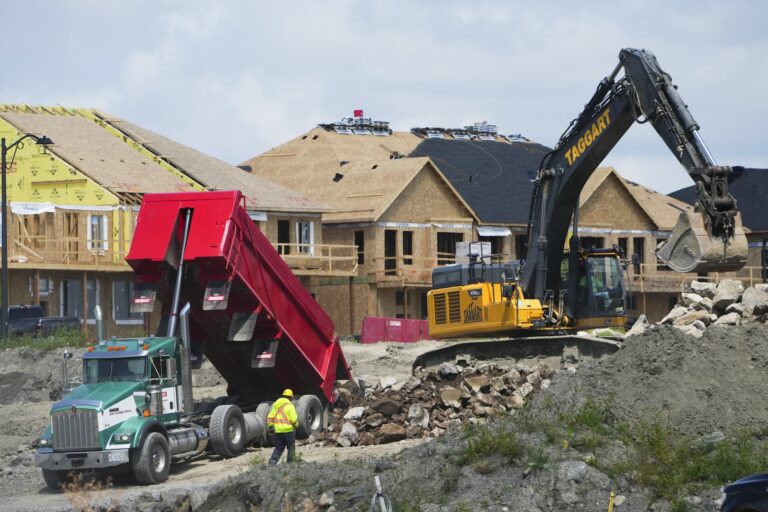
President Donald Trump’s desire to use tariffs to force more factory investment to the U.S. could expose weaknesses in manufacturing and transportation. The sorry state of Canada’s construction industry is already on full display. Politicians have been describing housing affordability as a crisis for years, and the federal government and the provinces have committed billions of dollars to increase supply.
Yet little changes. Former prime minister Justin Trudeau set a goal of building 3.87 million homes by 2031—a target that amounts to 550,000 units per year, more than double the current one-year record set in the 1970s. The six-month trend in housing starts decreased 0.7 per cent in March to 235,316 units, according to Canada Mortgage and Housing Corporation. “Our supply curve in Canada is very inelastic,” Michael Waters, chief executive of property developer Minto Group said in an interview with The Logic last year. “It’s not responsive to demand.”
Economists call that a market failure. Mathieu Laberge, senior vice president of housing economics and insights at Canada Mortgage and Housing Corporation (CMHC), estimates that Canada should be able to build around 400,000 homes a year with the resources we have—there were a record 650,000 people employed in homebuilding in 2023. Laberge says there could be 377,000 housing starts if we had historic productivity rates in construction, and 465,000 starts based on maximum levels achieved in the best performing municipalities.
Why is the rate of home construction half of that? The list of obstacles is long and familiar. The status gap between white-collar degrees and trade school has drained the labour pool of talented and experienced carpenters.
Regulation makes it hard to plan and keep projects on schedule. Unpredictability makes it hard to raise money to expand and invest. A lack of capital keeps the industry small and fragmented, creating long and fragile supply chains that rely on multiple contractors to complete single projects—or small outfits that are content to build one home per year. Technology could make a difference, but smaller companies can’t afford it.
And so on. The productivity problem is circular, so solving it means breaking the wheel. Fiorellino is trying. Fero International operates a 300,000-square-foot factory that is capable of building schools, hospitals and homes simultaneously on multiple lines. “In four months last year, we built 55 classrooms,” she said. “In seven months, we built an outpatient clinic for a hospital in Winnipeg.”
The company could do a lot more. Fiorellino wants to become the biggest maker of modular buildings in the world. First step: getting that massive factory running at capacity. Modular construction is cheaper and faster, yet Canada has been slow to embrace an approach to construction that’s widely used in Europe and Asia. It’s baffling, but Fiorellino has an explanation. “Why did the Roman Empire fall? Because they never had a crisis,” she said. “They sat like fat cats and did whatever they wanted for as long as they wanted without having to think about resilience.”
Modular homes won’t be the entire solution for all the pent-up demand for housing. But perhaps the first step to getting out of both our housing crisis and our productivity crisis is to start thinking differently about the problems.



Loading...
Thanks for sharing!
You have shared 5 articles this month and reached the maximum amount of shares available.
CloseThis account has reached its share limit.
If you would like to purchase a sharing license please contact The Logic support at [email protected].
CloseGift the full article!
You have gifted 0 article(s) this month and have 5 remaining.
Recipients will be able to read the full text of the article after submitting their email address. They will not have access to other articles or subscriber benefits.
Photo: Paul Kim for The Logic
Sabrina Fiorellino, chief executive and co-founder of Fero International, which makes modular homes and buildings at a factory in Stoney Creek, Ont.
Most Popular This Week




In-depth, agenda-setting reporting
Great journalism delivered straight to your inbox.
Commentary
Carmichael: Canadian ignorance about India is a strategic weakness
Briefing
Aritzia shares pop after earnings rise 204%
First Nation in Alberta goes to court over fast-tracked oil pipeline
Chinese EV maker Geely Auto Group to launch in Canadian market in 2027
Best business newsletter in Canada
Get up to speed in minutes with insights and analysis on the most important stories of the day, every weekday.
Exclusive events
See the bigger picture with reporters and industry experts in subscriber-exclusive events.
Membership in The Logic Council
Membership provides access to our popular Slack channel, participation in subscriber surveys and invitations to exclusive events with our journalists and special guests.