Listen Now
0:00
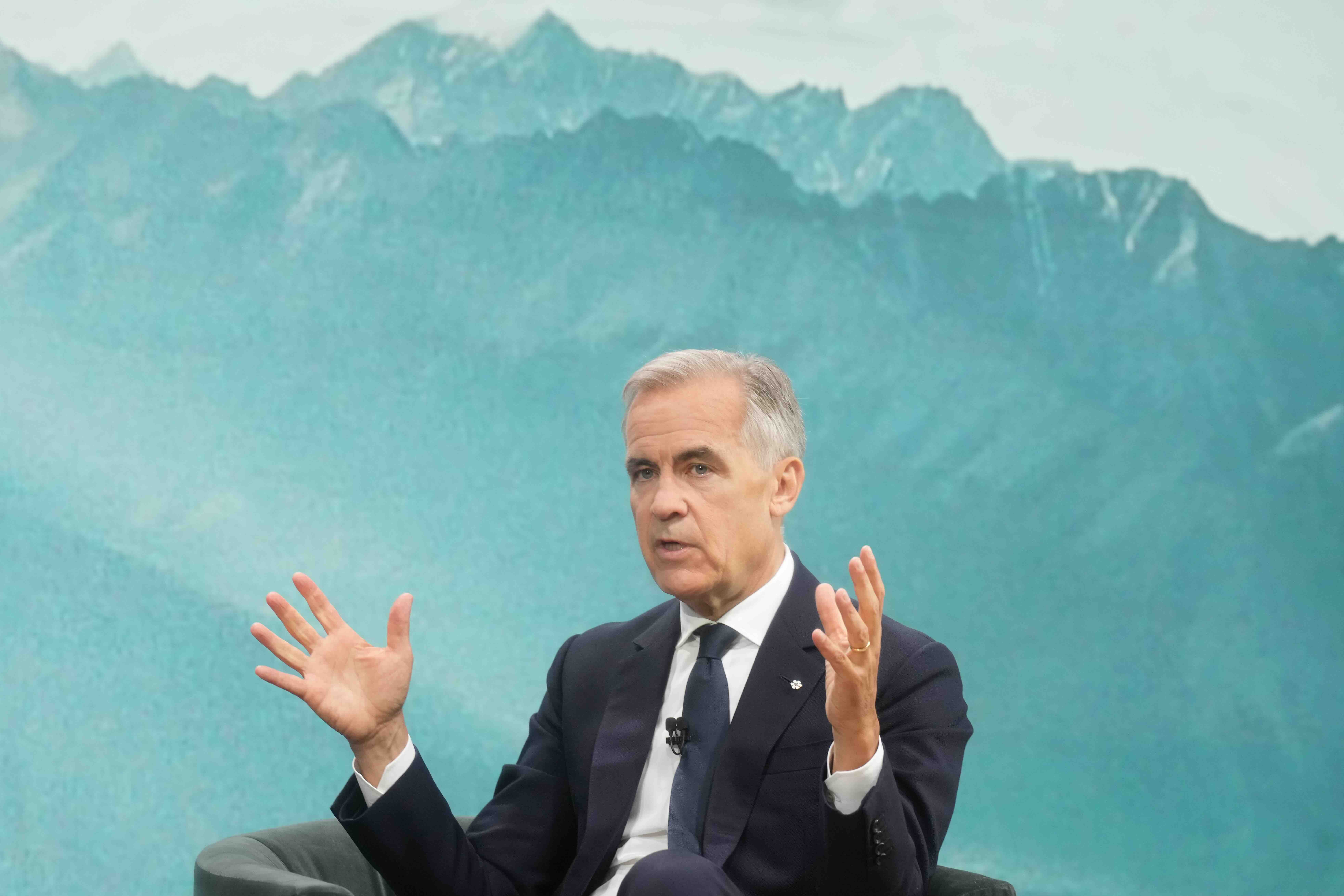
Canada has what the world wants, Prime Minister Mark Carney has been telling Canadians. On Monday and Tuesday in Toronto, at the Canada Investment Summit, he tried to get the world to buy it.
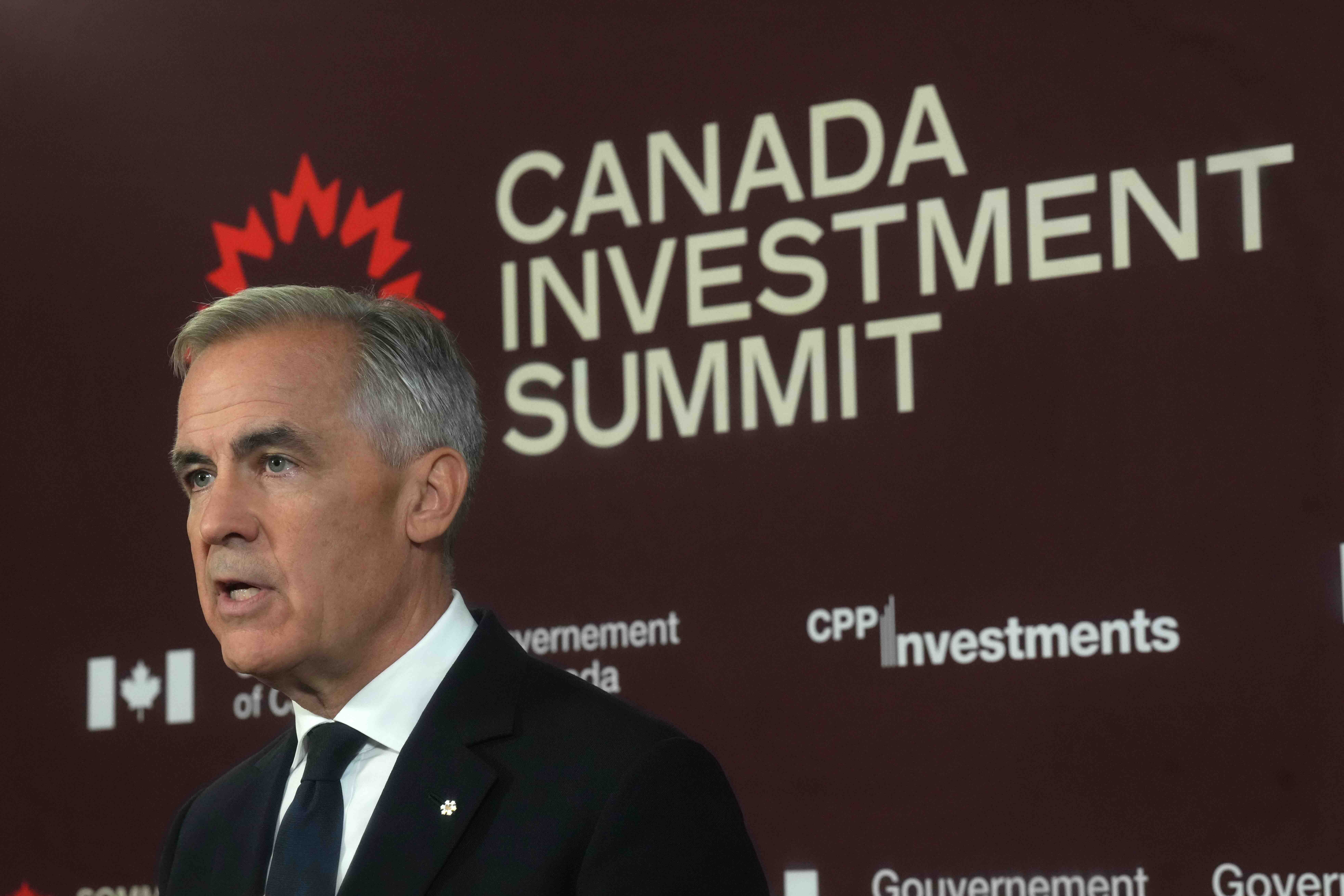
The gathering of global leaders and investors controlling a collective $120 trillion is part of Carney’s effort to “catalyze” $1 trillion in investments in the Canadian economy over the next five years. The summit was organized by the Prime Minister’s Office, the Canadian Pension Plan Investment Board and the Public Sector Pension Investment Board.
On Monday evening, Carney hosted a welcome dinner inside the Art Gallery of Ontario—a gathering beset by protesters objecting to building pipelines, selling public assets, and billionaires as a class.
Related Articles
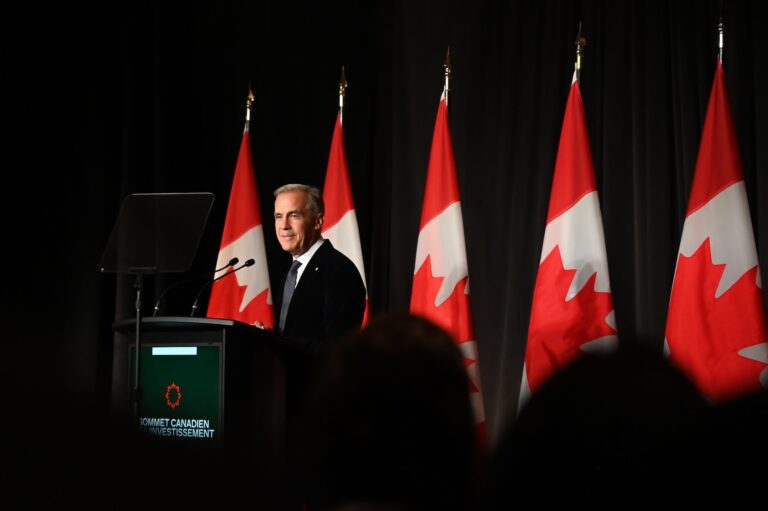

Tuesday, pension-fund bosses, sovereign wealth fund CEOs and executives from asset managers like Brookfield and Blackstone were arrayed hip-to-hip in seats before him in Yorkville’s Four Seasons hotel, with federal and provincial cabinet ministers sprinkled in the mix.
There was no room for entourages. A few grandees, like Finance Minister François-Philippe Champagne and Foreign Affairs Minister Anita Anand, slipped in late and stood at the back for lack of seats.
The message was straightforward: Canada has the resources, infrastructure and companies to absorb far more capital—and needs investors to start writing the cheques.
Carney, a former Goldman Sachs banker, central bank governor and Brookfield executive, knew his audience. After a sizzle reel of Canadian scenes—dogsled teams, mountains, forests, interspersed with construction projects and office towers—he took the dais Tuesday morning to drum up support for the wheeling and dealing he was hoping for.
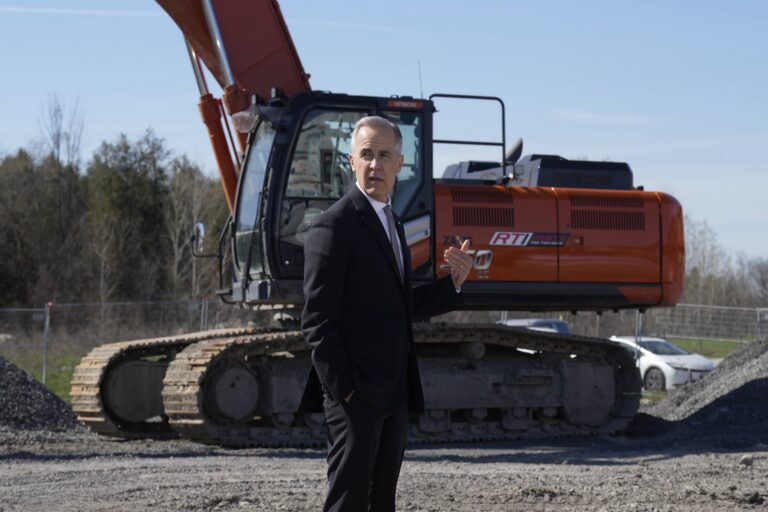
The federal government plans to contract out operations at four major airports, broaden a major investment tax writeoff and put a one-year deadline on approving or rejecting major project proposals, Carney announced.
The country’s four largest airports—in Toronto, Montreal, Vancouver and Calgary—will be put up for bids by investment groups that want to operate and profit from them. Canadian pension funds have been calling for this for years.
“We will reinvest the tens of billions of dollars of capital that we raise into infrastructure that Canada needs for the next generation,” Carney said.
That includes “a sovereign broadband backbone that connects Canadians from coast to coast to coast, with more direct and secure links to Europe and Asia,” he said.
The tax benefit, meanwhile, will cost about $36 billion in tax revenues over five years, according to a news release. The measure allows businesses to write capital expenses off against their tax bills all at once, as soon as a new asset is ready to use, instead of spreading the costs over an asset’s expected life.
“Your investment dollars will go a lot further in Canada than anywhere else in the advanced world,” Carney said.
“In terms of cash flow, this is the biggest thing we’ve done in multiple generations,” Champagne said outside the conference room. Only certain assets with very long lives—like buildings—will be excluded, he said.
Finally, Carney promised legislation once Parliament reconvenes next week that he called the Build Canada Strong Act (distinct from the Building Canada Act the Liberals previously passed). He promised the investors it will turbocharge the federal approvals process for projects that need them.
“Our standard will be simple: one project, one review, one year,” he said. “Canada will remain a country of high standards, but high standards do not require slow decisions. Speed, certainty [and] predictability themselves are competitive advantages.”
Dave McKay, the CEO of RBC, said there was a “wow” in the room when Carney made his tax announcement.
“That was consequential,” he told reporters afterward.
The head of the country’s biggest bank—its most valuable company by market capitalization—urged the government to keep it coming. He said tax policies need to change to keep startup founders from bolting to the U.S. and other places.
McKay said he believes the federal government is “considering” changing the way it taxes deferred compensation, for example. Canada also should consider copying a U.S. policy that lets entrepreneurs sell their companies tax-free, if the proceeds are used to invest in a new company, he said.
Christian Sewing, CEO of Germany’s Deutsche Bank, similarly said that Canada has his attention, but he wants to see action. Saying that projects will be approved within one year is “all good and nice,” but credit will get more expensive over time, and it will take discipline to keep project costs in line.
While the bank is “deeply interested” in Canada, to impress the private sector, he said, “what you really need to show over the next 12 months is delivery.”
Previous efforts to speed up just a handful of major project reviews have flooded Indigenous communities with consultation demands, an issue the government has said it will address.
Drawing billions of dollars of foreign investment to Canada is fraught, particularly as Carney seeks to strengthen Canada’s sovereignty and resilience in a time of international “rupture”—during what he has called a trade war with the United States under President Donald Trump.
From the dais, Carney told a story about two ceremonial keys he’s been given. One is from his hometown of Fort Smith, N.W.T., which he joked is ironic because Fort Smith is the kind of place where people don’t really lock their doors.
The other is a golden key from Trump, who gave it to Carney when he visited for a tense meeting in spring 2025. “He said, ‘Yeah, it’s a key. It’s a key to the White House. You just bring it, they’ll let you in.’ And then he says, ‘Maybe they’ll shoot you.’ And that sort of sums up the relationship.”
Given that volatility, Carney told the audience, “We know we can’t control what others do, but we can be masters in our own home.”
That audience included leaders from American investment titans like BlackRock and Blackstone, whose money the Canadian government still wants. The organizers put BlackRock CEO Larry Fink and Blackstone president Jon Gray on a panel later in the day, talking about opportunities in Canada.
“Just under 80 per cent of our trade with the United States is still tariff-free. So there still are deep ties,” Carney explained in a news conference after his speech. “American capital is welcome here to help build this economy.”
But, he said, other countries’ money is welcome, too, as are Canadian investors who are newly interested in Canada.
Fink and Gray said they liked what they were hearing—though, as always, execution is the hard part.
Globally, Fink said he expects the call for big infrastructure and industrial investments will make for growing competition for capital.
“If Canada executes as was described to all of us as investors last night and today, then I do believe even in this more challenging world for more supply of capital, Canada will be a large beneficiary,” Fink said.
Gray concurred, calling Canada “a bit of a sleeping giant economically.” Decades of overregulation, well-intended though it has been, has held the country back. “What we’re hearing at this conference—that we’re going to sort of unleash Canada, speed up the permitting, look at regulation, look at taxation, so the folks on this stage can invest here more easily—I think the potential growth rates here are much higher than most people would expect.”
Dilhan Pillay Sandrasegara, CEO of Singapore’s Temasek, said on the same panel that outsiders have long seen the Canadian and U.S. economies as linked, so there was no need to think about investing in Canada specifically. Temasek started to see a difference between the countries about a decade ago, particularly in innovative AI-oriented startups, he said.
“The problem with those businesses, if you don’t have capital to scale, they migrate to the United States,” he said. “The question that now has come to us, with this whole transformation brought about by the changes that we see in geopolitics, [is] how do each of us decide to build businesses for the long term?”
Canadian technology founders have long said domestic investors are less willing to write the very large cheques that firms need to scale up than their U.S. counterparts, and often offer worse terms. “They’re more conservative in terms of the bets,” said Christian Weedbrook, CEO of quantum computing firm Xanadu—a technology that’s a “crazy bet,” he acknowledged.
Still, Weedbrook expressed hope that could change as more Canadian capital flows into the technology sector. “You can siphon off a little bit of the money and say, ‘I want to do this moonshot sort of company,’” he said, adding that such deals are often “the things that pay back the whole fund.”
Indeed, Canadian banks and pension funds have committed to invest tens of billions more domestically this week.
That money should flow into deals “fast,” Jordan Jacobs, managing partner of Radical Ventures, told reporters. The Toronto-based investment firm on Tuesday announced the first close of over US$1 billion for a new late-stage fund, backed by four pension plans and two major banks. “Everyone is motivated to invest,” he said.
The summit guest list was restricted to the chief executives or equivalents of participating firms. Institutional investors’ new Canadian spending commitments have been similarly “driven from the top,” said Janet Bannister, managing partner of Staircase Ventures. “The CEOs are involved.” That suggests they will move quickly, she said.
The AI boom is another major theme that loomed over the summit. Tech founders and funders made the case for Canada to participate in and capitalize on the buildout of AI infrastructure, all the way from energy through the chips that power AI applications, to the models themselves.
“Owning the full stack is essential for our sovereignty,” Bannister told reporters. There were several data centre projects in the deal book circulated to attendees ahead of the summit.
“This compute will become an essential resource for the globe,” Cohere CEO Aidan Gomez had said on stage earlier, calling it “an enormous strategic lever that we can use into the next century.” Bell—which is both a client of and data centre supplier to Cohere—announced plans Monday to more than double its AI infrastructure capacity in Canada to 1.7 gigawatts.
The bulk of the deal book the federal government prepared, however, is hard infrastructure: things like pipelines, ports, power and especially mines. Mining opportunities make up 38 per cent of the total book.
For Canadian companies that made it into the book, the past two weeks have been a scramble—starting with snagging a hotel room in the middle of the Toronto International Film Festival, where downtown rooms were easily going for over $1,000 a night by Tuesday afternoon.
Still, Adam Johnson, senior vice-president of external affairs at critical mineral technology company Nano One, decided to make the trek with the company’s chair, Anthony Tse, to attend some of the more than 50 side events in the city, in hopes that the government would take a similar approach to events like Hannover Messe and do “matchmaking” between investors and companies.
Two of the hottest tickets in town were events hosted by Saskatchewan and Yukon: a Monday event highlighting mining opportunities in Saskatchewan was well attended by premiers and cabinet ministers, while a gathering hosted by Yukon officials generated similar excitement, said Todd Stone of the Association for Mineral Exploration.
“The buzz and excitement in Toronto right now is unlike anything I’ve actually ever experienced or been part of,” said Stone.
Even if the film festival supplied part of that buzz—fleets of black SUVs coursed around the city Monday and Tuesday, with no way for an onlooker to tell whether their smoked windows concealed an Oscar-winner, a Mubadala executive or a provincial premier—mining’s appeal is not as ephemeral as movie stardom. It’s measurable.
TMX Group’s John McKenzie directed a friendly jab at his friends on Bay Street: mining has been the biggest source of new financing, with $27 billion in new financing just this year, the stock-exchange CEO said in an interview.
“I love hearing all these billions that people are talking about. We actually have raised billions. Not promised—they’ve been raised. They’re actually deployed.”
The junior market alone has raised almost $9 billion in capital, he said. “That’s a phenomenal year, and we’re only eight months into it.”
But in some cases, it’s not the mines, or their owners, that are in most need of investment, CEOs said at the summit.
Jonathan Price, CEO of mining giant Teck, said the company is well-capitalized for building its own copper mines. Where more investment is needed, he said, is in the roads and infrastructures around mines. Cameco CEO Tim Gitzel similarly said that his company is all set to work on uranium mines, and he would like to see investment flow toward roads and the nuclear plants that use the uranium Cameco produces.
Some of the summit’s events were plain investor pitches: one featuring the CEOs of Canadian defence (and defence-adjacent) companies CAE, Telesat, Bombardier and Linamar, focused on Canadian governments’ spending in the sector and the advantages of investing in NATO suppliers.
Former prime minister Stephen Harper, a Conservative who now chairs the Alberta Investment Management Corporation, closed the summit with restrained support for the current Liberal government’s agenda, after a shot at Justin Trudeau’s.
“In 2015, Canada was poised to become [an] energy superpower. Today, we are not. Why? Because of deliberate policy choices that followed over the next decade,” he said. “But there is no point bemoaning what is past, especially because the opportunity of becoming that global energy superpower is fortuitously offering itself to us once again.”
Under Carney, Canada has done important work to streamline approvals of major projects like the ones the current government wants the investment summit’s audience to finance, Harper said.
“However, more does need to be done,” he told the investors. They need “comprehensive regulatory reform” before they put more money into Canada, Harper said.
“I believe that Canada’s new government is committed to further reforms in these areas and committed to their urgency,” he said, and urged Alberta Premier Danielle Smith to keep pressing for them.
The summit drew investors looking for deals, Harper said, but he closed with praise for Canada’s character. “Friends, this country offers something even more precious than our abundant raw resources and our plentiful business opportunities. It offers a mindset of respect, of collaboration, and of partnership.”
John Graham, chief executive of co-organizer CPP Investments, exhorted his fellow investment managers to “identify one opportunity worth diligence, one Canadian partner worth building with, one concrete next action. Canada has not changed overnight, but its strategic value has.”
Ultimately, he said, the summit was not a victory lap. “It’s a working session whose value will be measured by what comes next.”
Other highlights from the Canada Investment Summit and other events on its sidelines:
- Radical Ventures announced Tuesday that it has raised the biggest venture capital fund in Canadian history. The Toronto-based, AI-focused VC firm has raised over US$1 billion so far for the fund, dubbed Breakouts. Investors in the fund include four of Canada’s largest retirement savings managers in Canada Pension Plan Investment Board, the Public Sector Pension Investment Board, the Healthcare of Ontario Pension Plan and OPTrust. Other Canadian backers include TD Bank and Bank of Montreal, as well as CI Global Asset Management. Radical said it’s also received commitments from foreign investors, although it did not name them.
- The Logic analyzed the 167 projects in the official Canada Investment Summit prospectus by sector, province and capital expenditure. Here are four charts that break it down.
- At the Milken Institute’s first Toronto event, business leaders warned that attracting the capital needed to develop the projects in the shop window this week will depend on reducing regulatory uncertainty and execution risks that held back past investment.
- At the Canadian Global Growth Forum, hosted by the Canadian Venture Capital & Private Equity Association, there were more warnings that it may not be easy to turn global intrigue about Canada into deals.
- Bell CEO Mirko Bibic announced plans to more than double the telecom giant’s national AI data-centre capacity via a significant expansion in Saskatchewan, under a non-binding new deal with the provincial government. Carney and Saskatchewan Premier Scott Moe were on hand for the announcement, as were former prime ministers Stephen Harper—who’ll be the closing speaker Tuesday at the investment summit—and Jean Chrétien.
- Moe is one of 11 premiers in Toronto for the summit, and while an official summit deal book is being circulated, he and some of his peers have arrived with deal books of their own, which promote their own agendas. The Logic obtained copies of some.
- One of the least flashy summit-linked announcements to date may also prove among the most significant: the Canada Revenue Agency pledged Monday to fast-track tax guidance for investments over $1 billion. Investors have already been able to get rulings on how the agency will tax the income from new investments, but now the CRA will bump requests on the biggest-ticket projects to the front of the line.
- CPP Investments and Brookfield Asset Management jointly launched a $50 billion Maple Fund to pursue “large-scale investments in critical infrastructure and strategic industries across Canada.” CPP Investments and Brookfield will structure the investments on a 50-50 basis, with up to $25 billion of equity capital from each organization over an initial five years. The Logic first reported on the fund in 2024.
- Sun Life launched an infrastructure fund that will aim to deploy $5 billion over five years into investments that will “support Canada’s economic growth and resilience, while delivering long-term returns.”
- BlackRock said it would commit $15 million over the next three years to help Canadians build careers in the skilled trades, starting with ironworkers.
- The Business Development Bank of Canada said its previously announced defence fund will allocate $500 million to venture capital, growth equity and private equity, starting with Intrepid Growth Partners. Another $200 million will go to StrongNorth, its own defence-focused venture fund.
- TD is pledging $150 billion over five years in new financing and support in key Canadian sectors including energy, critical minerals, defence and aerospace, AI and infrastructure. The bank, which has earmarked the money for new financing, underwriting, advisory and other services, hopes the new funding will speed up an investment supercycle of funding for capital-intensive projects, and help its clients take advantage of it.
- Scotiabank committed more than $100 billion to fund Canadian businesses over the next five years. It will deploy the money to support Canadian companies and projects that “will drive forward Canada’s economic growth agenda,” according to a release. It also launched a think tank, the Scotia Growth Institute, that will study how to best support Canada’s long-term growth and competitiveness.
- Venture capital investor Arlene Dickinson is raising a new $500-million growth-equity fund that will back Canadian agriculture and food companies expanding in Southeast Asia. Farm Credit Canada is the fund’s lead investor, with a $150-million commitment. Dickinson, who will serve as general partner, is in discussions with other domestic and international investors to raise the rest.
- AI investment firm Intrepid Growth Partners has raised a US$525-million fund. The Toronto- and London-based firm, co-led by former CPP Investments CEO Mark Machin, along with Mark Shulgan and Ajay Agrawal, closed the fund at US$25 million above its target. Intrepid’s limited partners include Temasek, Abu Dhabi Investment Council and the British Business Bank. The firm is one of relatively few in Canada focused on investing in growth-stage companies.
- BMO plans to deploy $70 billion in new capital over the next 10 years to sectors it considers “critical” to Canada’s economic security and resilience. That could take the form of bank lending, debt capital markets activity and public equity raises, the bank said in a release Friday.
- CIBC is committing $2 billion to defence businesses. The bank is targeting small and medium-sized Canadian defence and dual-use businesses, including in infrastructure, energy, cybersecurity, digital capabilities and advanced technologies. The program will combine financing with sector expertise and dedicated banking support. It has also built a national network of defence specialists within its commercial bank.
- The Ontario Teachers’ Pension Plan will invest $10 billion more in Canada by the end of 2027, into public and private investments “that meet its return objectives.” The $303-billion pension fund manager’s press release announcing the move directly linked it to the summit, but offered few other details about its plans for the money.
- PSP Investments expects its Canadian investments to surpass $100 billion over the next few years, about 30 to 40 per cent above current levels, as it sees a growing pipeline of opportunities at home. “It’s not a top-down geographic allocation decision, but rather a reflection of the good investment opportunities that we think will serve our pension mandate well,” CEO Deborah Orida told The Logic in an interview.
- RBC launched a $1.4 billion fund to back Canadian tech companies. The RBCx Growth Fund will invest in sectors such as energy, agriculture, AI, health care and defence. Sid Paquette, the head of the bank’s technology banking and innovation arm, will lead the fund. RBC will contribute up to $416 million, with the rest coming from investors.
- Power Sustainable plans to invest more than $10 billion in Canadian projects and companies over the next five years. It will invest the money across its infrastructure equity, infrastructure credit, clean energy and industrial private equity and agri-food private equity strategies.
- Ardian, a Paris-based investment firm, is in talks with Canadian pension funds to set up a new buyout fund in the next two years.
- OpenAI is open to potential data centre partnerships in Canada, executive George Osborne told Bloomberg.