Listen Now
0:00
Canada is pitching US$430 billion worth of projects to some of the world’s biggest investors this week, as the federal government tries to turn a wave of global interest in the country into $1 trillion in investment over the next five years.
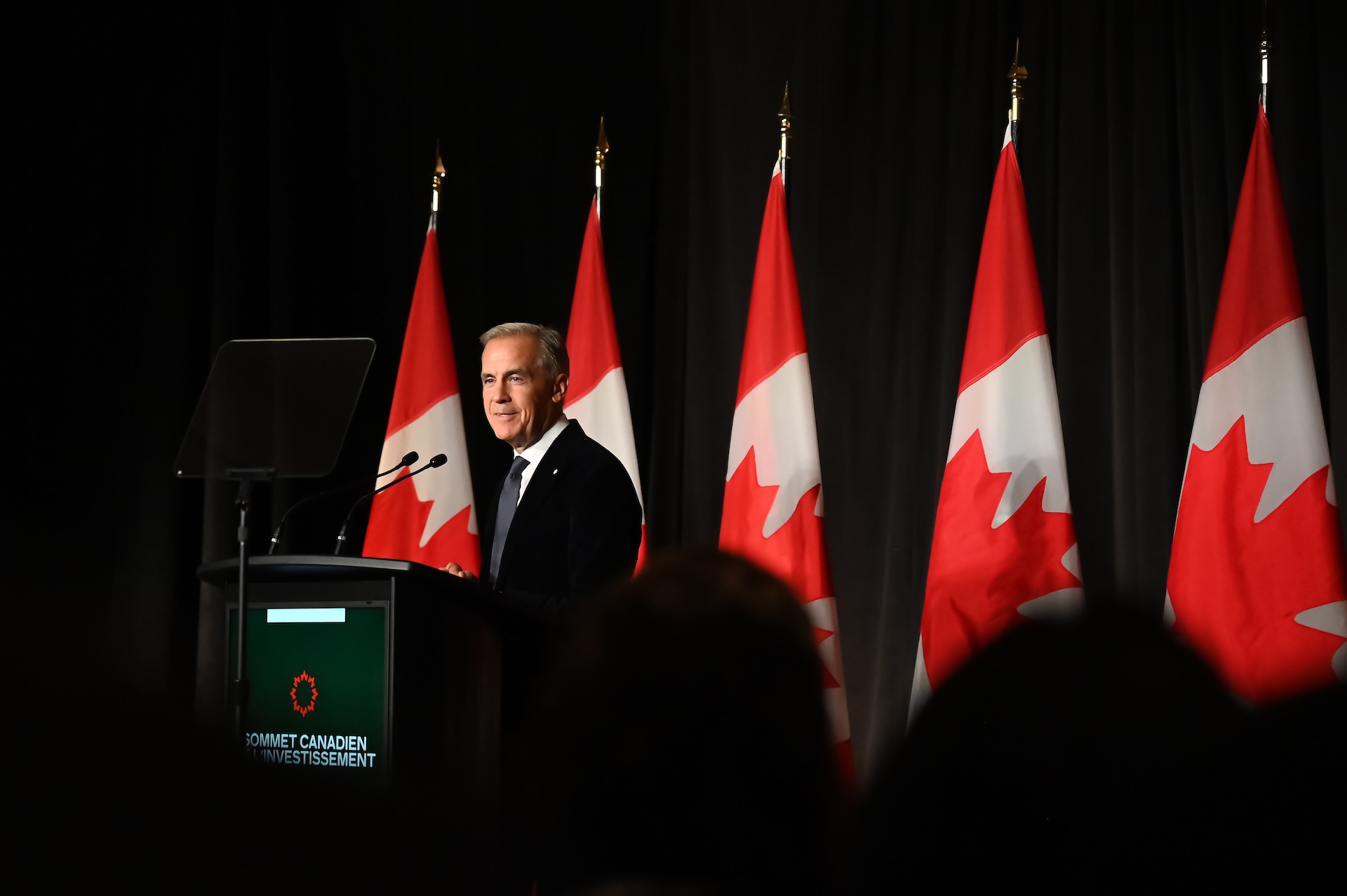
The Logic obtained a copy of the prospectus for the Canada Investment Summit, which the Prime Minister’s Office organized in collaboration with the Canadian Pension Plan Investment Board and the Public Sector Pension Investment Board. The prospectus touts 167 projects at different stages of development, spanning oil and gas, clean energy, ports, transportation, power infrastructure, digital technology and advanced manufacturing.
Mining and critical-minerals projects make up the largest group of investment opportunities. Some projects are tied to individual provinces, while others span multiple jurisdictions or are international in scope.
The Logic analyzed the projects in the prospectus, breaking down where the opportunities are concentrated, which sectors account for the largest share and how much capital expenditure is required.
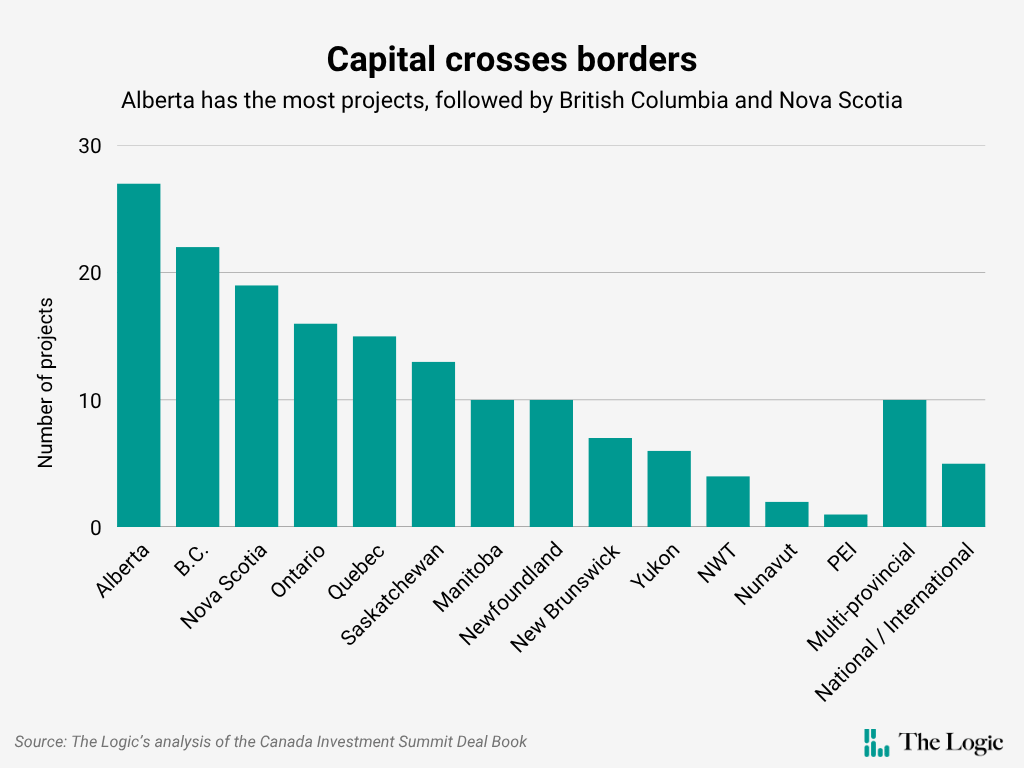
Alberta has the greatest representation in the prospectus of any province with 27 projects, followed by British Columbia with 22 and Nova Scotia with 19. Alberta’s tally spans every sector in the prospectus, with projects including conventional-energy plants, a cluster of AI data centres and two proposed high-speed transportation links between Calgary and Edmonton.
Related Articles
B.C.’s list is dominated by mining and minerals, alongside several large LNG and clean-energy proposals. Projects include the Wicheeda rare-earth, Baptiste nickel and Berg copper developments, as well as Ksi Lisims LNG, a proposed 12-million-tonne-per-year export terminal in northern B.C. with an estimated US$28.5-billion price tag.
Nova Scotia’s projects tilt more toward clean energy and Atlantic trade infrastructure. They include Wind West, a proposed offshore-wind and transmission project targeting up to five gigawatts of generation, the US$4.5-billion Nova Scotia Renewable Energy Park and several port developments.
Ten projects cross provincial boundaries or have yet to settle on a single location. Among them are the proposed West Coast Oil Pipeline, which would carry up to one million barrels of Alberta crude a day to a deepwater export terminal in southern B.C.; Kino Aski LNG, which would connect Western Canadian natural gas to Baie-Comeau, Que.; and the Bissett Creek project, which would mine graphite in Ontario and process it into battery anode material in Baie-Comeau.
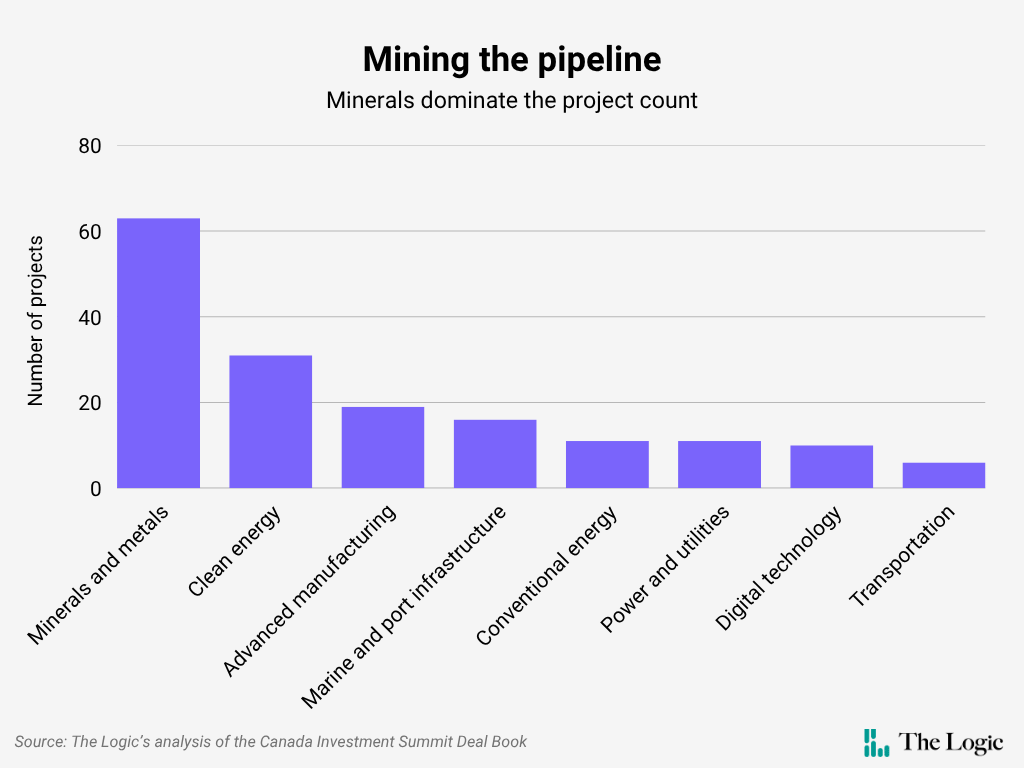
Minerals and metals make up the largest share of projects in the prospectus, accounting for 63 of the 167, or roughly 38 per cent of the total. They span gold, copper, nickel, lithium, graphite and rare earths, from early-stage exploration to mines and downstream processing facilities. The list includes Ontario’s Ring of Fire, where Juno Corp. is exploring for gold and critical minerals including titanium, vanadium, scandium, gallium and rare earth elements, as well as the Strange Lake project, an integrated rare-earth development spanning Quebec and Labrador with an estimated US$2.17-billion capital cost.
Clean energy is a distant second, with 31 projects covering offshore wind, hydrogen, sustainable fuels, carbon capture and energy storage. Among them are Newfoundland and Labrador’s U.S$10.6-billion EVREC Green Energy Hub, which combines wind, solar, battery storage and green hydrogen production, and Alberta’s Deep Sky One, a carbon-removal facility designed to capture as much as 500,000 tonnes of carbon dioxide annually. Notably, no housing projects feature in the prospectus.
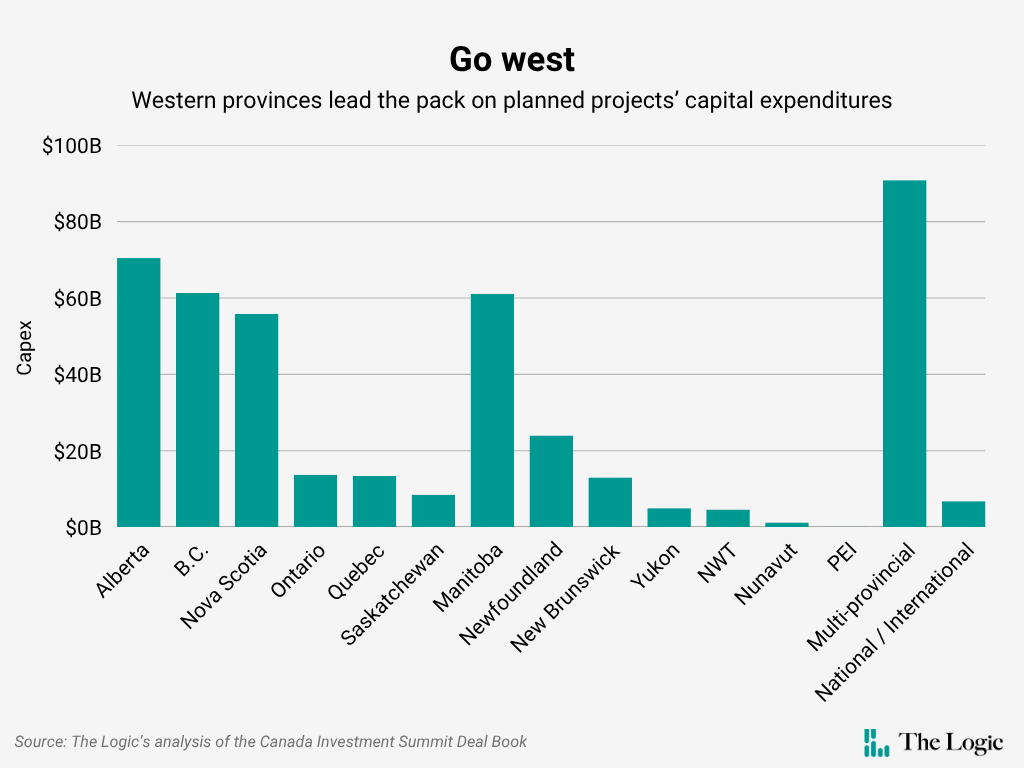
The picture changes when the provinces are ranked by the projects’ capital expenditure rather than by their number. Of the 167 projects in the prospectus, 155 projects disclose planned capital expenditure, representing about US$430 billion in proposed investment, according to The Logic’s analysis. Alberta leads the provinces with roughly US$70.5 billion in potential spending, followed by British Columbia at US$61.4 billion, Manitoba at US$61.1 billion and Nova Scotia at US$55.8 billion.
Those totals are heavily influenced by a handful of megaprojects. Nearly all of Manitoba’s total comes from the US$57-billion Port of Churchill Plus proposal. The US$44-billion Wind West project similarly accounts for most of Nova Scotia’s total.
The largest bucket overall is not a single province. Ten multi-provincial projects account for about US$90.9 billion in proposed capital spending. Three account for more than 90 per cent of that amount: the US$36-billion Novatron clean-energy and transmission platform linking Atlantic Canada with Quebec, the US$25.33-billion West Coast Oil Pipeline and the US$23-billion Kino Aski LNG.
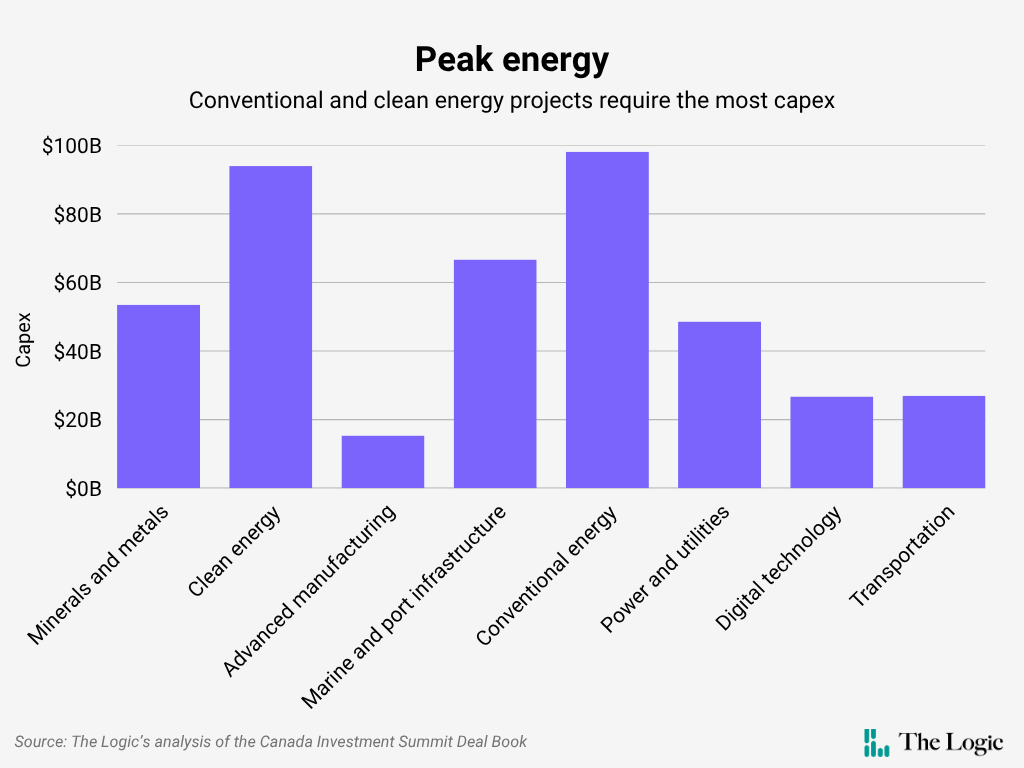
Energy projects carry the biggest price tags in the prospectus. Conventional-energy projects account for about US$98 billion in disclosed capital expenditures, narrowly ahead of clean energy at about US$94 billion. Together, the two sectors represent nearly 45 per cent of the nearly US$430 billion in disclosed project costs.
The ranking also flips the picture from the project-count chart. Minerals and metals make up 63 of the 167 projects, by far the largest group, but account for only about US$53.5 billion, or just over 12 percent of planned spending.