MONTREAL — Serge Sasseville is many things: former Quebecor vice-president, current Montreal city concillor and noted personae non-grata in Russia—the fruit of a nearly 1,000-day trolling of the Russian consulate across the street from his house. (There are currently eight Ukrainian flags hanging from his windows.)
Skip to content


Commentary: Quebec Ink
They say Montreal has a Valérie Plante problem. Nobody wants to fix it
Montreal’s business community says major problems in the city are dragging down investment. On the streets, it’s a different story.
Mayor Valérie Plante in Montreal in February 2024. Photo: The Canadian Press/Christinne Muschi
MONTREAL — Serge Sasseville is many things: former Quebecor vice-president, current Montreal city concillor and noted personae non-grata in Russia—the fruit of a nearly 1,000-day trolling of the Russian consulate across the street from his house. (There are currently eight Ukrainian flags hanging from his windows.)
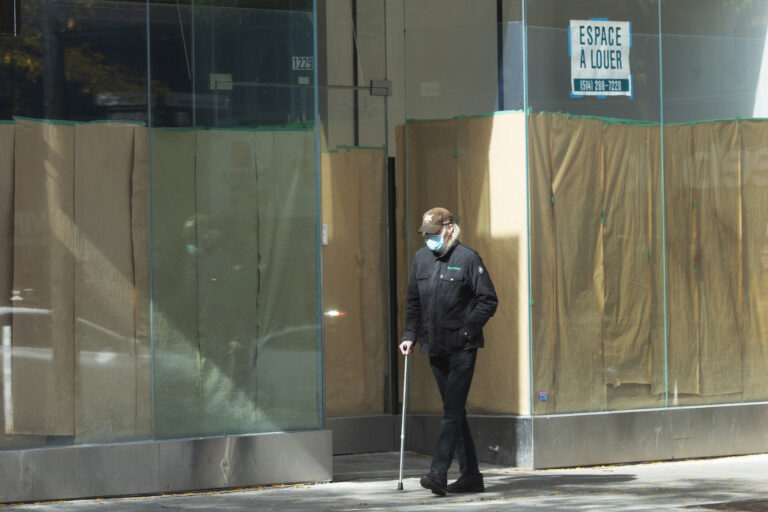
For the last four months, pictures of garbage-strewn streets, homeless encampments, shuttered businesses and, in one awful case, an apparent dead body in a park near city hall have populated Sasseville’s social media accounts—all sent to him by frustrated and anonymous Montrealers. The somewhat unsubtle message: Montreal is broken, and the blame lies squarely at the feet of Mayor Valérie Plante.
It’s a common refrain these days. Now in her seventh year in the job, Plante is regularly taken to task for failing to address burgeoning homelessness, gridlocked traffic, shaky public security, over-officious permit inspectors and an alleged war on cars, complete with runaway bike path construction. “Montreal’s business community declares itself worried for Montreal,” read a recent Le Devoir headline. The business community’s main apprehension, in a nutshell: Montreal’s ailments, exacerbated under Plante, will have a negative effect on investment in the city.
Related Articles

As with Prime Minister Justin Trudeau, much of Plante’s electorate is seemingly convinced all problems begin and end with her. Also like Trudeau, Plante faces an imminent reckoning. You’d think, with the municipal election just over a year away, there would be a lineup of people ready to capitalize on all this Plante malaise.
Yet unlike Trudeau, Plante hasn’t had a credible opponent for four years, if only because no one seems willing to take her on. Sasseville, an independent councillor elected in 2021, was visibly frustrated when I asked him why. Though his contact list brims with business-minded boldfaced names, Sasseville’s own recruitment efforts have yielded exactly two: one woman who said no, and one man who is on the fence.
Granted, a number of those boldfaced names have circulated. Some sound credible; others, like former Hydro-Québec doyenne Sophie Brochu, smack of wishful thinking. In any case, potential Plante opponents remain the political equivalent of vaporware, and one of the main reasons is the clown-car nature of Montreal’s government itself.
Consider this: Montreal has four levels of governance populated by 103 elected officials, roughly the same as the cities of New York, Toronto and Ottawa combined. The city is composed not only of 19 boroughs but of 15 mini-cities that, for reasons both ancient and boring, are not a part of Montreal itself and each have their own gaggle of elected officials.
This makes the city borderline fugazi, organizationally speaking. It is also radically decentralized, meaning the mayor’s office has far less power than, say, the Bloombergs, Daleys and Drapeaus of yore. One example: the City of Montreal only wrested control of garbage removal, traffic lights and the other staple municipal tasks from the boroughs in 2017. Your average elbows-first businessperson may find this working environment challenging, to say the least.
Organizationally, Plante’s Projet Montréal has the advantage of incumbency and numbers, holding 52 of those 103 seats. Meanwhile, the opposition Ensemble Montréal has been an official political party for all of four months. It must find not only a permanent leader; but also recruit dozens of warm bodies to fill out the candidate slate.
Another reason why no one has been able to capitalize on Plante malaise: maybe things aren’t as broken as social media might suggest. Unemployment in Montreal, having dipped below five per cent in spring 2022, sits at 6.6 per cent—and has been consistently lower than in Toronto since mid-2020. This, despite a dramatic population increase between 2022 and 2023. And while crime, gridlock and homelessness are huge problems, they are hardly unique to Montreal.
The city remains affordable relative to Toronto and Vancouver, thanks in part to the Plante administration’s knack for building housing. It is one of eight “sweet spot” cities in the world, having combined low costs with a high quality of life, according to Mercer, a U.S. consulting firm. And those bike paths? They’re actually good for business.
“You open Facebook and read how everyone hates Plante. Then you go to, say, the borough of Rosemont, and see a swimming pool that everyone uses. People vote for the swimming pool,” Christina Smith, mayor of the independent on-island city of Westmount, told me.
Sasseville’s social media posts are a window on Montreal’s big, messy problems, and the online hordes have decided Plante is to blame. Outside, though, is where it really counts. Out here, the silence is deafening.
Martin Patriquin is The Logic’s Quebec correspondent. He joined in 2019 after 10 years as Quebec bureau chief for Maclean’s. A National Magazine Award and SABEW winner, he has written for The New York Times, The Guardian, The Walrus, Vice, BuzzFeed and The Globe and Mail, among others. He is also a panelist on CBC’s “Power & Politics.”
Loading...
Thanks for sharing!
You have shared 5 articles this month and reached the maximum amount of shares available.
CloseThis account has reached its share limit.
If you would like to purchase a sharing license please contact The Logic support at [email protected].
CloseGift the full article!
You have gifted 0 article(s) this month and have 5 remaining.
Recipients will be able to read the full text of the article after submitting their email address. They will not have access to other articles or subscriber benefits.
Photo: The Canadian Press/Christinne Muschi
Most Popular This Week


In-depth, agenda-setting reporting
Great journalism delivered straight to your inbox.
News
AI is helping bring Indigenous languages back from the brink
Briefing
Toronto-based Organic Traditions raises $15M to fund U.S. expansion
Canada ready to retaliate if U.S. follows through on latest tariff threats, says Carney
University of Toronto mathematician Jacob Tsimerman wins ‘Nobel prize of math’
Best business newsletter in Canada
Get up to speed in minutes with insights and analysis on the most important stories of the day, every weekday.
Exclusive events
See the bigger picture with reporters and industry experts in subscriber-exclusive events.
Membership in The Logic Council
Membership provides access to our popular Slack channel, participation in subscriber surveys and invitations to exclusive events with our journalists and special guests.