Listen Now
0:00
OTTAWA — More than three years after Canada and Germany promised to kick-start a transatlantic trade in a new clean fuel by 2025, another global crisis is putting supplies of natural gas at risk and Canada still has no green hydrogen for Europe to replace it with.
Some of the projects in Atlantic Canada that then-leaders Justin Trudeau and Olaf Scholz hoped would fulfill Germany’s energy needs are still in the works, but the landscape is littered with failures and the plans are years behind schedule.
Talking Points
- Germany wanted to replace Russian natural gas with Canadian hydrogen in 2022, but with Persian Gulf gas choked off, Canadian H2 supplies are still not online
- Multiple plans for wind farms, electrolyzers and port terminals in Newfoundland have collapsed while a joint subsidy program meant to link Canadian producers and German buyers waited for EU approval
“Projects with strong fundamentals continue to advance while others pause or step back,” Dean Comand, chief operating officer of Abraxas Power, told The Logic in a recent interview. Abraxas, headquartered in Ontario, is working with French energy utility EDF to produce hydrogen in north-central Newfoundland through a joint venture called the Exploits Valley Renewable Energy Corporation, or EVREC.
“We see this process just naturally sorting itself out,” Comand said.
The EVREC project continues, though it’s still years away from producing any hydrogen. The stuff could have been useful now. Persian Gulf states are known for their oil exports, but about one-fifth of the world’s liquefied natural gas moves through the choke point of the Strait of Hormuz as well.
Related Articles

Iran’s effective blockade of the strait, in response to American and Israeli bombing, has coincided with the end of winter in the Northern Hemisphere, so the price of natural gas hasn’t spiked the way oil’s has. But the global market is being distorted, with natural-gas transport ships even being diverted mid-voyage from their routes to Europe to higher-paying destinations in Asia.
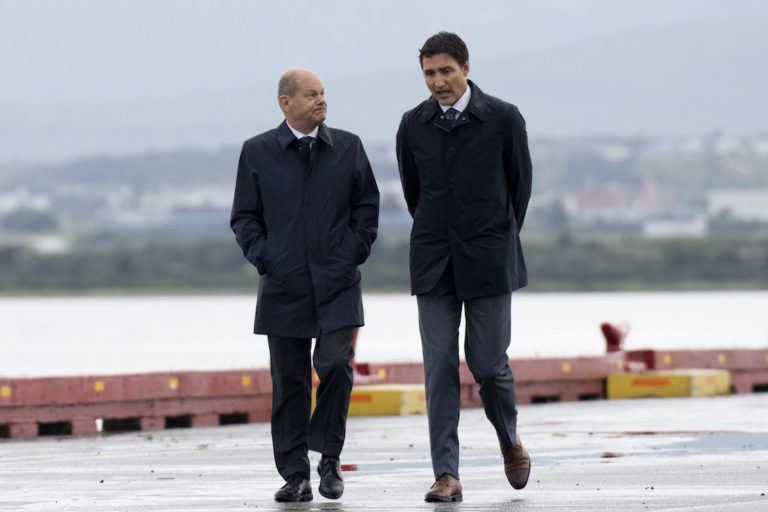
In 2022, after Russia’s full-scale invasion of Ukraine, western Europe was rushing to break its addiction to Russian-supplied gas. Germany’s chancellor, Olaf Scholz, met then-prime minister Justin Trudeau in Newfoundland to sign a deal aimed at kick-starting a transatlantic trade in green hydrogen. Canadian industry would break hydrogen off water molecules, using power generated by wind turbines on the East Coast, and ship it to waiting German industrial customers.
Hydrogen isn’t a perfect substitute for natural gas but they can be blended, like ethanol into gasoline; engines built to use hydrogen can run vehicles and produce power. Hydrogen packs an energy punch, and the waste product when it burns is water.
Under the Canada-Germany deal, the first Canadian exports were to be shipped east in 2025.
Pulling that off was going to be difficult, as The Logic reported then. An internal Canadian government document warned that even if proponents installed the electrolyzers to extract the hydrogen from water and the turbines to power the process, Canada lacked the transportation, storage and port terminals to get hydrogen onto ships for export.
“The industrial facilities, the port, the logistics supply chains—they’re very much complex infrastructure projects. They’re not your cut-and-paste solar project or wind farm project,” Comand said.
One way Germany and Canada saw to push the industry forward was to lock in German customers, which the two countries agreed to do in 2024 by subsidizing an auction to match the cheapest Canadian sellers to the most eager German buyers. Canada would put up $300 million and Germany would put up €200 million—roughly equivalent amounts—to bridge the gaps between what German buyers were willing to pay and what Canadian producers needed to make.
The scheme went nowhere fast, largely thanks to Europe. Germany needed sign-off from the European Union before it could subsidize the auction, and the EU didn’t approve the subsidy until Jan. 14 of this year, after the first shipments were supposed to cross the ocean.
In the meantime, several projects that were supposed to answer the Canadian-German call have collapsed.
In mid-February, Newfoundland and Labrador cancelled the land rights it had awarded to three wind-to-hydrogen companies, saying they’d shown little progress and not paid the fees they owed. The decision by Energy Minister Lloyd Parrott slashed the province’s “wind reserve” space by more than 90 per cent, from nearly 382,000 hectares to 30,700.
One of the failing companies is World Energy GH2, which had been backed by Nova Scotia seafood tycoon John Risley. In January, Risley publicly gave up on plans to erect 4,000 megawatts of wind turbines near Stephenville—the town on Newfoundland’s western coast where Trudeau and Scholz signed their accord—to feed an ammonia plant there.
World Energy GH2 had gone as far as buying Stephenville’s small port in 2023, in preparation for shipping hydrogen out through it.
Now, World Energy GH2 is in creditor protection, having filed court papers saying it’s “in an immediate liquidity crisis” and has liabilities of about $100 million against assets of about $29.2 million. The company has spent about $120 million trying to bring its wind-to-hydrogen dream to life, the filings say.
(Risley’s personal investment vehicle, CFFI Ventures, which owns 30 per cent of World Energy GH2’s common shares, is also in creditor protection.)
World Energy GH2’s core problem, according to an affidavit from CEO Richard Hugh, is everything: “[T]he market, the related industrial infrastructure needed to support the development of the market and required investment from governments and private industry into [a] green hydrogen energy ecosystem that was envisioned to materialize in 2024 and beyond did not materialize.”
There’s no hope for the project without the land rights the province is revoking over the $10.5 million in rent the company hasn’t paid, Hugh’s affidavit said. World Energy GH2 wants the revocation stayed.
This is part of a natural consolidation process, as far as Comand is concerned. “The way we see it is that the hydrogen market didn’t fail, the markets just simply matured,” he said.
EVREC has predicted it’ll be making ammonia—whose molecules have three hydrogen atoms and are much easier to store and transport than plain hydrogen—in quantity in 2030, after starting initial production in 2028. That’s now looking a little optimistic, said Comand: “I think we’re going to probably shift into 2029.”
During the delay in the Canadian-German hydrogen auction, both countries’ governments have changed.
In Germany, Scholz was a left-of-centre Social Democrat whose coalition government had a Green Party legislator as its energy minister. Scholz’s successor, Friedrich Merz, is a more conservative Christian Democrat—but minister of economic affairs and energy Katherina Reiche was chair of Germany’s National Hydrogen Council before landing her current post. The Merz government shepherded a pro-hydrogen bill through its parliament in February.
Germany still supports the long-delayed auction: “The German grant has already been bindingly promised,” said a statement from Reiche’s ministry, relayed to The Logic by a spokesperson for the country’s embassy in Ottawa, Valentina Goldmann.
In Canada, Natural Resources Minister Tim Hodgson refused to say whether the Liberal government under Prime Minister Mark Carney is as keen on hydrogen exports as it was under Trudeau.
His spokesperson Charlotte Power referred questions to his department’s spokespeople, who wouldn’t say whether the Canadian funding has been put aside, or when an auction or first shipment might now take place.
The department “continues to work with German counterparts on the implementation of the bilateral mechanism,” spokesperson Miriam Galipeau said.