OTTAWA — Behind the drab grey siding of the one-storey industrial building that holds its headquarters, across from a self-storage facility, Mission Control Space Services has a secret.
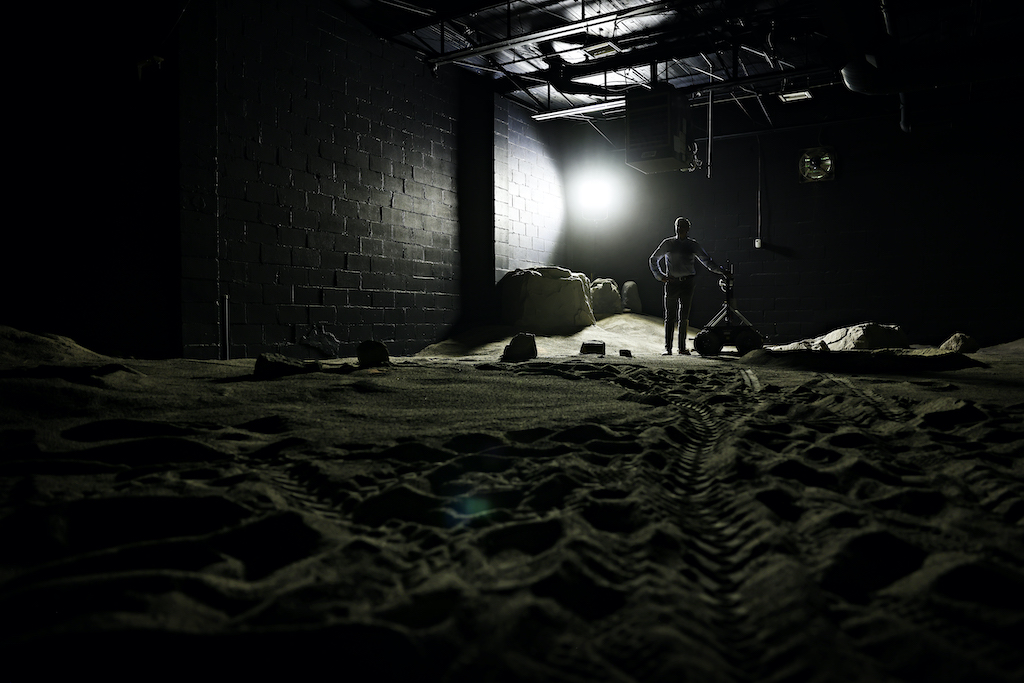
About half of Mission Control’s square footage there, walking distance from Parliament Hill on the western edge of downtown Ottawa, is ordinary office space. The other half is the moon.
Stepping through the door between them is disorienting. The office is lit by fluorescents; it has cubicles, and carpet on the floor. The moon is dark, a single bright utility light on a stand casting harsh shadows. The surface is covered with coarse sand and rocky outcroppings, dotted with craters of varying sizes.
Talking Point
Mission Control Space Services is part of a new breed in the space industry, taking advantage of plunging launch costs and growing international interest in the sector to show it has a working solution to the problem of long lag and low bandwidth for Earth-moon communications.
“No one has what we have,” Mission Control’s CEO Ewan Reid grinned in an interview with The Logic. “A 4,000-square-foot area with no pillars, good lighting, good black conditions and good craters and all that stuff, and you can actually drive robots around it.”
This is the testing ground for a key Mission Control product: software that uses artificial intelligence to evaluate an extraterrestrial rover’s surroundings, identifying landscape features and potential navigation hazards.
“What do you need to do to build an AI?” Reid asked. “First you need to train an AI model. Well, how do you train a model? You use thousands of images. Where do you get thousands of images?”
There’s the problem. “They don’t exist. The only people that have modern images in any quantity from the surface of the moon is China,” Reid said. That’s the only country to land a probe there in the modern era.
So Mission Control built one. The quality of the sand doesn’t match the moon’s powdery regolith, but this isn’t a place for testing wheels and treads—it’s for testing and training imagers and image processors. The company’s moonscape has been used by researchers at universities, by Canadian space stalwart MDA and by a partner in India, Reid said.
Canada has a publicly owned rover testing ground at the Canadian Space Agency’s headquarters outside Montreal, called the Mars Yard. It’s about 20 times the size of Mission Control’s, but it’s outdoors, making it unusable for several months a year. And the lighting is all wrong.
Mission Control’s technology is meant to tackle basic problems with controlling complex devices from very, very far away.
When you’re dealing with distances like those between Earth and the moon, the limited speed of light means irreducible delays of several seconds in transmitting data. Between Earth and Mars, the minimum lag is about three minutes. Having decisions made on Earth for robots that far away is inherently inefficient.
Then there’s bandwidth. “You’re getting very little data,” Reid said. “The Canadian Space Agency is planning to put a rover on the moon in the next five years, and they’re talking about being able to do that with less than 100 kilobits per second to be able to control it and get images.”
Mission Control’s CEO Ewan Reid. Photo: Blair Gable for The Logic
A hundred kilobits a second would be very fast for, say, a dial-up internet connection in the 1990s. But it would take more than a minute to transfer a megabyte of data—very slow for real-time control of sophisticated equipment several hundred thousand kilometres away.
Mission Control’s two-part solution includes the artificial-intelligence software, which reduces the amount of data rovers need to transmit because they can do more of the thinking themselves; and a data protocol for controlling equipment through very constrained networks. It all needs to run on space-hardened processors that can operate in cold vacuum while being bombarded by solar and cosmic radiation.
Artificial intelligence and remote sensing and manipulation are meant to be two of Canada’s major contributions to space exploration, as spelled out in the federal government’s 2019 space strategy.
Soon, Mission Control’s AI is to be tested in a non-simulated environment.
“Yeah, we’re going to the moon,” Reid said, with studied nonchalance.
The mission, scheduled for late 2022, is symbolic of the current age of space exploration: Mission Control’s technology will be on a rover built by the United Arab Emirates’s space agency, delivered to the moon on a Japanese lander, launched there aboard a SpaceX rocket.
Mission Control’s part in it is supported by a $3-million grant from the Canadian Space Agency, out of a $150-million fund called the Lunar Exploration Accelerator Program, which is meant to help small- and medium-sized businesses prove their moon-oriented technologies work. The company has received about $6 million in federal funding over the years, according to public records.
“Providing space heritage to Canadian technologies opens the door to further commercial sales, expecting commercial potential or scientific return in the medium to long term,” CSA spokesperson Sarah Berjaoui wrote in an email about the Mission Control grant.
“Space heritage,” here, means evidence that something actually works in space. Which helps a lot when trying to make a sale when the first question is likely to be about how many times your product has been used on a mission, Reid said.
“You say, ‘Well, it’s never been on a mission.’ And then they say, ‘Well, it’s pretty hard for us to write you a cheque for a couple million dollars when you’ve never even proved it.’”
Selling this technology as a product is a shift for the company, which began in 2015 as something more like a consulting operation, answering RFPs and making solutions to order. That history is reflected in the company name: Mission Control Space Services.
At the beginning of the summer, Mission Control celebrated its first round of outside financing. Reid’s not disclosing the total, saying only that it’s seven figures.
“It’s mostly about scaling up our team,” he said. “By and large, we’ve been very technical … We very much recognize we need a marketing department. We need a sales team. We need all the rest of that if we’re going to sell software and not just in a responding-to-RFPs kind of way.”
The patchwork mission of upstarts and novices that aims to take Mission Control’s technology to the moon is at the far end of the spectrum from, say, MDA’s massive contracts to build a next-generation Canadarm for the U.S.-led Lunar Gateway space station.
But like MDA’s CEO Mike Greenley, Reid is adamant that space is a frontier Canada needs to be on. It’s pretty well too late for any country to build an auto industry from scratch, he said, and space will be the same if we wait. “It has to be now, and it has to be in a pretty big way.”