OTTAWA — Seven months after space-engineering company MDA went public again, and with years of corporate convulsions behind it, CEO Mike Greenley is making big promises about where the storied maker of Canadarms, communications satellites and probe instruments is going.
Skip to content

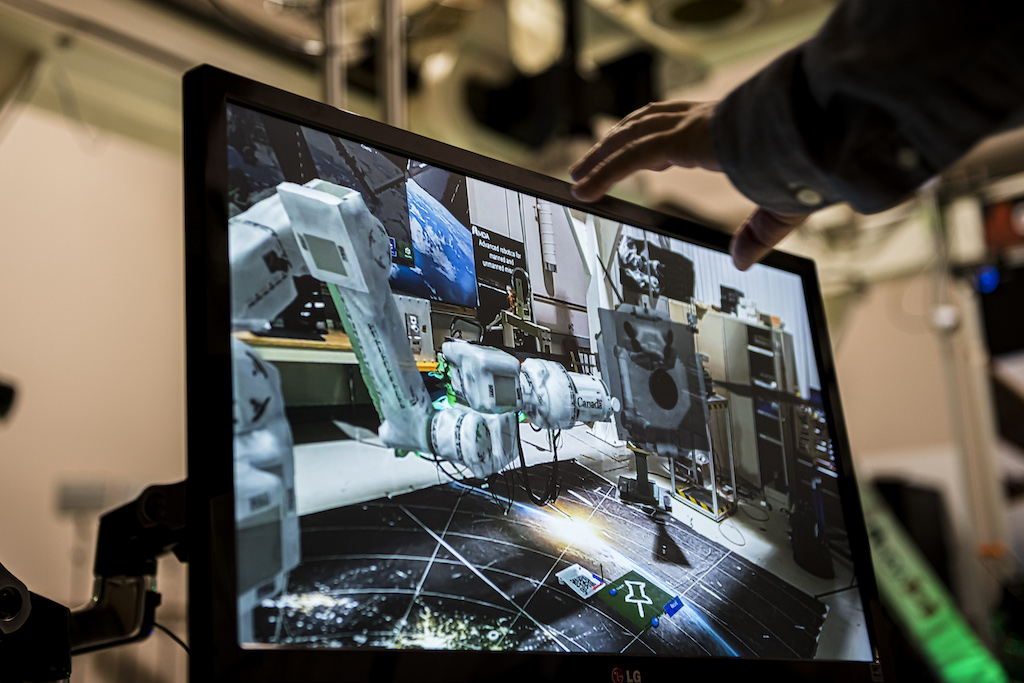 A video screen captures precision machinery at work at MDA’s headquarters in Brampton, Ont. The company is pursuing progressively larger contracts for Canada’s contribution of a robotic manipulator arm for the U.S.-led Lunar Gateway project. Photo: Christopher Katsarov Luna for The Logic
 A worker at MDA’s Brampton, Ont., headquarters. The company has been Canada’s major player in the space industry since one of its corporate ancestors built the first Canadarm, but even its CEO Mike Greenley says that prominence comes with an obligation to promote smaller firms and a diverse industrial ecosystem. Photo: Christopher Katsarov Luna for The Logic

The Big Read
The new space race: MDA says it’s time for Canada to set a new strategy for the stars
Mike Greenley, CEO of MDA, with one of its robotic manipulator arms emblazoned with the same logo as the Canadarms the company built. Photo: Christopher Katsarov Luna for The Logic
OTTAWA — Seven months after space-engineering company MDA went public again, and with years of corporate convulsions behind it, CEO Mike Greenley is making big promises about where the storied maker of Canadarms, communications satellites and probe instruments is going.
“We’ve demonstrated that our company will double in size between 2020 and 2022,” he said, with revenue rising to about $850 million by then. And Greenley expects a redoubling of revenue by 2025.
Talking Point
Canada is a major player in space robotics and fine instrumentation, thanks to a strategic decision to specialize decades ago. Now, as sending things into orbit becomes cheaper, and competition grows, the CEO of the company that makes Canadarms says it’s time for us to make another such choice.
This prediction is, he stressed, based on work the Brampton, Ont.-headquartered company already has on its books or forecasts it will get. Space is big business, and it’s getting bigger because the cost to put things in orbit has plunged, opening markets for MDA’s gear and services.
“We provide advanced technologies across the space sector, in almost everything except launch,” Greenley said.
Besides instruments for space missions, MDA makes whole satellites (it’s working with Telesat on the satellites for its planned low Earth-orbit internet service, and just the first batch of 300 could mean work worth $800 million), operates its own constellation of earth-observation satellites and crunches the data they collect, and is supplying sensors and countermeasures against laser-guided attacks for Canada’s new fleet of navy ships.
It’s contracted to be the fleet’s “electronic warfare suite systems integrator,” pulling all the ships’ sensor data together. In its last quarterly report, MDA said that’s worth $1.5 billion over 20 years, or $100 million per ship, and involves technologies it believes it can sell to other navies.
Despite those projections, Greenley said MDA has been surfing the success of a decision Canada made decades ago to focus its national space expertise on robotics. Canadian antennas had been on NASA’s early manned rockets, and when the U.S. came looking for contributions to its shuttle program in the 1970s, the federal government, National Research Council and private industry agreed that remote manipulators were what the country was best placed to offer.
“We put the robotics on the space shuttle, we flew 100 missions. We put robotics on a space station, we’ve operated for 20 years. We now have a 40-year lead with over three million hours of expertise in my team right now of on-orbit planning and operational support, which is the largest resume outside of NASA in the world for space-based robotic operations,” he said, then took a breath.
“That comes from Canada making a choice. It chose to do something on purpose.”
It is, in Greenley’s view, time for Canada to make more choices like that.
“One of the challenges of ‘Canadianism’ has been to never want to pick winners and losers,” Greenley said. “But I think you do have to pick the strategic areas that we’re going to excel in as a country, you have to support those as a government as an anchor customer. And then you have to partner with industry to export those around the world.”
As a general approach, this makes sense, said Lawrence Plummer, an associate professor of entrepreneurship at Western University who has worked in aerospace. Canada isn’t big enough to do everything in space engineering: “We have a huge geography, but we’re tiny. We’re the population of California.”
Canada’s geography isn’t great for space launches (which are usually best done from the equator, where the planet’s rotation helps craft reach orbital speed). But it does have domestic needs for remote sensing and communication, and for equipment that works in harsh environments. Hence the focus on satellites and space robotics.
“When the Canadian Space Agency and Canadian companies are looking at [providing] value to Canada, it’s going to be very specific to certain problems that only Canadians or other countries with very high northern latitudes are going to have,” Plummer said.
Jayshri Sabarinathan, an associate professor of electrical engineering also at Western University, is working on a LIDAR device (like a radar that uses light pulses instead of radio waves to assess its surroundings) that’s to cooperate with an MDA-made multispectral imager (more like a traditional camera) on a future moon rover.
Robotics and LIDAR have been Canada’s strengths in space technology and still are, she told The Logic. And we’re skilled at space science, evaluating data gathered by devices in space. Extraterrestrial prospecting and mining follow naturally.
“Canada has a very strong mining presence—terrestrially, we have very strong mining companies. And we also have the space sector, so there’s actually a very good synergy to take some of these mining technologies that we have and apply them to mining asteroids,” Sabarinathan said.
***
Still, Canada’s space industry could be more ambitious, said Tanya Harrison, a fellow at the University of British Columbia’s Outer Space Institute, who spends much of her time in Washington. As a planetary scientist specializing in Mars, she’s worked with NASA on both government and commercial missions.
“Canada is capable of building more than arms for NASA space missions,” she said, noting how industry costs—from components, to full satellite or rover missions—have declined. “We should really be taking advantage of the expertise that we have within the country and thinking more strategically, like how could we be a bigger player on the stage?”
Sending a Canadian rover mission to Mars is probably still out of our national reach, but putting a Canadian rover on the moon isn’t, Harrison said.
If we are going to stick to components, though, Harrison adds optical transmission of data—think fibre optics, but with laser beams instead of the fibre—to the list of areas where Canada has potential.
Canada produced a “space strategy” in 2019, a brief, image-heavy document whose first specific element was a promise to build a “next-generation AI-enabled deep-space robotic system.” It was explicitly to be a manipulator arm for the U.S.-led Lunar Gateway outpost, a descendant of the Canadarms.
Enter MDA, eagerly. One of its predecessor companies, Spar Aerospace, built the first Canadarm for the space-shuttle program. It built Canadarm2 for the International Space Station. Now MDA has won the first contracts to scope out what it’s calling Canadarm3, a manipulator for the U.S.-led Lunar Gateway station meant to start orbiting the moon in 2024. If the Canadian Space Agency sticks with MDA through full design and construction, the company estimates the work will be worth $1.4 billion.
The new Canadarm project is to incorporate significant AI technology. The Lunar Gateway station isn’t intended to be continuously crewed, and it will be much farther from earth than the International Space Station—the moon is more than 400,000 kilometres from us at its farthest, while the ISS orbits just 400 or so kilometres up. The communication delay at that distance is just a couple of seconds, but enough that controlling Canadarm3 from earth isn’t feasible for fine operations.
That project is a signpost to where Canada’s space industry is going, said Michael Lipsett, a professor of mechanical engineering at the University of Alberta. Earlier in his career, he worked with MDA on a U.S.-sponsored project to service satellites that were already in orbit.
“It’s amazing, being able to take another Canadian area of excellence, which is machine learning and artificial intelligence, and integrate that into remote operations in space—that is a tremendous opportunity for Canada,” he said.
***
MDA has been through a lot. In 2017, MacDonald Dettwiler and Associates rebranded itself as Maxar Technologies and moved its headquarters to Colorado a few months later. Then in 2019, in a transaction meant to reduce its debt, Maxar sold its Canadian operations (renamed again to just “MDA”) back to a consortium of private investors for $1 billion.
They included former Research in Motion co-CEO Jim Balsillie and Northern Private Capital, an equity firm led by John Risley (who is, among other things, chair of the federal government’s tech-promoting “Ocean Supercluster”) and Andrew Lapham (who is, among other things, married to Ontario’s transportation minister Caroline Mulroney).
Last April, MDA went public (in a somewhat disappointing IPO that raised $400 million instead of the anticipated $500 million). In July, it secured the latest Canadarm contract. In August, it said it will supply landing sensors for upcoming moon missions. In September, it announced it will supply laser altimeters for a Japanese probe meant to land on one of Mars’s moons and return samples to Earth.
“If you look at the first time we went to space, and for a decade or two after that, there’s about six countries that had a space agency,” Greenley said. “Now we have about 90 countries that have a space agency.”
Australia, for instance, formed a national space agency in 2018, and MDA is hiring a director of business development there.
“We look for countries that have space ambitions and budgets,” Greenley said, noting how Australia is joining that club. It also has a lot in common with Canada. “They are a strong mining and resource-management and remote-operations type of a country…. They’ve got that terrestrial capability, we represent the space capability.”
Post-Brexit Britain is another target, after Boris Johnson announced in a new space strategy in September that “the days of the U.K. space industry idling on the launch pad are over.”
Asked to name another Canadian space company with global renown, Harrison couldn’t. While there are subsidiaries of international powerhouses—Ontario’s Com Dev, a maker of satellites and probe components now owned by Honeywell, is one example—and startups with potential, MDA is the clear leader.
It can be Canada’s flag bearer, but it shouldn’t be the country’s only international competitor, Lipsett said.
“I think there should be more programs that help companies other than MDA to be credible participants,” he said. “We’ve seen some very exciting startups in space technology, who are small and nimble, and they’re looking at applications that a company like MDA is just too big and too organized to be able to tackle.”
“We recognize we have a role in developing and strengthening an ecosystem,” Greenley said. MDA has a program it calls LaunchPad, inviting smaller Canadian companies to collaborate on its marquee projects like Canadarm3. More announcements are coming in the next six months of ways small and medium firms can join MDA’s export-oriented work, he said.
Lipsett and Sabarinathan both pointed to Canadian “CubeSats,” micro satellites about the size of a Rubik’s Cube, as indicative of the future of space science and engineering: smaller, cheaper, more democratic.
“Canada has to have an ecosystem with these huge mature partners, but it also needs to fund mid-level companies and startup companies” if it wants to be competitive in commercial space industries, not just international missions to the moon and Mars, Sabarinathan said.
Space is one of the ultimate draws for young minds interested in the sciences, Harrison said.
“People get really jazzed about the idea of the positive future that the idea of space provides to people,” she said.
“A lot of students are graduating from engineering and science programs related to space in Canada, and when they can’t find jobs, they’re thinking of coming to the U.S.,” she said. “But then a lot of them are like me, kind of eyeballing Canada all the time… It would be great to just have more jobs and a more thriving sector could be a little bit more competitive with the United States in terms of retaining Canadian talent.”
Lipsett recalled using punch cards on a special machine in the basement of a university building to work on mathematics as a student, on the brink of a technological revolution.
“By the time I graduated, you could buy an IBM PC. From there, it just erupted,” he said.
“If we think of the CubeSat as being the equivalent of the open architecture of the IBM PC, and we think about what people have been able to do with computers as soon as they could start to interact with them, themselves, that’s the way space is going to become.”



Loading...
Thanks for sharing!
You have shared 5 articles this month and reached the maximum amount of shares available.
CloseThis account has reached its share limit.
If you would like to purchase a sharing license please contact The Logic support at [email protected].
CloseGift the full article!
You have gifted 0 article(s) this month and have 5 remaining.
Recipients will be able to read the full text of the article after submitting their email address. They will not have access to other articles or subscriber benefits.
Photo: Christopher Katsarov Luna for The Logic
A video screen captures precision machinery at work at MDA’s headquarters in Brampton, Ont. The company is pursuing progressively larger contracts for Canada’s contribution of a robotic manipulator arm for the U.S.-led Lunar Gateway project.
A worker at MDA’s Brampton, Ont., headquarters. The company has been Canada’s major player in the space industry since one of its corporate ancestors built the first Canadarm, but even its CEO Mike Greenley says that prominence comes with an obligation to promote smaller firms and a diverse industrial ecosystem.
Most Popular This Week




In-depth, agenda-setting reporting
Great journalism delivered straight to your inbox.
Commentary
Carmichael: Being boxed in will help Canada focus on what matters
Briefing
Rio Tinto gets nearly $165M in additional federal funds for Quebec aluminum
U.S. to lift tariffs on some Canadian products crucial to Maine: Collins
Carney warns of tech dependence after Starlink disruptions in Ukraine
Best business newsletter in Canada
Get up to speed in minutes with insights and analysis on the most important stories of the day, every weekday.
Exclusive events
See the bigger picture with reporters and industry experts in subscriber-exclusive events.
Membership in The Logic Council
Membership provides access to our popular Slack channel, participation in subscriber surveys and invitations to exclusive events with our journalists and special guests.






