The Canadian arm of Swiss mining multinational Glencore is in talks to acquire Li-Cycle, a Toronto-based EV battery recycling startup once valued at US$1.7 billion that has seen its valuation plunge 99 per cent.
Skip to content


News
Glencore is in talks to acquire Li-Cycle, the beleaguered Canadian EV battery recycling company
Once expected to be a prominent player in Canada’s EV supply chain, Li-Cycle’s valuation has plunged 99 per cent
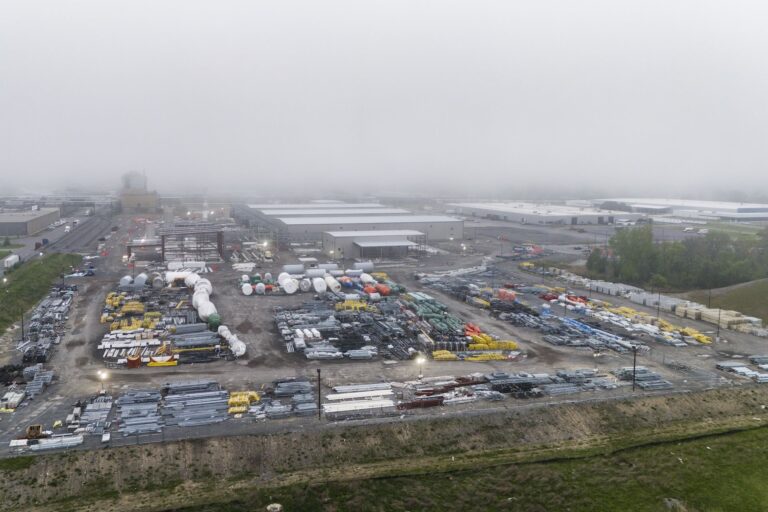
A Li-Cycle building project is photographed in Rochester, N.Y., on Wednesday May 15, 2024. Photo: Christopher Katsarov Luna for The Logic
The Canadian arm of Swiss mining multinational Glencore is in talks to acquire Li-Cycle, a Toronto-based EV battery recycling startup once valued at US$1.7 billion that has seen its valuation plunge 99 per cent.
Talking Points
- The Canadian arm of Swiss multinational Glencore is in non-binding talks to acquire Toronto-based Li-Cycle, once expected to be a key link in North America’s EV supply chain
- Li-Cycle has faced a string of financial and logistical challenges over the past few years, and its valuation has plunged
Glencore Canada, one of Li-Cycle’s major investors, is looking to acquire the company and its businesses to “address the issues impacting its operations and capital structure,” according to a March 14 letter from Glencore’s senior legal counsel Adam Luckie to Li-Cycle’s board chair Jacqueline Dedo.
The potential acquisition is non-binding, and is contingent on Li-Cycle taking “immediate effort to preserve cash to avoid further worsening the Company’s already strained liquidity,” Luckie wrote.
Li-Cycle spokesperson Louie Diaz said the Canadian company’s board established a committee to evaluate Glencore’s offer, but that there was “no assurance that any particular transaction will be proposed, recommended or consummated.” Glencore declined to comment.
Related Articles
The startup’s stock rose 30.2 per cent in early trading Monday. Its stock price has fallen about 99 per cent in less than five years, from a high of around US$110.
Li-Cycle, which developed technology for turning EV batteries into recycled critical minerals, has faced a string of financial and logistical challenges over the past few years, going from being a prominent player in Canada’s EV push to halting factory work in October 2023.
Acquiring Li-Cycle would give Glencore access to more critical minerals without needing to open new mines, at a time when global mining companies face steep competition from Chinese rivals. Li-Cycle’s environmentally friendly mission would also help the miner do deals with mineral-hungry tech and auto companies while complying with Europe’s increasingly strict battery-manufacturing rules.
But the deal also threatens to take a promising startup out of Canadian hands.
The transaction, if it proceeds, could test Canada’s stricter regime for foreign investments in critical mineral companies as it faces pressure to rationalize its investments in the faltering EV supply chain. Glencore’s last major acquisition in Canada, Teck’s Elk Valley Resources, prompted the government to enact a new policy in July that it would only approve foreign acquisitions of critical mineral firms “in the most exceptional of circumstances.” More recently, however, insolvent EV companies like Lion Electric and Northvolt have struggled to find investors.
Glencore already holds US$327 million in unsecured convertible notes which, if converted to shares, would represent over two-thirds of Li-Cycle’s common shares.
Glencore first invested in Li-Cycle back in June 2022 with a US$200-million convertible note purchase, and agreed to supply a steady flow of batteries and scrap for the startup. The multinational would make other investments in Li-Cycle, including a US$75-million secured convertible note in March 2024. Interest on the loans brought the company’s total investment to US$327 million as of Friday.
Li-Cycle also has partnerships with General Motors and LG, a US$100-million investment from Koch Investments Group, and major government investments like a US$475-million loan from the U.S. Department of Energy.
Wall Street analysts viewed Li-Cycle favourably when it went public during the boom in special-purpose acquisitions companies, or SPACs, in 2021, thanks to its unique intellectual property and climate-friendly business model that promised to find a home for the discarded EV batteries that worried environmentalists. The company launched plans to build several factories across the world, which would recycle batteries and send the material back to its New York hub to be processed into key critical minerals needed to make new EV batteries.
But the Canadian founders’ business model has failed to translate into financial stability, as construction costs ballooned at its New York factory, halting its progress and bogging it down with lawsuits with investors and contractors.
In March 2024, Li-Cycle laid off around 17 per cent of workers, about 60 people, as it put the brakes on production in three U.S. factories, listed four European locations as under review and closed its spoke factory in Kingston, Ont. Amid the cuts, various executives left the startup and their board seats were filled by Glencore-nominated members.
Since then, Li-Cycle has tried to revamp its business to attract customers that store energy for artificial-intelligence data centres.



Loading...
Thanks for sharing!
You have shared 5 articles this month and reached the maximum amount of shares available.
CloseThis account has reached its share limit.
If you would like to purchase a sharing license please contact The Logic support at [email protected].
CloseGift the full article!
You have gifted 0 article(s) this month and have 5 remaining.
Recipients will be able to read the full text of the article after submitting their email address. They will not have access to other articles or subscriber benefits.
Photo: Christopher Katsarov Luna for The Logic
Most Popular This Week




In-depth, agenda-setting reporting
Great journalism delivered straight to your inbox.
Commentary
Carmichael: Being boxed in will help Canada focus on what matters
Briefing
Rio Tinto gets nearly $165M in additional federal funds for Quebec aluminum
U.S. to lift tariffs on some Canadian products crucial to Maine: Collins
Carney warns of tech dependence after Starlink disruptions in Ukraine
Best business newsletter in Canada
Get up to speed in minutes with insights and analysis on the most important stories of the day, every weekday.
Exclusive events
See the bigger picture with reporters and industry experts in subscriber-exclusive events.
Membership in The Logic Council
Membership provides access to our popular Slack channel, participation in subscriber surveys and invitations to exclusive events with our journalists and special guests.






