Listen Now
0:00
OTTAWA — Canada will launch a sovereign wealth fund seeded with $25 billion in federal money, Prime Minister Mark Carney announced Monday, billing the fund as a way for Canadians to share the proceeds of investments in major national projects.
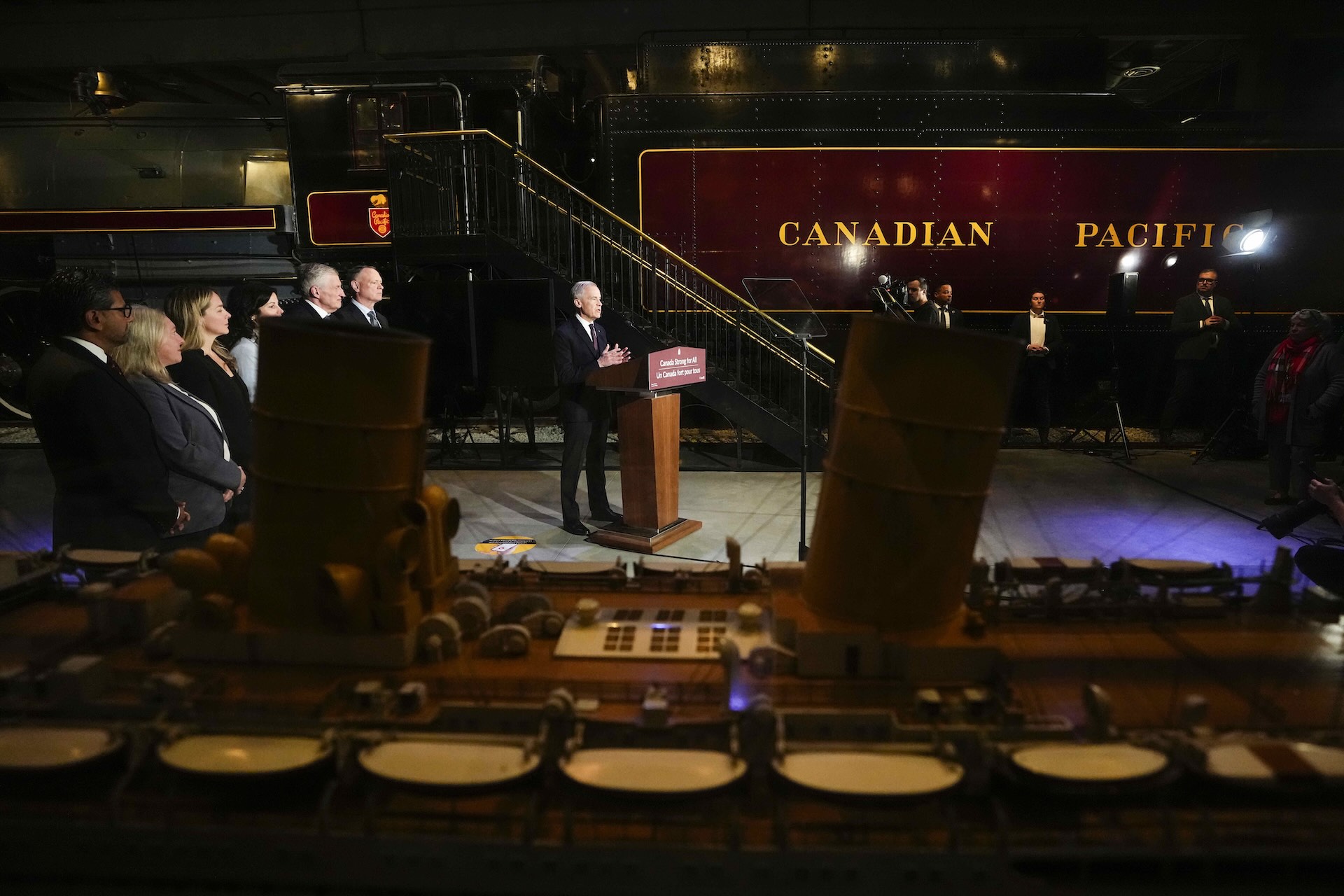
He made the announcement of what he called the Canada Strong Fund at Ottawa’s Canada Science and Technology Museum, after descending from the cab of a giant Canadian Pacific Railway steam locomotive. Canada is investing in projects akin to its first transcontinental railway, he said, and the benefits need to be shared beyond the 21st-century equivalents of Lord Strathcona and Lord Mount Stephen. With the CPR, the country got a railway, but the financiers made the profits, he said.
Talking Points
- Prime Minister Mark Carney said the government-owned fund will invest in major projects in Canada, to make sure Canadians get an equity cut of the proceeds from generational investments
- The fund’s own profits will fund its expansion, he said, rather than growing through regular infusions from sources like resource royalties
A lot about how the fund will work is to be decided after a round of consultations. But Carney sketched out the basics.
The fund will be run by a Crown corporation managed at arm’s length from the government of the day, he said.
It is also expected to grow with returns on its investments “through asset recycling and reinvestment,” Carney said. That sets it apart from other jurisdictions’ sovereign wealth funds that receive income from outside sources, such as oil and gas levies. Alberta established its Heritage Savings Trust Fund in 1976, for instance, to invest fossil-fuel royalties. Norway’s US$2-trillion Government Pension Fund Global is consistently boosted by government revenues from natural resources.
Also unlike other such funds, the Canada Strong Fund will invest only in domestic projects, the prime minister said. It might someday expand its horizons, but for now, he said, “we’re focused on generational investments.”
The government intends to create a way for regular people to invest in the fund, he said—with something like a government savings bond.
Related Articles


In his own news conference in Montreal, Finance Minister François-Philippe Champagne called the retail-investment component a way of sharing not just wealth, but pride. Young people will get work from national-scale projects, he said, and a patriotic boost from putting their own money in if they want to.
“They will be able to co-invest and look back at their investment 20 years from now and say, ‘I was part of it—these big national projects where we built mines, critical minerals, transportation corridors, energy,’” Champagne said.
The major-projects focus of the fund drew criticism, however, from the Canadian Shield Institute, a think tank focused on economic sovereignty. The institute gave the Canada Strong Fund, as described so far, a 6/10 on its sovereignty scorecard, docking points because the fund seems to emphasize hard infrastructure and resources rather than innovation and intellectual property.
Prominent investor John Ruffolo has called for Canada to get a sovereign wealth fund, as has tech-oriented advocacy group Build Canada.
Part of Ruffolo’s argument, however, is that a Canadian fund could be an intermediary between foreign capital and valuable Canadian assets, including intellectual property. Foreign investors could buy into a fund that would in turn invest in Canadian enterprises; the investors could get returns from Canada without getting to own (and spirit away) Canadian innovations.
That would be at odds with the vision Carney described for the newly announced fund, which included nothing about institutional-scale outside investors or venture investments.
Build Canada said the Liberal government’s plan doesn’t match its vision of a fund filled largely by budget surpluses and focused on investments outside Canada. Instead, the government will be seeding the investment fund with billions of dollars as it runs budget deficits also in the billions, racking up future interest payments.
Conservative Leader Pierre Poilievre took up that criticism: “Norway, Singapore and Saudi Arabia run big budget surpluses, which they accumulate and then put into their sovereign wealth funds,” he said. “Carney has no surplus, and therefore no wealth to put in such a fund. He’s talking about a sovereign debt fund.”
Carney said Tuesday’s spring economic update will show improvement in the government’s books.
“There will be good news tomorrow with the spring update on the fiscal situation,” he said. Besides, Carney said, he promised to spend less and invest more, and the Canada Strong Fund is an example of the latter.
The government already has numerous ways of investing in private firms, from the Business Development Bank of Canada to the Canada Growth Fund to the Canada Infrastructure Bank.
These are all devoted to helping businesses move forward, Carney said—whether through investments in small to medium enterprises or by lending money. The Canada Strong Fund is about getting Canadians, via their government, a cut of the returns that an equity investor gets from a successful project, he said.
“This comes in on a commercial basis. It gets those returns alongside the private sector, and it will spread the benefits of those returns over a much longer horizon,” he said.
The fund is not being created because of a lack of private capital to pay for such projects, Carney said.
“Capital for investment—this is not the issue we have,” Carney said. “Making sure that this transformation benefits all Canadians—that’s what we’re focused on.”
Michael Wissell, the chief investment officer at the Healthcare of Ontario Pension Plan, said he’s not sure his fund, or any of the other big Maple 8 pensions, would want to filter investments through a federal fund because they have their own experts to evaluate opportunities.
Nevertheless, he’s restrainedly optimistic about the fund’s prospects.
“Investing is hard. Doing it well is hard,” he said. “We certainly have a lot of talent in this country. We have a lot of opportunities to invest in Canada. Those two things brought together should create the opportunity, in a broad sense, of a good outcome.”
With files from Kevin Carmichael and Catherine McIntyre
This story has been updated to add details, and reaction to the announcement.