Skip to content

News
Carney’s pipeline deal is set to create a carbon-credit windfall in the oilsands
Suncor, CNRL and Cenovus have stockpiled huge inventories of carbon credits. Now, Alberta’s pipeline deal with Ottawa could ratchet up their value.
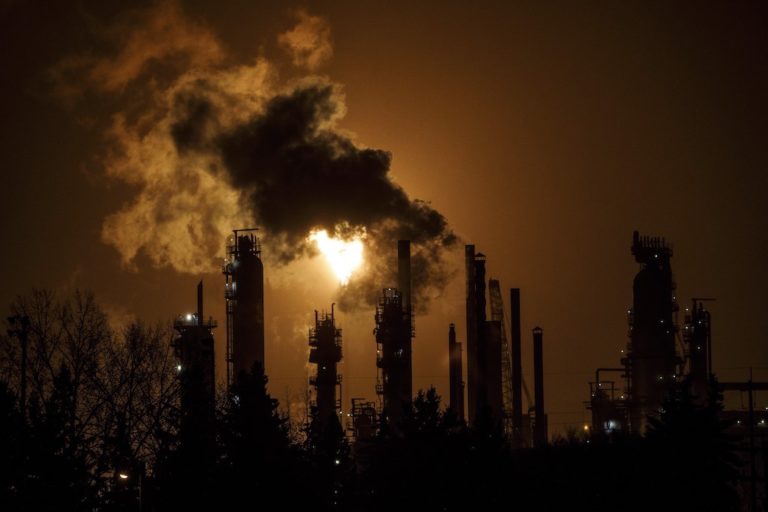
A Suncor oil refinery near Edmonton. Photo: Nur Photo via Getty Images/Artur Widak
CALGARY — Canada’s biggest oilsands companies have stockpiled millions of carbon credits, public data shows, which could produce a windfall for the firms if the Alberta and federal governments meet the terms of last month’s landmark energy deal.
Canadian Natural Resources has accumulated the biggest supply of credits inside Alberta’s carbon market with 6,022,266, according to a provincial registry that tracks heavy emitters’ holdings. Cenovus Energy owns 2,301,828 credits, while Suncor Energy has banked 1,258,876. Together, those inventories could soon carry an implied value of more than $1.2 billion, should Alberta and Ottawa agree on how to lock in the province’s carbon price at $130 per tonne before an April 1 deadline.
Talking Points
- Canada’s biggest oilsands companies spent years stockpiling millions of credits in Alberta’s carbon-trading system
- These massive inventories of “emissions performance credits” underscore the challenge Alberta faces in meeting the terms of its sweeping new energy deal with Ottawa
- To meet its responsibilities, the province must bring its carbon market back into balance, reversing years of oversupply
They’re unlikely to be worth that much—the credits’ real value will depend on how the provincial and federal governments go about raising the effective price of carbon in Alberta. Still, any increase in their worth would benefit the companies, which can sell the credits, or count them towards their broader emissions-reduction obligations.
CNRL, Suncor and Cenovus did not respond to questions.
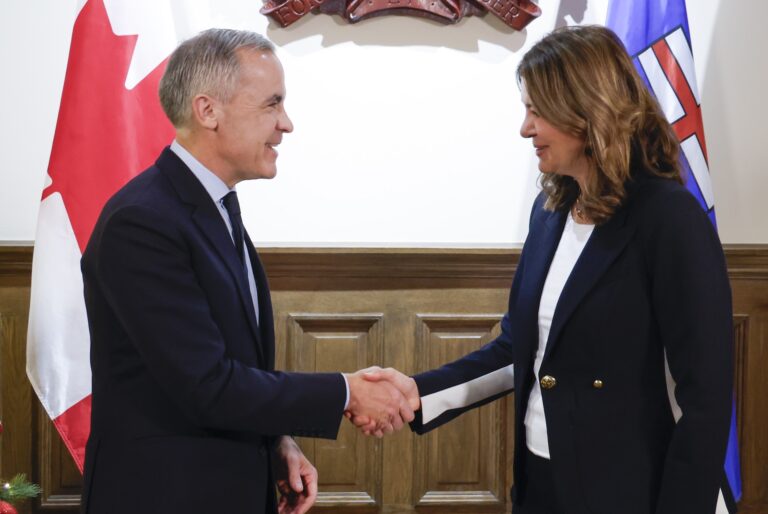
The growing stockpiles underscore the chronic oversupply of credits that has plagued Alberta’s carbon trading system—an issue that represents the province’s biggest hurdle in fulfilling the terms of its memorandum of understanding with Prime Minister Mark Carney.
Related Articles

CNRL, Suncor and Cenovus built up their current reserves of credits mostly between 2020 and 2023, when companies were generating, or banking, far more of them than they were buying. They acquired the credits through the province’s carbon trading system—called Technology Innovation and Emissions Reduction, or TIER—which is the government’s mechanism for enforcing carbon prices. TIER is Canada’s largest carbon-trading market, regulating about a quarter of the roughly 694 million tonnes of greenhouse gases that the country emits every year.
Under TIER, commercial-scale companies are required to pay into the system if they don’t meet certain emissions-intensity targets. Those that miss their targets have several options, like paying carbon prices in the form of purchasing per-tonne carbon credits, or investing directly in emissions reduction. Those that beat their targets—or, in the case of oilsands companies, drive down the emissions intensity of their facilities—can reap a financial reward by selling credits into the system, or banking them to sell later.
There are now 50 million unsold credits sloshing around Alberta’s carbon-trading system.
Oilsands firms typically have high emissions profiles, but, because they have been able to regularly meet Alberta’s emissions intensity thresholds, they and other companies have banked large numbers of credits. That has thrown TIER into persistent oversupply, to the extent that there are now 50 million unsold credits sloshing around the system.
It’s unclear how much the oilsands companies’ nearly 10 million credits will actually be worth should the Alberta and federal governments reach an agreement. While Alberta currently charges $95 per tonne for those who miss their benchmarks, years of oversupply has driven the real value of TIER credits far lower—as low as $17 per tonne in recent weeks, according to data tracked by the Atlanta-based Intercontinental Exchange. Government officials will soon have to hike that to $130 per tonne.
The question is how to close the gap. Given the already large chasm between government-set carbon prices and real prices in TIER, doing so will “require the Government of Alberta to significantly clean up the system,” said Dave Sawyer, principal economist at EnviroEconomics, an environmental advisory group.
One possible approach, according to Sawyer, is for Alberta to simply purchase the excess credits in the system. However, that would come at significant cost to taxpayers: As a rough guide, purchasing 50 million credits at $95 apiece would cost $4.75 billion; at their current value of $17, they would cost $850 million.
The other option, according to experts, is through tighter regulations—for example, by adjusting intensity rates to make companies pay for a larger proportion of their overall emissions.
“How you would force those prices up is really tricky,” said Scott MacDougall, a climate policy expert at the Pembina Institute, a Calgary-based clean energy think tank.
A spokesperson for Alberta Environment Minister Rebecca Schulz, who oversees TIER, did not respond to The Logic’s questions about why the system became oversupplied, and how the province plans to address the issue.
Environmentalists and some analysts say Alberta’s government has actively set TIER’s emissions targets too low, or otherwise designed the market in a way that caused the oversupply.
On Dec. 3, just days after Alberta signed its MOU with Ottawa, Minister Schulz introduced two new credit types to TIER that, Sawyer said in a statement, “will flood the province’s industrial carbon-pricing market with credits and further weaken the carbon-price signal for major emitters.”
Accepting the higher TIER price was Alberta’s greatest concession under the deal, which sought to reset the province’s fractured energy relationship with the federal government. In exchange, Ottawa said it would relax proposed electricity regulations, scrap its cap on oil and gas emissions and support a new West Coast pipeline, among other things.
The industry has long argued that higher carbon prices would make it less competitive with its global rivals, compounding challenges like pipeline constraints. That could in turn hamper Carney’s efforts to unleash Canada’s oil and gas sector, establishing the country as an “energy superpower” capable of reducing its dependence on U.S. buyers.
“This is not the time to continue the pattern of the past decade of layering on policy complexity and cost on Canadian industries,” Canadian Association of Petroleum Producers president and CEO Lisa Baiton said in a statement on industrial carbon prices in March.
At the same time, though, those companies need high carbon prices to justify planned investments in decarbonization technology like carbon capture and storage. Under the deal, the two governments are looking to encourage oilsands companies to build the proposed Pathways project, a massive hub that would gather CO2 from at least 13 oilsands projects and inject it deep underground for storage.
The energy sector has claimed that it needs guaranteed compensation for every tonne of CO2 it sequesters through Pathways to make the project financially viable. One way governments could do that is through a mechanism called carbon contracts for difference, or CCFDs. CCFDs act as a floor price for carbon removal credits, with the government paying the difference for every tonne of emissions successfully stored underground.
Ottawa earmarked at least $7 billion for CCFDs in 2023, and has already signed contracts with several carbon capture companies, including Calgary-based Entropy. Under the deal, Ottawa guaranteed a price of at least $86.50 for every tonne of carbon dioxide the energy company stores underground.



Loading...
Thanks for sharing!
You have shared 5 articles this month and reached the maximum amount of shares available.
CloseThis account has reached its share limit.
If you would like to purchase a sharing license please contact The Logic support at [email protected].
CloseGift the full article!
You have gifted 0 article(s) this month and have 5 remaining.
Recipients will be able to read the full text of the article after submitting their email address. They will not have access to other articles or subscriber benefits.
Photo: Nur Photo via Getty Images/Artur Widak
Most Popular This Week



In-depth, agenda-setting reporting
Great journalism delivered straight to your inbox.
Commentary
Carmichael: Being boxed in will help Canada focus on what matters
Briefing
Rio Tinto gets nearly $165M in additional federal funds for Quebec aluminum
U.S. to lift tariffs on some Canadian products crucial to Maine: Collins
Carney warns of tech dependence after Starlink disruptions in Ukraine
Best business newsletter in Canada
Get up to speed in minutes with insights and analysis on the most important stories of the day, every weekday.
Exclusive events
See the bigger picture with reporters and industry experts in subscriber-exclusive events.
Membership in The Logic Council
Membership provides access to our popular Slack channel, participation in subscriber surveys and invitations to exclusive events with our journalists and special guests.






