OTTAWA — The federal government plans to spend $7 billion on market protections for industrial CO2 emitters, a policy that advocates say could go a long way to encouraging construction of energy projects and emissions-reducing technologies like carbon capture and storage.
Skip to content

News
Ottawa to use nearly half of $15B growth fund to guarantee carbon prices for heavy polluters
Government to use $7 billion from Canada Growth Fund to guarantee price polluters receive for offsetting emissions
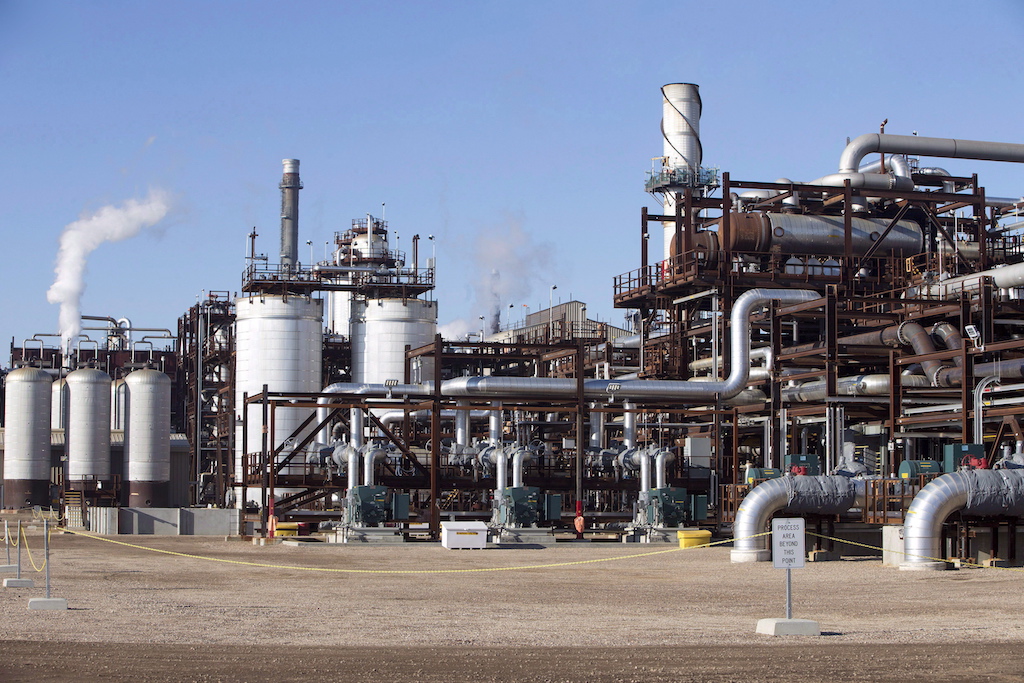
The Quest carbon-capture and -storage facility in Fort Saskatchewan, Alta., in November 2015. Photo: The Canadian Press/Jason Franson
OTTAWA — The federal government plans to spend $7 billion on market protections for industrial CO2 emitters, a policy that advocates say could go a long way to encouraging construction of energy projects and emissions-reducing technologies like carbon capture and storage.
In her fall economic update on Tuesday, Finance Minister Chrystia Freeland said the Ottawa-backed Canada Growth Fund will begin negotiating contracts with energy companies to effectively guarantee the price they will receive for offsetting or removing carbon emissions. The policy tool—called carbon contracts for difference (CCFD)—was a key recommendation of the Canadian energy sector, which has argued that CCFDs are critical to reducing operating costs and making major low-carbon projects economically viable.
Talking Points
- The federal government will begin guaranteeing the prices heavy polluters received for emissions reductions—-a policy known as carbon contracts for differences.
- The mechanism could go a long way toward making low-carbon energy projects more economic and meeting net-zero emissions, advocates say
Under a CCFD agreement, heavy emitters like mining companies, concrete makers and natural gas producers would reduce emissions by the tonne and then sell those reductions on carbon offset markets. Government-backed CCFDs would guarantee those companies receive a minimum price for those offsets—say, $80 or $100 per tonne. Other types of companies, like those that use direct air-capture technologies to draw CO2 directly from the atmosphere, will be eligible to negotiate CCFDs for the carbon they remove.
The $7 billion allocated for CCFDs make up nearly half of Ottawa’s $15-billion Canada Growth Fund, a key program in the government’s efforts to slash carbon emissions and develop innovative technologies.
Freeland’s economic update acknowledged that CCFDs come with “significant fiscal risks” given that, if carbon prices implode, the government could be on the hook to make up the difference. Still, the policy could also work in the opposite direction and generate revenue for Ottawa if carbon prices rise higher than agreed-upon prices.
Read more on 2023 fall economic statement


The policy represents a significant expenditure for the Liberal government as it looks to meet its net-zero emission goals. It comes as Canada struggles to match U.S. President Joe Biden’s Inflation Reduction Act, which promises to shower American energy developers with as much as US$1 trillion in subsidies over the next decade.
CCFDs come in addition to a range of investment tax credits the federal government has promised as a way to cover the up-front costs required to build major projects like hydrogen plants or carbon-capture and -storage (CCS) installations.
The government has not yet tabled legislation introducing the investment tax credit for carbon capture and storage projects—which will cover up to 60 per cent of the cost for some projects—prompting industry concerns that Canada is at risk of falling behind its U.S. competitors. In the fiscal update, Finance officials said the government would table the CCS tax credit legislation by the end of the year. Separate tax credits for cleantech manufacturing and hydrogen are expected to be legislated before next year’s fall economic update, the government said.
Related Articles


The Pathways Alliance—a group of six major oilsands companies including Suncor Energy, Cenovus Energy, Canadian Natural Resources and others—has been pressing Ottawa to introduce CCFDs in order to help cover operating costs.
The group has proposed a $16.5-billion CCS hub in northern Alberta that would sequester a sizeable chunk of the oil and gas sector’s total emissions.
Other major proposed CCS developments including Air Products’ $1.6-billion project currently under construction near Edmonton, which will be Canada’s first commercial-scale hydrogen facility.
Tuesday’s document said the growth fund is “already in the process of negotiating carbon contracts for difference with a number of project proponents across a range of sectors,” but did not specify which companies or industries.
It also said CCFDs would “support the establishment of robust carbon credit markets” by bringing investor confidence to the nascent sector.
Carbon offset markets are viewed by some observers as a way to incentivize carbon reduction efforts and take some of the financial burden of decarbonization off of the public sector.
This story was updated to specify who will negotiate and be eligible for CCFDs



Loading...
Thanks for sharing!
You have shared 5 articles this month and reached the maximum amount of shares available.
CloseThis account has reached its share limit.
If you would like to purchase a sharing license please contact The Logic support at [email protected].
CloseGift the full article!
You have gifted 0 article(s) this month and have 5 remaining.
Recipients will be able to read the full text of the article after submitting their email address. They will not have access to other articles or subscriber benefits.
Photo: The Canadian Press/Jason Franson
Most Popular This Week



In-depth, agenda-setting reporting
Great journalism delivered straight to your inbox.
The Big Read
Alberta’s referendum is just the start of the turmoil
Briefing
EverWind plans $10B data centre and wind development in Nova Scotia
Canada ready to force Stelco to sell its Canadian operations, Joly says
Feds plan a 60 MW defence-oriented data centre for Ottawa
Best business newsletter in Canada
Get up to speed in minutes with insights and analysis on the most important stories of the day, every weekday.
Exclusive events
See the bigger picture with reporters and industry experts in subscriber-exclusive events.
Membership in The Logic Council
Membership provides access to our popular Slack channel, participation in subscriber surveys and invitations to exclusive events with our journalists and special guests.