Skip to content


News
Carney and Smith sign wide-ranging deal committing to new pipeline and carbon capture
The pact gives the oil industry a major break on emissions, but makes large-scale carbon capture a condition of a pipeline going ahead
Prime Minister Mark Carney and Alberta Premier Danielle Smith signed a sweeping deal Thursday intended to kickstart development of a new oil pipeline to the West Coast. Photo: The Canadian Press/Jeff McIntosh
CALGARY — Prime Minister Mark Carney and Alberta Premier Danielle Smith set out Thursday to overcome the often rancorous relationship between the federal and Alberta governments with a wide-ranging agreement to pave the way for a new pipeline to the West Coast.
Smith dubbed the memorandum of understanding the two signed in Calgary Thursday a “grand bargain” between Ottawa and Alberta to spur pipeline and carbon capture investments, with a view to exporting Alberta oil to Asian markets.
Talking Points
- Prime Minister Mark Carney and Alberta Premier Danielle Smith signed an agreement Thursday to declare an oil pipeline from Alberta to the coast of B.C. a project of national interest—but there are conditions
- Ottawa will scrap the emissions cap for oil and gas production and exempt Alberta from clean electricity regulations in exchange for reform of the province’s carbon market
- The B.C government and coastal First Nations have vowed to stop any oil pipeline proposal, and called on the federal government to maintain its ban on tankers off the north coast
The deal boils down to a series of trade-offs. Ottawa has agreed to prioritize a bitumen pipeline to the coast of British Columbia, provided there is opportunity for Indigenous co-ownership in the development. The federal government also agreed to scrap the emissions cap for oil and gas production that was set to take effect in 2030, and give Alberta a unique carve-out from federal clean electricity regulations.
In exchange, Alberta agreed to reform its sluggish carbon pricing and emissions trading system to encourage investment in emissions offsetting technology. It also agreed to work with Ottawa on a plan to reduce methane emissions by 75 per cent from 2014 levels by 2035.
Related Articles
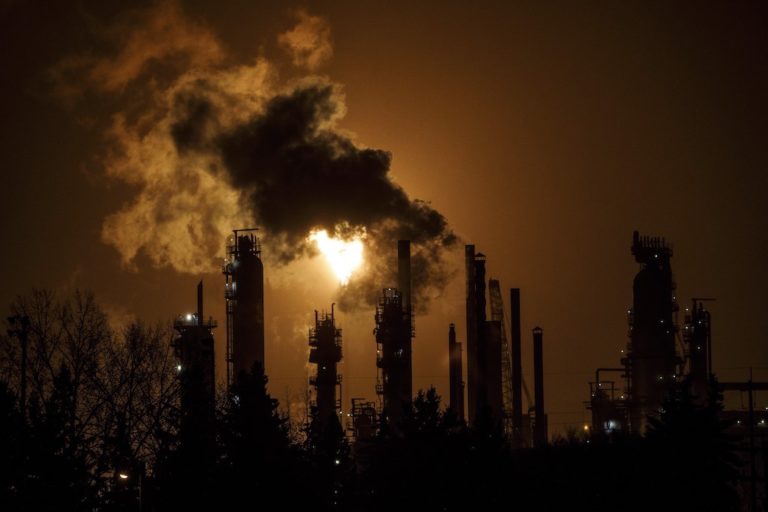
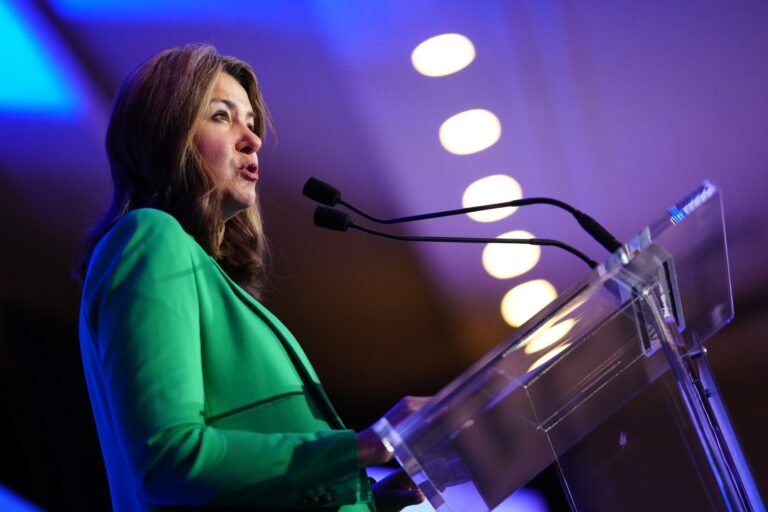
The deal “sets the stage for an industrial transformation,” Carney said at a signing ceremony in Calgary. Smith cast it as a “new starting point” for an economic partnership between Ottawa and Alberta.
Pipeline of dreams: The goal of the agreement is to build at least one Indigenous-owned pipeline to carry one million barrels a day of “low-emission Alberta bitumen” to a port with access to Asia. Ottawa agrees to “adjust” its tanker ban off the B.C. coast to make that possible, if necessary.
There are still plenty of hurdles standing between oil producers and a pipeline to the West Coast though, not least staunch opposition from the B.C. government and coastal First Nations, who vowed the pipeline would “never happen.” B.C. Premier David Eby has rebuked Carney for leaving his province out of the conversations, and earlier this week said the pipeline project “doesn’t actually exist,” calling the whole proposal a communications exercise.
After reviewing the memorandum on Thursday, Eby sounded unswayed, describing the potential pipeline as a “vampire” proposal that would suck resources away from other major projects that have a greater likelihood of completion. “I will always defend B.C.’s interest,” he said.
Carney and Smith have put different spins on that opposition. Earlier this week, the prime minister said a pipeline can’t happen without buy-in from B.C. and coastal First Nations; on Thursday, Smith pointed out the agreement gives neither of those parties a veto. Rather, she noted, it calls for their input, and for B.C. and First Nations to share in the economic benefits.
On Thursday, Carney described the agreement as a beginning, stressing that a pipeline would also require equity ownership and economic benefits for First Nations in Alberta and B.C. “We’ve created some of the necessary conditions for this to happen, but there’s a lot more work to do and very much in the spirit of partnership,” he said.
Awaiting a (private) dance partner: The pipeline deal is also missing its most crucial component: a private-sector proponent. No company has signed on to actually build the line, and Smith has suggested that resorting to using public money to build the infrastructure would signal a failure. With the right regulatory conditions, a proponent and private investors will come forward, she has said.
She repeated that message at her press conference on Thursday, with a crowd of energy industry stakeholders looking on. “I think we want to create the conditions that the private sector has confidence in the building, so that’s what we’re working toward,” she said, adding that she’s confident a proponent or consortium of private backers will come on board once Ottawa officially commits to fast-tracking the pipeline through its Major Projects Office.
Carney appeared to agree: “If there’s not a private-sector proponent, there won’t be a pipeline,” he told reporters in Calgary. Later, he joked about crowdsourcing a proponent. “If you know one in the room, please, you can come see us afterwards,” Carney said with a laugh in a speech to the Calgary Chamber of Commerce.
In the meantime, though, the Alberta government is leading the project, and is planning the route with the help of three major, Calgary-based pipeline companies: Enbridge, Trans Mountain and South Bow.
Stronger carbon price, no cap: Even if a pipeline never materializes, the deal is still a win for an oil and gas sector that felt chafed by the previous Liberal government’s environmental policies, said Smith.
“I think it’s going to unleash an incredible amount of investment,” Smith said, listing off recent commitments and expressions of interest from Trans Mountain and Enbridge as proof of renewed investor confidence.
During a closed-door meeting between the premier and energy industry representatives after the announcement, a distinct “yee-haw!” could be heard from outside the room.
Carney received two standing ovations from the 1,200-strong crowd at the chamber of commerce event, which was sponsored by the Canadian Association of Petroleum Producers. Attendees had waited in a line that stretched a full city block to hear him speak.
Official responses were more measured. “The emissions cap has was never a law, but it was probably the biggest barrier for capital to come to Canada,” Lisa Baiton, CEO of the Canadian Association of Petroleum Producers, told The Logic, calling the move to eliminate it a signal to the industry that the federal government wants to “leverage one of our best resources.”
Earlier this month, Carney doubled down on industrial carbon pricing in the budget, even as the government acknowledged carbon markets weren’t working as well as they should. The budget opened the door to dropping the federal emissions cap, which oil companies protested as a cap on production, if carbon markets can be fixed and methane-emissions are captured by the scheme.
The budget also promised to continue to backstop carbon prices through the Canada Growth Fund with contracts for difference, which lower the risk of investment in carbon capture technology by acting as insurance for producers in case the value of their credits plummets.
By far the largest of those projects, Pathways Plus, has already made Carney’s list of candidates to receive fast-track treatment from the new Major Project Office, headed by the former chair of Trans Mountain, which operates the only oil pipeline system to Canada’s West Coast. It would be the largest carbon capture facility in the world, Carney said, and a pipeline is contingent on that Pathway project making progress.
The agreement gives the governments an April 1 deadline to reach an agreement between the Pathways companies to move forward.
Investments in projects like Pathways have looked less and less appealing to the oil industry as the value of carbon credits drops. Earlier this year, the Alberta government said it would freeze the carbon price at $95 per tonne through 2026 as a relief measure for the oil and gas sector, and despite the federal backstop.
Under Thursday’s agreement, Smith will ramp the price up to $130 per tonne, and much of the pact with Ottawa depends on agreeing on other reforms to stabilize the carbon market by April.
Not only oil: The pact looks beyond the oil sector, setting the stage for a nuclear generation strategy to build and operate power in the province and interconnected markets such as B.C. and Saskatchewan by 2050.
Alberta has taken early strides to become a data hub for some of the world’s largest AI hyperscalers. The province aims to finalize its plan next summer, and Carney said his deal with Smith will ensure any AI data centres built are “sovereign,” which Carney said means “we control in Canada, our data, our information, our intelligence.”
The deal will also see Alberta sign onto some of Carney’s ambitions to buy Canadian steel, including for the potential pipeline project.
Into the sunset: While the prime minister’s promises were being lauded in Alberta, back in Ottawa Steven Guilbeault, Carney’s heritage minister, resigned from cabinet, citing his strong opposition to Thursday’s agreement. As former prime minister Justin Trudeau’s environment minister, Guilbeault spearheaded several policies Carney rolled back as part of the deal.
“Over the past few months, several elements of the climate action plan I worked on as a minister of the environment have been, or are about to be dismantled,” Guilbeault said in a statement, adding: “My commitment to leaving a better world for the future of our children and our planet remains unchanged.”
Because he’s so closely identified with the environmental protections Smith has been fighting, Guilbeault’s departure may actually bolster perceptions she and Carney are serious about the memorandum’s proposals. For Carney, though, Thursday’s agreement is only the first step in winning the trust of a cautious oil sector, said former Alberta premier Jason Kenney. “CEOs cannot go to their boards and propose billions in new capital spending based on vibes, based on good intentions, or on an MOU,” Kenney told The Logic. Though he can’t imagine reaching this point when Trudeau was prime minister, Kenney said Ottawa needs to deliver concrete policy changes before large-scale investment will return to the oil patch.
With files from Joanna Smith in Ottawa



Loading...
Thanks for sharing!
You have shared 5 articles this month and reached the maximum amount of shares available.
CloseThis account has reached its share limit.
If you would like to purchase a sharing license please contact The Logic support at [email protected].
CloseGift the full article!
You have gifted 0 article(s) this month and have 5 remaining.
Recipients will be able to read the full text of the article after submitting their email address. They will not have access to other articles or subscriber benefits.
Photo: The Canadian Press/Jeff McIntosh
Most Popular This Week




In-depth, agenda-setting reporting
Great journalism delivered straight to your inbox.
News
India wants to buy less Canadian uranium. Canada’s nuclear lab is helping
Briefing
Aritzia shares pop after earnings rise 204%
First Nation in Alberta goes to court over fast-tracked oil pipeline
Chinese EV maker Geely Auto Group to launch in Canadian market in 2027
Best business newsletter in Canada
Get up to speed in minutes with insights and analysis on the most important stories of the day, every weekday.
Exclusive events
See the bigger picture with reporters and industry experts in subscriber-exclusive events.
Membership in The Logic Council
Membership provides access to our popular Slack channel, participation in subscriber surveys and invitations to exclusive events with our journalists and special guests.





