CALGARY — For more than two decades, Michael Belenkie sought out better ways to coax hydrocarbons out of the ground. Now, the CEO of Calgary-based carbon-capture company Entropy is trying to perfect the art of putting emissions back in.
Last month, Entropy signed a first-of-its-kind contract with the federal government’s new Canada Growth Fund, guaranteeing the firm can generate revenue from sequestering carbon for years to come. Worth as much as $1.3 billion, the contract shed light on a key part of Canada’s plan to remove millions of tonnes of fossil-fuel emissions from the atmosphere, and vaulted Entropy to the head of the country’s carbon-capture pack.
Talking Points
- Entropy, a Calgary-based carbon-capture company, signed a contract with Ottawa at the end of last year guaranteeing a price for the emissions it sequesters
- The company is reaping the benefits of its years-long carbon sequestration play after dusting off technology developed at the University of Regina
Under the agreement, the federal government will guarantee that Entropy—which uses a solvent-based process to separate CO2 from industrial exhaust systems—receives at least $86.50 for every tonne of CO2 it successfully gathers and stores underground. The company can sell 600,000 tonnes of emissions a year for 15 years—initially through carbon-capture technology at its Glacier natural gas facility in western Alberta—with an option to later bump that limit up to one million tonnes.
The deal validated a corporate pivot that Belenkie had set into motion years early, part of a longer-term strategy to safeguard his company against looming environmental regulations.
In Belenkie’s opinion, the contract fundamentally changed the landscape for Canadian hydrocarbon developers looking to curb their massive carbon footprints through the use of carbon-capture and -storage (CCS) technology.
“Up until a few days ago, we saw Canada as being un-investible,” Belenkie told The Logic in an interview shortly following the December announcement.
“[Now] we have 600,000 tonnes per annum of guaranteed offtake. It’s a very different spot than we were in two days ago.”
The arrangement broadly falls under the umbrella of carbon contracts for difference (CCFDs), a policy intended to hasten the development of carbon-trading markets by incentivizing heavy polluters to curb emissions in exchange for credits. On carbon-trading markets—still a relatively undeveloped platform globally—companies can buy and sell those credits as they would any other commodity.
Canada’s oil and gas sector, facing immense pressure to reduce its emissions profile, has said it wants to drive down CO2 emissions using carbon-capture technology, but warned that the process is uneconomic without major government subsidies. At the heart of the matter is a stubborn truth: Carbon credits, unlike other commodities in the marketplace, have no inherent value.
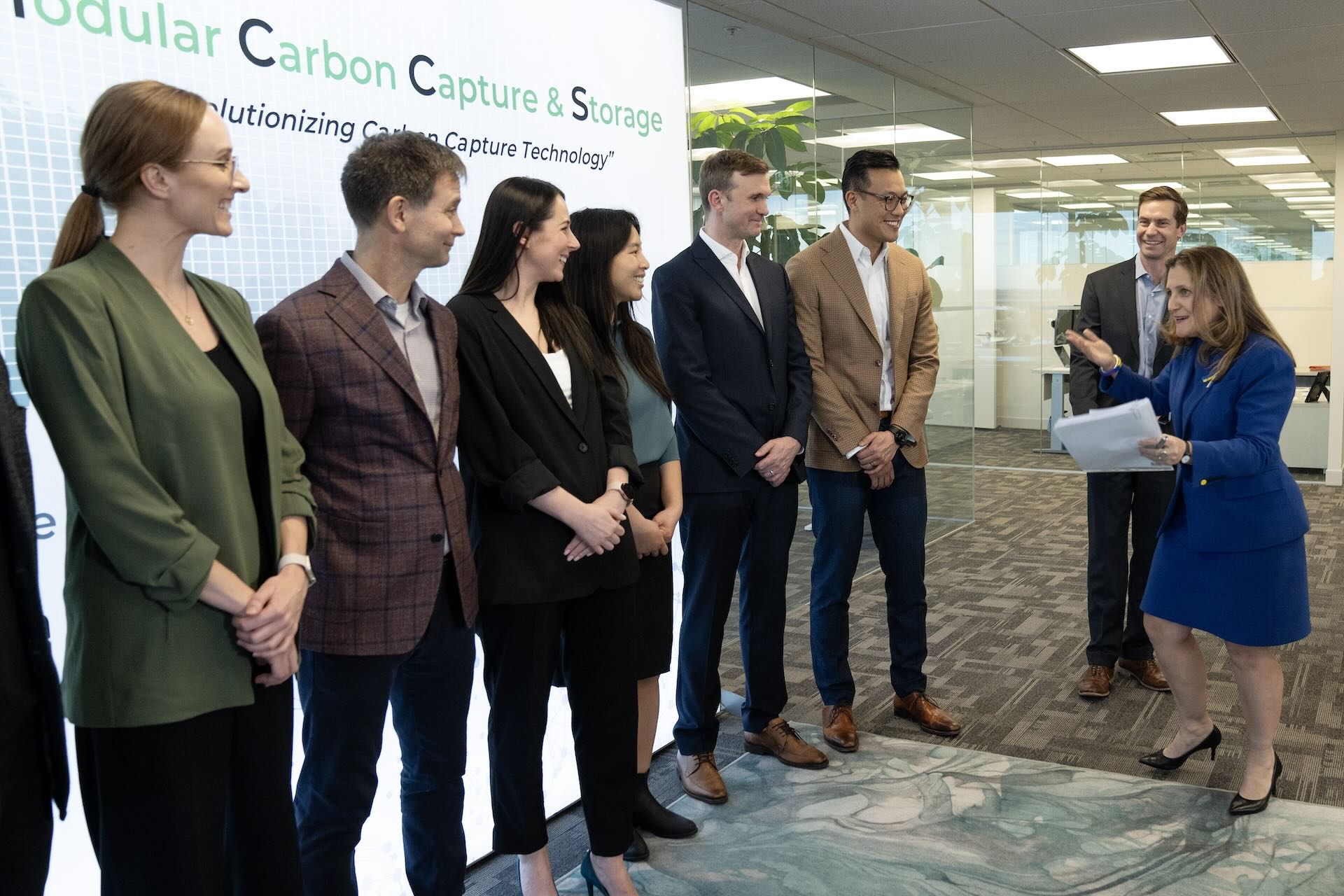
Deputy Prime Minister Chrystia Freeland meets with staff from Entropy in December 2023. Photo: The Canadian Press/Todd Korol
“The problem is, there’s no product,” Belenkie said. “It’s an environmental attribute. And you can’t eat an environmental attribute. You can’t put it in your car, you can’t heat your house with it, you can’t wear it to keep you warm.”
In response, governments have sought to fill the gap, putting a floor under the per-tonne value of carbon credits with the help of CCFDs. In its latest fiscal update, Ottawa allocated $7 billion toward CCFDs out of the Canada Growth Fund, a sum that will account for nearly half of the new innovation program’s $15-billion budget. The fund will administer and distribute the CCFDs, and is already in discussions with various interested parties.
In a statement just after the announcement, Dale Beugin, executive vice-president of the Ottawa-based Canadian Climate Institute, said CCFDs play a crucial role in incentivizing further investment in decarbonization technology by establishing that floor on carbon credit prices.
“If firms don’t expect credits to be valuable, private investment won’t flow into low-carbon projects,” he said. “By guaranteeing value for Entropy’s carbon credits, this investment drives emissions reductions, without crowding out private investment.”
The Entropy deal marked the Canada Growth Fund’s first such contract, the first of what could become a major public cost on the government’s books. (While the contract is worth a maximum of $1.3 billion over 15 years, the fund will constantly be selling the credits it buys, and therefore won’t likely hold anything close to that upper limit at any given time.)
For the company, the contract was a significant milestone in a broader corporate shift years in the making.
Entropy is a spin-off of Advantage Energy, a mid-size oil and gas producer for which Belenkie also serves as CEO. Around five years ago, Belenkie—at that time Advantage’s chief operating officer—began developing a standalone company that, rather than producing oil, would focus on capturing carbon.
“It became important for us to ensure that our company will be strong regardless of what policies are thrust upon us by the government,” he said.
Governments—particularly following the 2015 election of Prime Minister Justin Trudeau—were outlining plans to introduce increasingly stringent environmental policies, from carbon taxes to clean fuel standards. Advantage, long a so-called “pure-play” company focused solely on drawing hydrocarbons out of deep underground formations, had to adapt.
“While I do believe that natural gas is the largest force for good [toward] decarbonizing in a global sense, governments don’t always see it that way,” Belenkie said.
“We started to recognize that this was a reality—and accepted it as reality—five years ago,” he said.
Belenkie purchased the IP for Entropy’s technology from the University of Regina, where researchers had toiled for years but were unable to commercialize their post-combustion carbon capture technology.
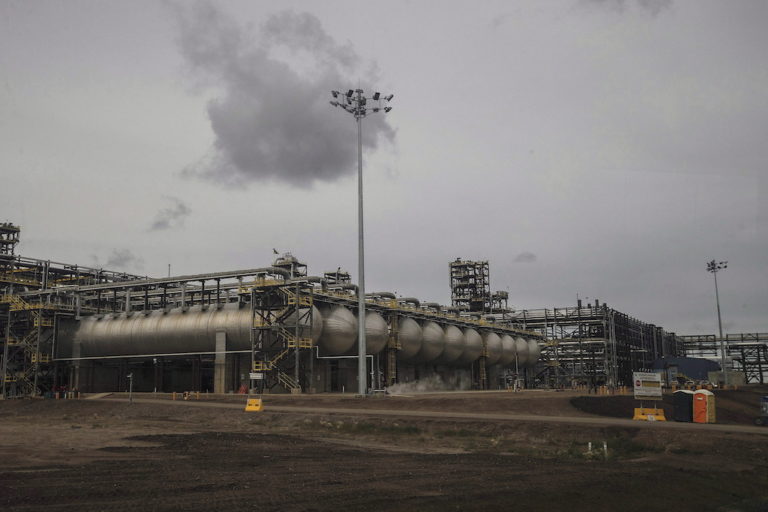
Entropy, which is also backed by Toronto’s Brookfield Renewable Partners, dusted off the technology and installed it at its Glacier facility, which processes around 400 million cubic feet of natural gas per day from a reservoir 300 metres thick. The technology works by taking industrial exhaust and mixing it with a solvent that clings to CO2 molecules. The solvent-exhaust mixture is then pumped into a large cylinder and heated, after which the CO2 is separated, transported and stored. The technology is modular and can fit onto a variety of commercial facilities, like concrete plants.
The company started developing the technology just as the broader energy industry began to enter a period of existential change.
For decades, the oil patch was personified by so-called “wildcatters,” the high-stakes gamblers who punched holes into unproven geological reservoirs in search of oceans of oil. That high-risk mentality brought with it massive amounts of cash generation and severe volatility—and spawned its share of big personalities.
Today, environmental concerns have restrained the sector’s growth and clouded expectations. Amid concerns over ESG-minded finance, tightening regulations and uncertainty over long-term fossil-fuel demand, investors have come to prefer efficiency and stability. In turn, some producers are as focused on what to do with their emissions as how to produce hydrocarbons in the first place.
“It’s [about] disciplined corporate management, and there’s no tolerance for risk and for irresponsible spending,” he said. “So in some ways, it’s taken some of the excitement and speculation out of oil and gas, and focused it back on being a fundamental business that generates value for investors.”
For Entropy, that will mean drilling down on its plans to sequester carbon, which it will now receive at least $86.50 per tonne to do. The company’s Glacier project is currently just one of four commercial projects in the world that uses post-combustion carbon capture to gather emissions (the other Canadian project is SaskPower’s Boundary Dam facility). The $100-million second phase of Glacier, which came online in 2022, brought the facility’s total CCS capacity to 200,000 tonnes of CO2 equivalent per year.
Entropy is in discussions with other companies to add more CCS capacity to its portfolio, and has already publicized plans to install its technology at Athabasca Oil’s Leismer site in northern Alberta.