The Bank of Canada cut its benchmark interest rate a quarter point, dropping the rate private lenders use to calculate borrowing costs to 2.25 per cent. Governor Tiff Macklem offered unusually explicit guidance that this probably will be the last adjustment for a while, unless current conditions change dramatically. “Governing Council sees the current policy rate at about the right level to keep inflation close to two per cent while helping the economy through this period of structural adjustment,” Macklem said in prepared remarks.
Skip to content


News
Bank of Canada again cuts key interest rate as economy flags in the face of U.S. tariffs
It’s the central bank’s second quarter-point cut since March, dropping the benchmark rate to 2.25%—but Macklem warns it’s likely the last one for a while
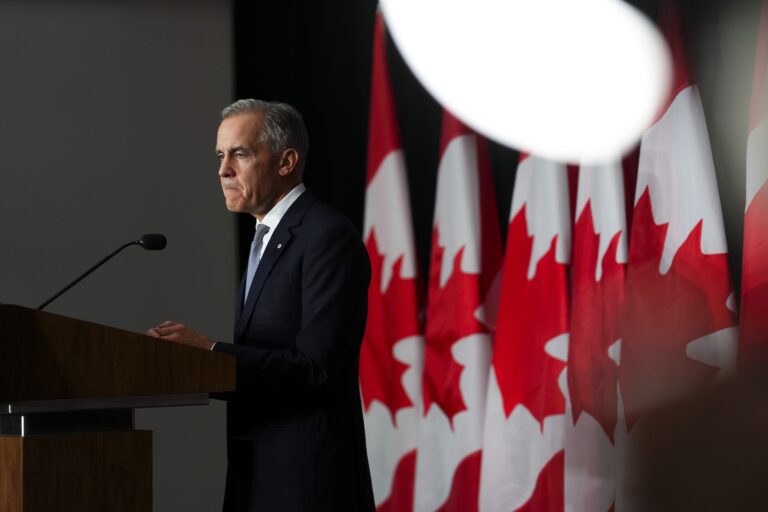
Bank of Canada Governor Tiff Macklem at a May 2025 news conference in Ottawa. Photo: The Canadian Press/Adrian Wyld
The Bank of Canada cut its benchmark interest rate a quarter point, dropping the rate private lenders use to calculate borrowing costs to 2.25 per cent. Governor Tiff Macklem offered unusually explicit guidance that this probably will be the last adjustment for a while, unless current conditions change dramatically. “Governing Council sees the current policy rate at about the right level to keep inflation close to two per cent while helping the economy through this period of structural adjustment,” Macklem said in prepared remarks.
Locked in: The most significant development Wednesday was the Bank of Canada’s decision to state clearly that it’s probably done all it can to counter the effects of U.S. tariffs. Central banks typically prefer ambiguity to leave themselves with some room to maneuver, and to avoid skewing market behaviour. They turn to more explicit forward guidance at times of stress, when clarity about the path of interest rates might bolster confidence amid heightened uncertainty.
This is such a time. The Bank of Canada published a proper economic forecast for the first time since January, as tariff rates have settled enough to make guesses about where the economy is headed with a degree of confidence. The outlook has business investment declining this year and remaining unchanged in 2026. The central bank also dropped its estimate of how much the economy can grow without stoking inflation, to a range of 0.4 per cent and 1.4 per cent in 2026 and 1.3 per cent to 2.3 per cent in 2027.
Related Articles

Smaller, slower: Those estimates are a good numerical representation of how U.S. President Donald Trump’s trade policies have shrunk the Canadian economy. Think of it like trying to power a pick-up truck with an engine from a compact car.
The Bank of Canada predicts the economy will avoid recession. It sees gross domestic product growing 1.2 per cent this year and 1.1 per cent in 2026. That’s weak growth, but also at the red line of what the central bank estimates the economy can handle without overheating. Macklem’s primary job is to keep inflation at about two per cent. The dials that policymakers watch to monitor underlying price pressures are hovering around 2.5 per cent, suggesting more stimulus could push inflation off target.
“The Canadian economy faces a difficult transition,” the central bank said in the statement explaining the rate cut. “The structural damage caused by the trade conflict reduces the capacity of the economy and adds costs. This limits the role that monetary policy can play to boost demand while maintaining low inflation.”
Where to from here: In some ways, Macklem’s tour of duty in the trade war is over. He’s retiring to the watchtower where he and his deputies will monitor the economy to make sure things are unfolding as they predicted. “We need to be humble about our forecast,” he said. “If the outlook changes, we are prepared to respond.”
Trump’s upset over Ontario’s anti-tariff ad is an example of how uncertain things are. The federal budget, and then the provincial plans that follow, could boost growth—and maybe even the economy’s potential to handle faster growth. Maybe China drops its tariffs on Canadian farm goods.
The Bank of Canada said the biggest threats to inflation are tariffs and trade agreements that lower sector-specific duties on aluminum, steel, automobiles and/or lumber. (The latter might be welcome, as it would bring stronger growth. The former would be bad: it could force the central bank to raise interest rates even though the economy is weak.) The central bank said the biggest threats to growth are continued trade uncertainty and a financial crisis triggered by the stock market bubble and the “rapid increase” in global government debt.
The watchtower will be as stressful as the front lines.



Loading...
Thanks for sharing!
You have shared 5 articles this month and reached the maximum amount of shares available.
CloseThis account has reached its share limit.
If you would like to purchase a sharing license please contact The Logic support at [email protected].
CloseGift the full article!
You have gifted 0 article(s) this month and have 5 remaining.
Recipients will be able to read the full text of the article after submitting their email address. They will not have access to other articles or subscriber benefits.
Photo: The Canadian Press/Adrian Wyld
Most Popular This Week



In-depth, agenda-setting reporting
Great journalism delivered straight to your inbox.
News
Panel decries Canada’s chaotic way of funding world-class science
Briefing
Feds pledge $15M for U.S. satellite navigation company Xona to expand in Montreal
Inovia raises US$200M for new VC fund as it eyes AI’s impact
43% of eligible Albertans voted ahead of Monday’s referendum
Best business newsletter in Canada
Get up to speed in minutes with insights and analysis on the most important stories of the day, every weekday.
Exclusive events
See the bigger picture with reporters and industry experts in subscriber-exclusive events.
Membership in The Logic Council
Membership provides access to our popular Slack channel, participation in subscriber surveys and invitations to exclusive events with our journalists and special guests.





