Seven in 10 readers responding to The Logic’s latest subscriber survey said increased capital-gains taxes in the federal government’s 2024 budget will not be good for the Canadian economy.
Skip to content
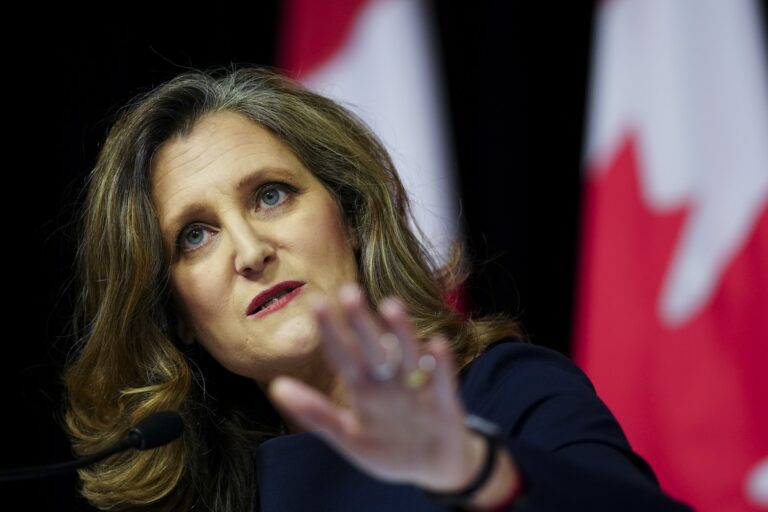
 Finance Minister Chrystia Freeland with a copy of the 2024 federal budget in Ottawa on April 16. Photo: The Canadian Press/Sean Kilpatrick


Subscriber Survey
More than 70% pan capital-gains tax measures in Logic subscribers’ survey
Most respondents doubt federal budget will address needs of Canadian businesses
Finance Minister Chrystia Freeland with a copy of the 2024 federal budget in Ottawa on April 16. Photo: The Canadian Press/Sean Kilpatrick
Seven in 10 readers responding to The Logic’s latest subscriber survey said increased capital-gains taxes in the federal government’s 2024 budget will not be good for the Canadian economy.
Finance Minister Chrystia Freeland’s budget, tabled last week, announced the tax increase along with funding announcements for areas like housing supply, AI computing power, open banking and loan guarantees for Indigenous communities.
The budget projected a declining ratio of debt to gross domestic product. But as The Logic’s David Reevely reported, the Liberal government achieved that mark, and will fund its new spending, in large part by increasing taxes on capital gains—the profits from selling assets like stocks, bonds, crypto and real estate.
Starting June 25, at an annual threshold of $250,000, the percentage of a capital gain counted as taxable income, known as the “inclusion rate,” will rise from half to two-thirds for individuals. For corporations, capital gains starting from zero will be taxed at the new higher rate. High-profile tech leaders argued last week that the changes will discourage investment, drive entrepreneurs out of Canada and hurt efforts to attract talent.
About 60 per cent of The Logic’s survey respondents said the higher taxes would not have a positive impact on Canada, while 11 per cent answered “mostly no.” Only about a quarter said yes or “mostly yes.”
Many comments on the change were deeply negative, with some respondents using words like “catastrophic” and “totalitarian” to describe the increase.
The increase “will have a profound psychological impact on entrepreneurs who are increasingly disincentivized to remain in Canada,” one reader said. “This will result in an exodus of entrepreneurial-minded people to friendlier jurisdictions where they are more valued.”
Related Articles


Another reader said their daughter, who is a physician, will likely try to leave Canada due to the changes. (Many doctors incorporate their medical practices and invest from them, meaning all their capital gains will be taxed at the higher inclusion rate.)
Others agreed with the move, saying the tax change applied only to a “small, privileged cohort” and it was the “least bad way” to raise funds to address the housing crisis.
“The main target of this measure is actually senior executives, who receive their compensation in stock to avoid paying the same tax rate as others,” a dissenting reader wrote. “I’d have preferred a more targeted measure that avoided hitting risk capital, but on the whole this is an important fairness measure.”
While other key pieces of the budget drew less criticism, a sizable majority of readers surveyed were unsatisfied with the fiscal blueprint overall. About 72 per cent said the budget’s measures were not or “mostly not” adequate to address the needs of Canadian businesses.
A $2-billion investment to increase computing power available to Canadian AI firms and researchers got a tepid response: one-third said they didn’t know whether it was enough to address Canada’s needs; just four per cent said it was enough.
“It’s a start and better than we were,” one reader said. “But Microsoft alone for its own use, let alone state actors like China, invest way more than this. It will depend on how exactly it is deployed.”
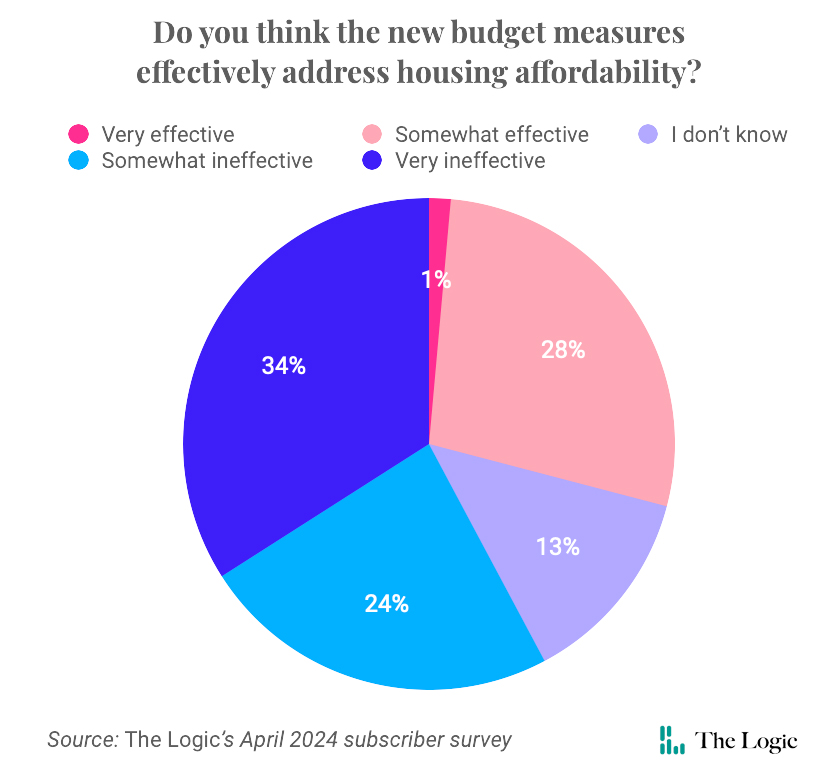
On housing, the budget included a new $6-billion construction fund for provinces and municipalities, as well as policy changes such as tax incentives for builders and plans to use transit funding to push cities to allow higher-density housing. Readers were pessimistic about the proposals: one-third of respondents said the budget’s measures will be very ineffective in addressing the housing crisis, and another quarter rated it as somewhat ineffective.
Only about one per cent scored it as very effective.
Many readers suggested cutting immigration rather than using public funds to build housing (though the relationship between housing and immigration is complex). Others called for cuts to red tape, and worried the capital-gains tax increase will make housing even less affordable.
“This is a tanker that has been heading in this direction for 40 years thanks to successive governments, so it will take a while to turn around,” one reader said. Another wrote that the scale of the proposals are “roughly half of what we need in terms of the rental markets.”
The survey also asked subscribers what the budget was missing. Measures to improve productivity was a common answer, as was reducing waste in the public sector, increasing defence spending to meet NATO targets and more support for technological innovation. One subscriber said they’d been hoping for an initiative modelled after the U.S. Small Business Innovation Research program, which provides federal funds to startups for research and development.
Another noted that much of the promised $1.8 billion federal research dollars were slated for after 2025. “Most of the ‘historic’ investment … will occur after the next election, and therefore it is an investment that may never materialize.”
The capital-gains tax was the most popular answer to a question about the most impactful measure in the budget, though some subscribers singled out the housing funding. “Positive: money for addressing housing and not increasing the deficit to do it,” one approving comment read.
Another reader said the capital-gains tax increase will make little difference, and cited the housing measures, a $5-billion Indigenous loan guarantee program and a new National Space Council as the most significant changes. “I am not that concerned about the impact of the capital-gains changes on investment,” the reader said. “I think that our sluggish investors aren’t likely to change their behaviour that much.”
Methodology
The Logic emailed subscribers a private link to an online survey on April 19 and the survey closed April 23. Respondents’ identities were kept anonymous. Subscribers were first asked, “Do you think the measures included in the Liberals’ federal budget are adequate to address the needs of Canadian businesses?” They could answer: “Yes,” “Mostly yes,” “I don’t know,” “Mostly no” or “No.”
Next, respondents were asked, “The budget proposes increasing the taxable portion of capital gains (the profit made on a sale of assets) above $250,000 from half to two-thirds. Do you think this will be a positive change for the Canadian economy?” They could answer: “Yes,” “Mostly yes,” “I don’t know,” “Mostly no” or “No.”
They were asked: “The budget proposes $2 billion to increase AI computing power and $50 million for an AI safety institute. Do you think those measures are enough to address Canada’s AI needs?” They could answer: “Yes,” “Mostly yes,” “I don’t know,” “Mostly no” or “No.”
Readers were asked, “How effective do you think the measures in the budget will be in addressing housing affordability?” They could answer: “Very effective,” “Somewhat effective,” “I don’t know, “Somewhat ineffective” or “Very ineffective” or “No.”
Finally, they were asked two open-ended questions where they could write their own answers: “What budget measures do you think will have the greatest impact—positive or negative—on Canada’s economy?” and, “What do you think was missing in this year’s budget?”



Loading...
Thanks for sharing!
You have shared 5 articles this month and reached the maximum amount of shares available.
CloseThis account has reached its share limit.
If you would like to purchase a sharing license please contact The Logic support at [email protected].
CloseGift the full article!
You have gifted 0 article(s) this month and have 5 remaining.
Recipients will be able to read the full text of the article after submitting their email address. They will not have access to other articles or subscriber benefits.
Photo: The Canadian Press/Sean Kilpatrick
Most Popular This Week




In-depth, agenda-setting reporting
Great journalism delivered straight to your inbox.
Commentary
Carmichael: Being boxed in will help Canada focus on what matters
Briefing
Rio Tinto gets nearly $165M in additional federal funds for Quebec aluminum
U.S. to lift tariffs on some Canadian products crucial to Maine: Collins
Carney warns of tech dependence after Starlink disruptions in Ukraine
Best business newsletter in Canada
Get up to speed in minutes with insights and analysis on the most important stories of the day, every weekday.
Exclusive events
See the bigger picture with reporters and industry experts in subscriber-exclusive events.
Membership in The Logic Council
Membership provides access to our popular Slack channel, participation in subscriber surveys and invitations to exclusive events with our journalists and special guests.






