OTTAWA — Finance Minister Chrystia Freeland’s new federal budget sticks within her fiscal guardrails by taking maximum advantage of economic strength—and tax hikes.
Skip to content
Analysis
Freeland’s budget keeps to fiscal guardrails, with help from a capital-gains tax hike on wealthiest
Strong revenues give Liberals breathing room the budget uses—and then some
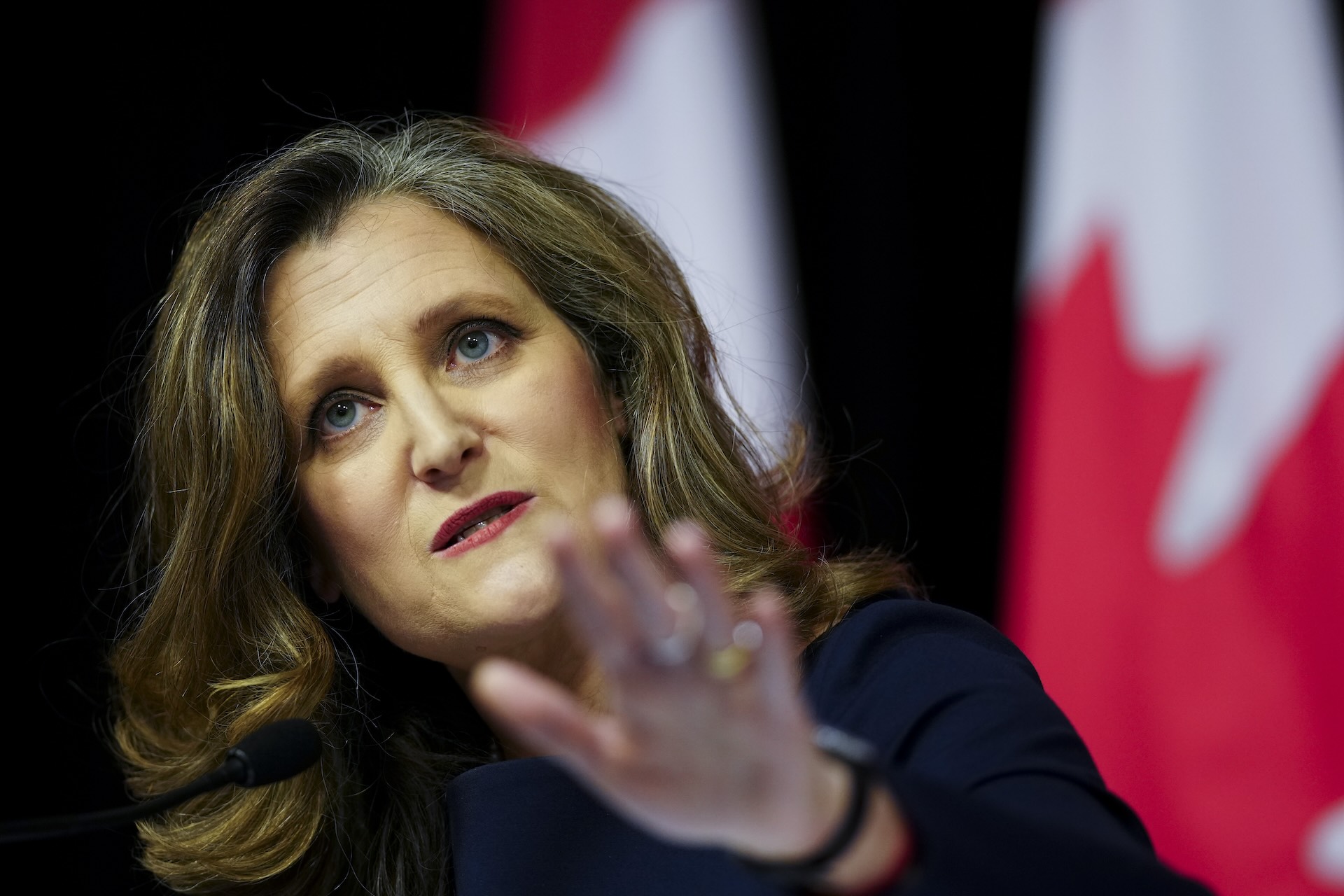
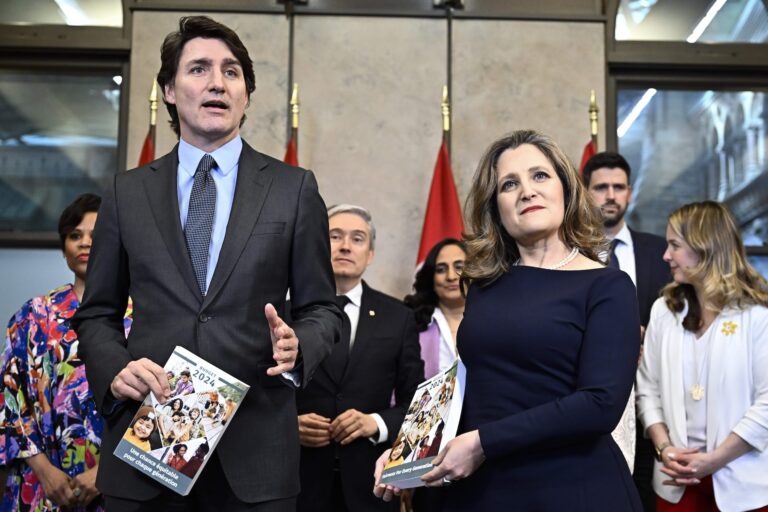
Finance Minister Chrystia Freeland speaks to reporters in Ottawa on April 16. Photo: The Canadian Press/Sean Kilpatrick
OTTAWA — Finance Minister Chrystia Freeland’s new federal budget sticks within her fiscal guardrails by taking maximum advantage of economic strength—and tax hikes.
The government is booking $7.7 billion more in income-tax revenue in the 2023-24 fiscal year than it expected as recently as Freeland’s fall economic statement last November. Her department projects multibillion-dollar bumps each year until 2028-29, the limit of the projections.
Talking Points
- Chrystia Freeland’s new budget keeps to her fiscal anchors
- It spends all of an unexpected tax windfall and raises taxes more to manage the trick
Freeland is spending all of that extra money and then some, in a budget that projects a $39.8-billion deficit this fiscal year, while the federal debt climbs 3.3 per cent to $1.255 trillion.
In the text of her budget speech, the finance minister argued this is the cost of giving younger Canadians “a fair chance to build a good, middle-class life.”
The alternative is dystopia, Freeland said.
“Do you want to live in a country where those at the very top live lives of luxury—but must do so in gated communities, behind ever higher fences, using private health care and airplanes, because the public sphere is so degraded and the wrath of the vast majority of their less privileged compatriots burns so hot?” she asked.
Budgets always demand educated guesses about the future, but there are some iffy parts to the government’s new projections, pointed out Charles St-Arnaud, the chief economist at Alberta Central and a former Finance Canada official. The budget anticipates weaker economic growth in Canada this year (0.7 per cent) than other major forecasts. The Bank of Canada, notably, projects growth of 1.5 per cent.
Read more from Federal Budget 2024

“If it happens, the deficit will be smaller,” St-Arnaud said. This is effectively what happened between the fall economic statement and the budget—and the government has spent all that unexpected money.
On the flip side, he said, the new budget anticipates fairly aggressive interest-rate cuts over the rest of the year and in the next few, which means it makes optimistic assumptions about the cost of the government’s ever-rising debt.
Much of the new spending is aimed at problems that whole sectors have been screaming about for years: housing; productivity and the green transition; defence; Indigenous Peoples’ rights and prosperity; the costs of dental care and medicine.
There’s big money for science and academic research, after last year’s fiscal plan left universities furious over a “bupkis budget.” For a year, the government did nothing with a pound-the-red-button report from the government’s own experts about inflation-impoverished grants and scholarships for some of Canada’s best brains, payments that had barely budged in 20 years.
It’s not as much as the universities wanted, but it’s still a lot: $1.8 billion over five years, and nearly $750 million each year thereafter, for the “granting councils” that fund academic research. Graduate scholarships are being consolidated and boosted, by an amount just shy of $200 million a year after a five-year ramp-up. Master’s students will see an increase from $17,500 a year to $27,000; postdoctoral researchers will be eligible for $70,000, which is as much as the most elite federal support program pays now.
Related Articles


The budget also pledges hundreds of millions for Canada’s major multi-university research facilities (though not the rethink of how they’re funded that they seek).
Small businesses are getting a rebate on their carbon-tax payments—retroactive to 2019, a tacit admission the government ought to have done this years ago. The result is a whopping $2.57 billion in those “urgent” retroactive payments to an estimated 600,000 businesses this year and another $625 million next year.
“This real, meaningful support is a testament to our commitment to Canada’s small businesses,” Freeland said in her speech.
An unsexy, expensive, decades-overdue government IT project, overhauling the antiquated systems that process benefits payments like EI and old-age pensions, gets a couple of paragraphs in the 416-page budget—to be allocated an additional $2.9 billion over five years.
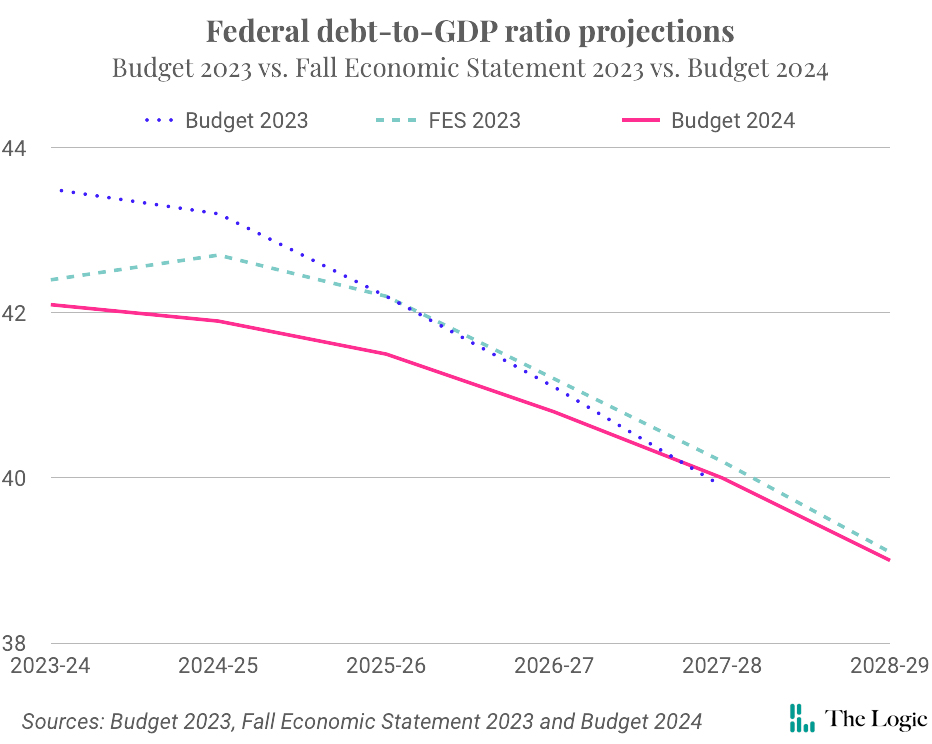
All the increased spending is more than the unexpectedly positive revenue numbers can cover. Yet Freeland’s budget remains true to the key fiscal guardrail she’s set for herself: a declining ratio of debt to gross domestic product. If anything, that ratio looks slightly better in the new budget than it has in the government’s last few look-aheads.
There is, of course, a catch: billions of dollars in tax increases. The government intends to charge higher taxes on capital gains—what you make by selling assets like shares, bonds, crypto and real estate, as opposed to doing paid labour.
The people drafting the budget for this Liberal finance minister worked hard to explain why this is fair and just. That a Royal Commission under former Tory prime minister John Diefenbaker declared that “a buck is a buck is a buck” and should be taxed that way is one such flourish, and the document follows up by pointing out that, even with the newly proposed increase, capital gains will still be treated more generously under Justin Trudeau than they were under Brian Mulroney.
Forty thousand Canadians will be affected by the tax increase, the budget says, and they have average gross incomes over $1.4 million. Businesses will also be covered, but the change will affect 307,000 corporations out of more than 2.4 million (based on 2022 figures).
The change is “to make Canada’s tax system more fair,” the budget says.
It also will add $6.9 billion to government revenue this year, the budget says, and more than $19.3 billion over five years.
Kevin Carmichael examines what this could mean for entrepreneurs and business investment; it undeniably means Freeland can meet her fiscal target even as the federal government does more and spends more.



Loading...
Thanks for sharing!
You have shared 5 articles this month and reached the maximum amount of shares available.
CloseThis account has reached its share limit.
If you would like to purchase a sharing license please contact The Logic support at [email protected].
CloseGift the full article!
You have gifted 0 article(s) this month and have 5 remaining.
Recipients will be able to read the full text of the article after submitting their email address. They will not have access to other articles or subscriber benefits.
Photo: The Canadian Press/Sean Kilpatrick
Most Popular This Week




In-depth, agenda-setting reporting
Great journalism delivered straight to your inbox.
News
Canada faces a satellite-launch crunch as SpaceX retires its workhorse rocket
Briefing
Cohere says it caught an Alibaba model trying to send data to a server in China
Feds and First Nations to work on sharing resource revenue, with a sovereign wealth fund one option
Zafin buys U.S. fintech Naehas in nine-figure deal
Best business newsletter in Canada
Get up to speed in minutes with insights and analysis on the most important stories of the day, every weekday.
Exclusive events
See the bigger picture with reporters and industry experts in subscriber-exclusive events.
Membership in The Logic Council
Membership provides access to our popular Slack channel, participation in subscriber surveys and invitations to exclusive events with our journalists and special guests.