Canadian businesses appear to have mostly stalled on progress in diversity, equity and inclusion, according to findings from The Logic’s latest subscriber survey.
Almost two-fifths of respondents, at 38 per cent, said that either nothing has changed or DEI progress has been lost in their industries in recent years, after many businesses pledged to improve DEI at their organizations in response to Black Lives Matter protests.
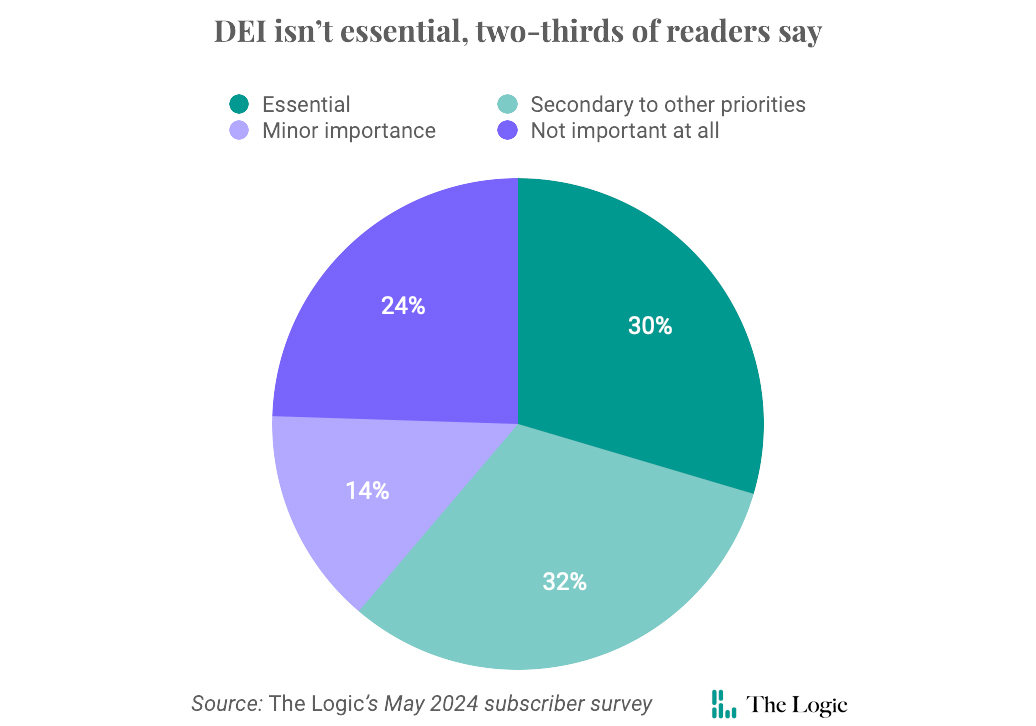
When asked about the significance of DEI for businesses, one out of four respondents said they weren’t important at all. One-third of subscribers said they were secondary to other priorities, while about 30 per cent said such programs are essential.
In the last 18 months amid the downturn, tech firms including Alphabet, Meta, Zoom, Snap and DoorDash made deep cuts to DEI initiatives, laying off employees and ending training programs. There were also fewer mentions of DEI on earnings calls in 2023, compared to the previous year.
Gaps in diversity and inclusion in tech and related industries remain. The Business Development Bank of Canada found last year that almost half of Canadian venture capital firms don’t have a single woman among their general partners. A report by Montreal non-profit QueerTech this month found that despite DEI initiatives, many queer tech employees face harassment and discrimination.
Some Logic readers said there was intense pressure to create DEI programs in 2020—when many companies made pledges after George Floyd’s death—that has since lessened. “Funding has been cut for programs and there has been a slight shift in focus away from the programs,” one subscriber wrote.
Subscribers said they’ve seen some progress, including hiring more women into management and technical roles. One said the shift to remote work has also made it easier to hire on merit rather than relying on personal connections: “It’s easier for candidates with language barriers or physical disabilities to engage. I’ve also seen a lot of companies leverage an immigration-friendly environment to help sponsor more diverse hires.”
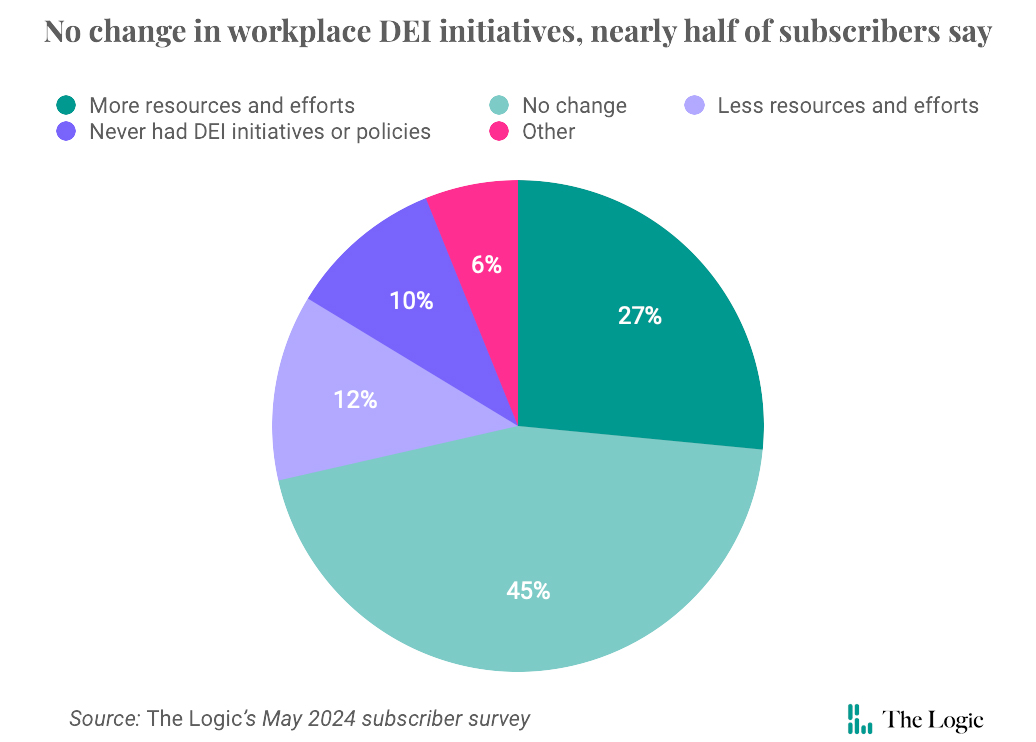
Almost half, at 45 per cent, said there has been no change to their workplace’s DEI efforts in the last 12 months, while about a quarter said more effort has gone into the programs. Several respondents said budget cuts meant smaller HR teams; some who work at startups said they never had an HR team to begin with.
More than half of respondents said their workplaces offer DEI-related programs, while about a third did not. About 16 per cent have staff who work exclusively on DEI; many more, at 41 per cent, said staff assigned to DEI tasks also have other responsibilities. About 39 per cent said they did not have any staff working on DEI initiatives at their organization.
“We used to, but when we reduced the HR team it’s now carried by founders and SLT [the senior leadership team],” a reader wrote.
Recruitment policies, training programs, workplace-wide goals and staff surveys were the most common DEI initiatives, though none received more than 45 per cent of votes.
About 32 per cent said none of the listed programs existed at their organization.
Some readers said diversity, equity and inclusion are important but need to be built into a company’s core culture rather than in standalone initiatives. “It is odd to me the relentless focus on having this as a separate thread to running a business. It should be integrated into the strategy and planning, not a box-checking exercise for the sake of it,” a respondent wrote.
Others wrote in to describe their disdain for DEI programs. One subscriber said “it’s a distraction and reduces productivity.” Several subscribers said DEI programs are themselves racist, echoing criticisms spread widely by billionaires Elon Musk and Bill Ackman.
Readers were asked to write in about what they believed to be the most pressing issues related to diversity, equity and inclusion. One mentioned collecting accurate employee data to track the current state of diversity and inclusion, while others pointed to Indigenous reconciliation and a lack of Indigenous inclusion in Canadian tech.
“Economic diversity is such an important thing that goes overlooked,” one reader wrote. “My workplace, which is ‘diverse’ in the most visible ways (race, gender), still hires from only the most elite private institutions and pedigreed backgrounds. Scratch below that surface and it feels like true diversity is something we are still not interested in, nor pursuing.”
Another said they’re worried that searching for “culture fit” often excludes new immigrants: “Canada’s habit of looking for ‘local experience’ as a filter for people with language and cultural fit is a massive problem that gets little attention. There are few advocates for newcomers, and integrating our recent immigrants faster is one of the best ways to drive national productivity.”
Some said DEI programs need to be reframed. “DEI is often weaponized and overshadowed by debates around hiring quotas,” a reader argued.
“Instead, the focus should shift towards creating inclusive spaces where all individuals feel valued and respected. By fostering a sense of belonging, we can cultivate an environment of equal opportunity, attracting the best talent from diverse backgrounds and experiences.”
Methodology
The Logic emailed subscribers a private link to an online survey on May 22 and the survey closed May 24. Respondents’ identities were kept anonymous. Subscribers were first asked, “Based on your experiences, do you believe your industry has made progress in addressing diversity, equity and inclusion gaps since 2021?” They could answer: “Yes,” “No, no change,” “No, progress has been lost,” “I don’t know” or “Other.” Next, respondents were asked, “Does your workplace offer programs or resources related to diversity, equity and inclusion?” They could answer: “Yes,” “No” or “Other/I am self-employed.”
They were next asked: “Has there been a change in DEI initiatives and resources at your workplace in the last 12 months?” They could answer: “More resources and efforts have gone into DEI, “No change,” “Less resources and efforts,” “My organization has never had DEI initiatives or policies” or “Other (please elaborate below).”
Readers were then asked, “What DEI-related initiatives, programs or policies exist at your organization? Select any that apply.” They could answer: “Workplace-wide goals and/or a DEI strategy,” “Boardroom diversity criteria or quotas,” “Employee training programs,” “Employee resource groups,” “Recruitment policies,” “Employee benefits policies,” “Mentorship or coaching programs,” “Wellness programs,” “Staff surveys and feedback mechanisms, such as reporting helplines,” “Initiatives to track DEI metrics” and “None.” In the next question, readers were asked, “Is there anyone on staff tasked with initiatives related to diversity, equity and inclusion, as far as you know?” and could answer with “Yes, and that’s their only job,” “Yes, but they have other responsibilities,” “No” or “I don’t know.”
The last multiple-choice question asked “How important do you think it is for businesses to have strong policies/programs on diversity, equity and inclusion?” with the following options: “Essential,” “Secondary to other priorities,” “Minor importance” or “Not important at all.”
Finally, they were asked an open-ended question where they could write their own answers: “In your opinion, what is the most pressing DEI issue that needs to be addressed immediately?”