Francine Ford remembers attending a conference in a university’s physics department in the 1990s and not being able to find a women’s washroom. “I had to go a few floors down and over in some obscure area,” said Ford, who has been the executive director of the Canadian Association of Physicists for over three decades. “That automatically creates a sense of not belonging.”
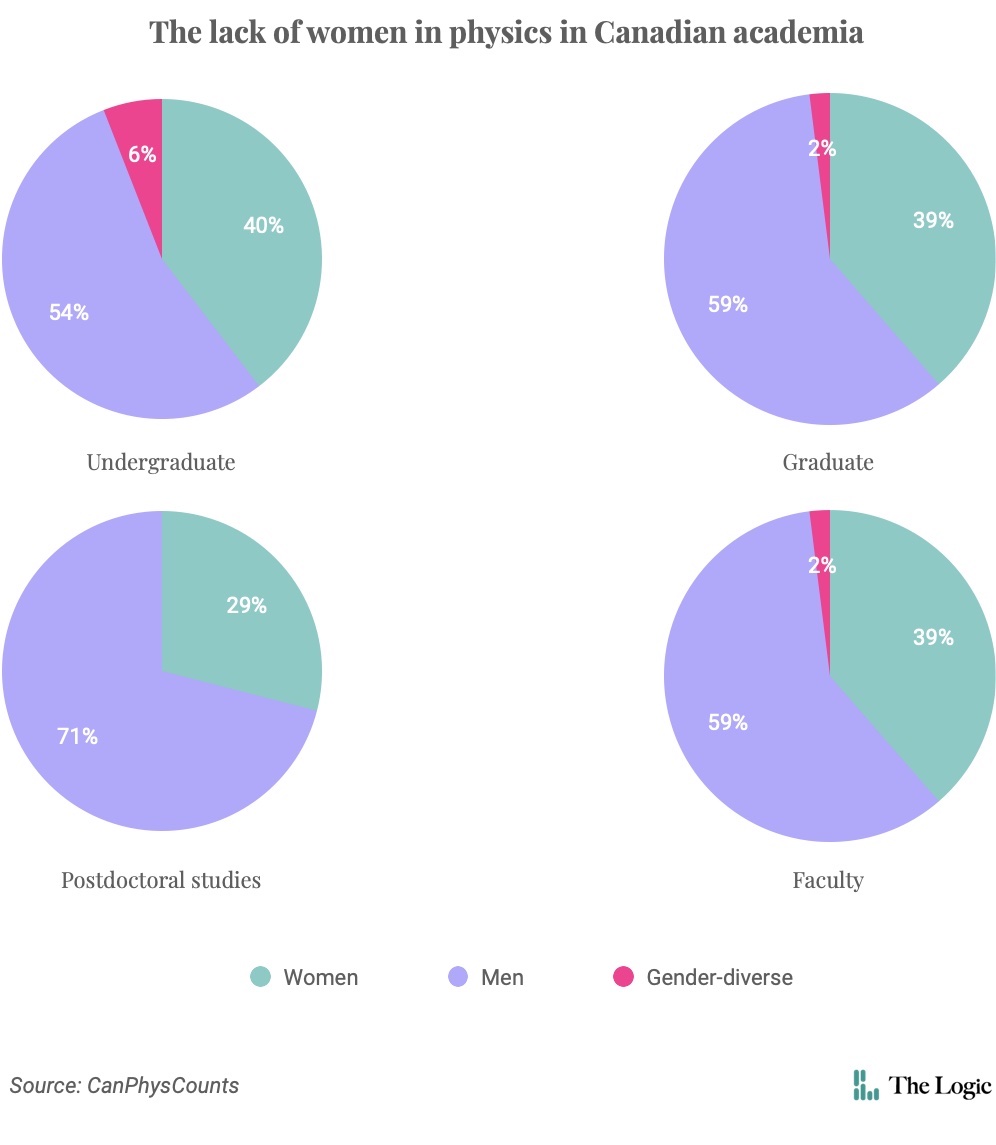
Although the restroom situation has improved in the decades since, Ford is concerned that the field still isn’t welcoming enough for women, discouraging them from pursuing a physics career. Men outnumbered women in physics almost two to one in academia and the workplace, according to a 2021 study by CanPhysCounts, Canada’s first national demographic survey of physicists by the Canadian Association of Physicists, Dalhousie University and Wilfred Laurier University.
Talking Points
- While many physics graduates end up working in tech and innovation, there is only one woman for every two men in physics workplaces and academia in Canada. That ultimately results in less gender diversity in the innovation economy
- Girls and young women need female physicists as mentors and role models, and inclusive workplace environments to help close the gap, experts and physicists say
Barriers for women in the field come from scarce female role models to look up to, biased gender perceptions in academia and workplace structures that don’t facilitate career growth for women, physicists told The Logic. If girls in high school aren’t inspired and the sector doesn’t build a more inclusive system, the country could lose out on a lot more than just scientific progress.
The numbers show a leaky pipeline. Despite female physics students achieving slightly higher grade averages than their male counterparts, fewer than one in three undergraduate physics students at the University of Waterloo and University of British Columbia are women. Across the country, 40 per cent of all physics undergraduates are women, shrinking to just 25 per cent at the faculty level, according to CanPhysCounts, a survey with 3,000 respondents.
The gender disparity in post-secondary physics departments could have wide-ranging talent implications for the innovation economy. Only 29 per cent of physics graduates in the government and private sector are women, according to CanPhysCounts.
The Canadian Association of Physicist’s website, for example, has a video series showing physics graduates in fields like medical imaging, video game development and financial analysis.
Many physics graduates land careers in finance and tech, said Alison Lister, associate physics professor at UBC and Canada Research Chair in experimental particle physics. She added that her students are frequently “snapped up” by Big Tech firms or hired by gaming companies in Vancouver.
“What can a [physics] degree buy me? And the answer is a whole bunch of things.”
“We’re not just training you to do physics,” said Lister. “‘What can a [physics] degree buy me?’ And the answer is a whole bunch of things.”
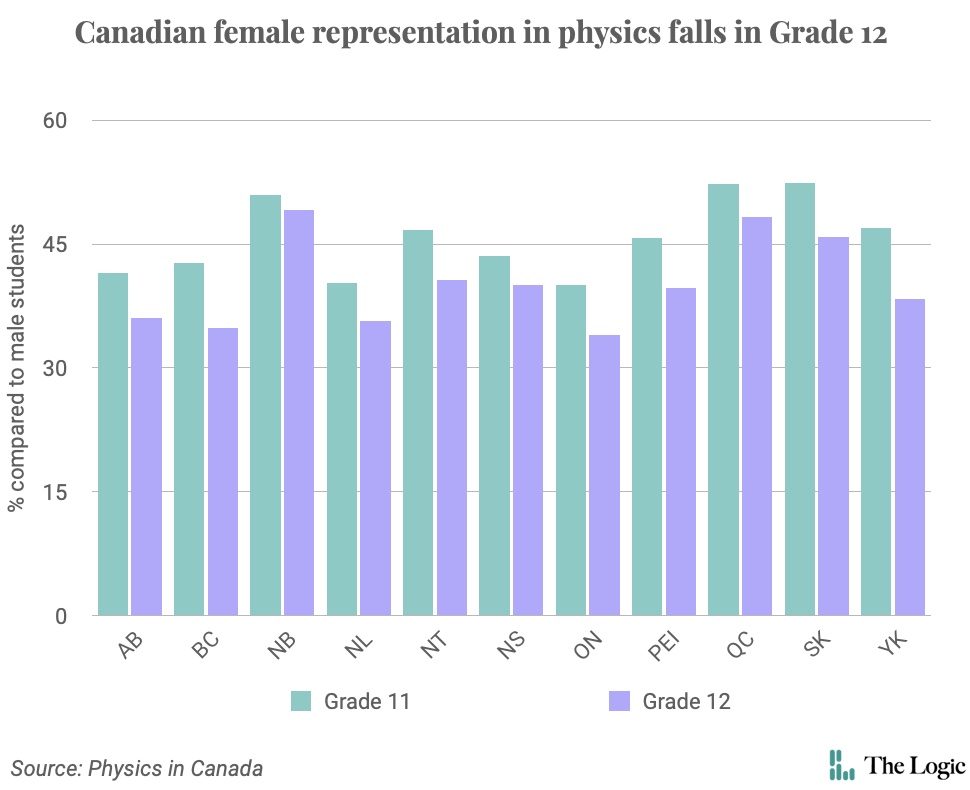
Part of the problem is a lack of awareness of the diverse career paths for physics students. A 2021 study published in the Physics in Canada journal showed that the percentage of female students in physics courses shrinks in Grade 12 compared to Grade 11 in every single province and territory.
The biggest issue for the lack of women in tech engineering roles lies in the low number of girls electing to take high school physics courses, said UWaterloo engineering dean Mary Wells at a Kitchener-Waterloo event hosted by The Logic in May. “That is the biggest pinch point we have right now.”
Women are more represented in other fields like medicine and business, but very few choose physics, said UWaterloo professor Donna Strickland, who won the Nobel Prize in physics in 2018 for her work in developing high-intensity laser pulses. “Parents are still telling kids to be doctors and lawyers; they’re not telling them to be physicists.”
In addition to parents, mentors can help aspiring women in physics see themselves in the field. Even women who didn’t pursue a graduate physics degree should become mentors because they’ve applied their undergraduate physics degree at the workplace, said Ford.
Having those realistic role models can help dispel the common misperception of physicists being “lone geniuses,” said Simone Têtu, a second-year math and physics undergraduate student at McGill University. “You hear about big names: Einstein, Feynman, Rutherford,” she said. “It’s a weird image to have for a field, when you want to be welcoming, to advertise it by showing the really cool work of, like, 10 white men of the 20th century.”
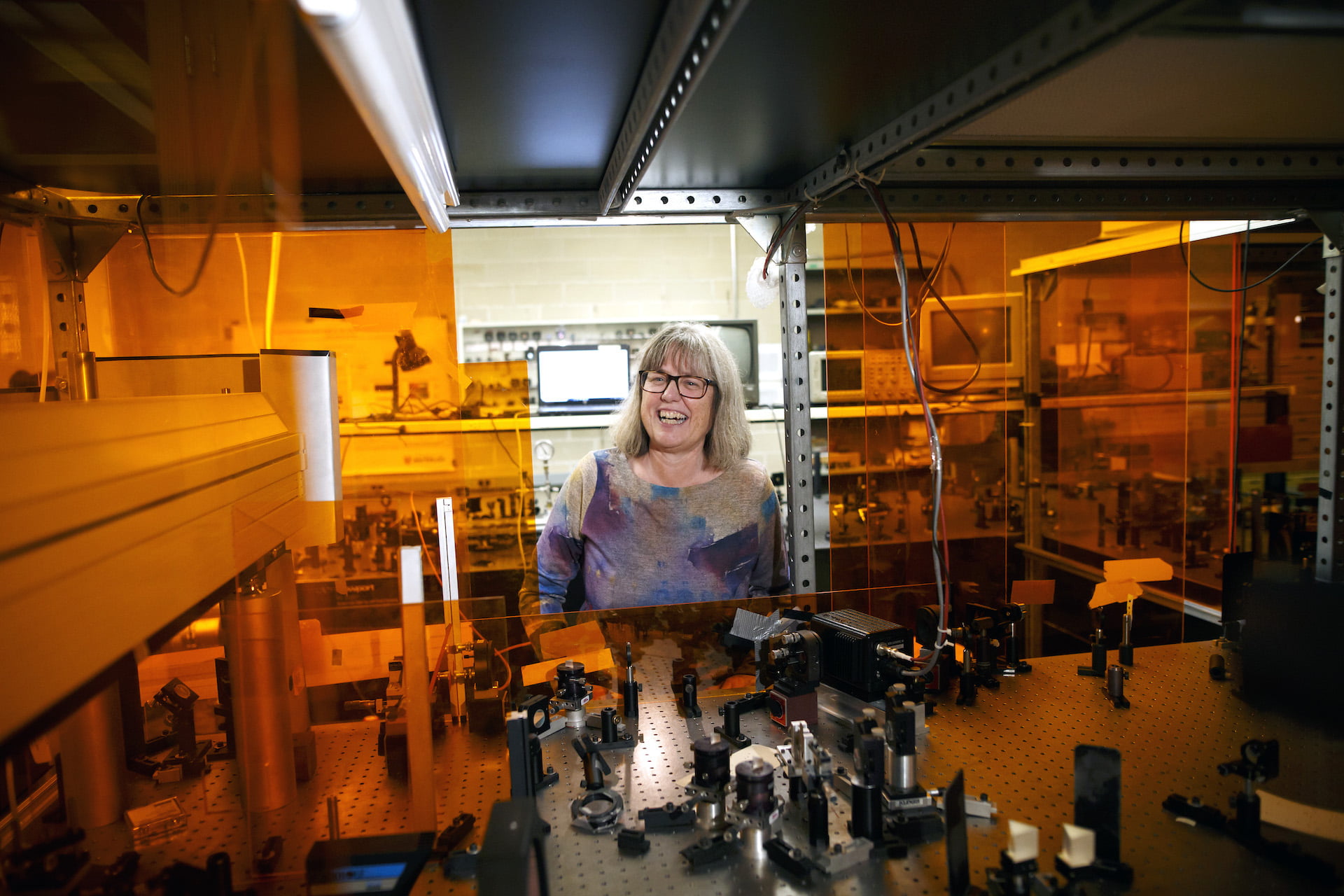
Professor Donna Strickland in her lab at the University of Waterloo in October 2018. Strickland won a Nobel Prize in Physics for her work on ultrashort lasers. Photo: Cole Burston/Getty Images
Women commonly aren’t acknowledged for their physics contributions, and historically men have taken or been given credit for the work of women scientists, a phenomenon known as the “Matilda effect,” said Shohini Ghose, a physics professor at Wilfrid Laurier University and author of Her Space, Her Time, a book detailing the stories of women in physics and astronomy who have largely been unacknowledged. “There is absolutely a deletion of [the] contributions of women,” she said.
With many physics graduates working in tech, building fair workplace structures matters as much as plugging the leaky pipeline. The tech ecosystem, in general, lacks diversity-enabling infrastructure to support women, said Allison Clark, a research and policy analyst at the Information and Communications Technology Council. A report the council published last year found algorithmic biases with job postings, where senior tech positions were shown more to men than to women. Clark said hiring managers can share job openings directly to women’s social media groups to make opportunities more accessible.
While tech firms may have great diversity and inclusion policies, they may not be evenly enforced by individual managers, said Clark. For example, some managers were less direct with women and didn’t provide as much constructive criticism in performance reviews as to men because they didn’t want to hurt female employees’ feelings. “Although it might be unconscious … it’s actually adversely affecting women and their ability to advance in their careers,” she said.