Skip to content

Canada's Business and Tech Newsroom

  • Professional Subscription
  • Partnerships & Advertising
  • Licensing & Syndication
Log In Subscribe
Welcome,
  • My Account
  • Log Out
  • Business
  • Tech
  • National
  • The Big Read
  • Briefings
  • Commentary
Search
Log In Subscribe
Welcome,
  • My Account
  • Log Out
Commentary

Carmichael: Pushback begins against Freeland’s pension plan

When Chrystia Freeland proposed tapping the $3 trillion in assets at the country’s pension funds to offset weak business investment, the pushback came quickly.

Evan Siddall, chief executive of Alberta Investment Management Corp., published a response in The Globe and Mail on Nov. 23, two days after Finance Minister Freeland used last week’s fall economic statement to say she will work “collaboratively” with pension funds to identify more opportunities for investment at home. Such a “dual mandate” would dilute fund managers’ fiduciary responsibility to deliver “safe, secure and growing” pension investments, Siddall wrote. “Inherently, it asks pensioners to foot the bill for Ottawa’s failure to promote Canadian economic growth and productivity.”

Commentary

Carmichael: Pushback begins against Freeland’s pension plan

But there’s a chance for the finance minister to strike a grand bargain

By Kevin Carmichael
Evan Siddall in Toronto in June 2017. Photo: The Canadian Press/Nathan Denette
Nov 29, 2023
A A
A Small A Medium A Large
Share

Gift

Share

When Chrystia Freeland proposed tapping the $3 trillion in assets at the country’s pension funds to offset weak business investment, the pushback came quickly.

Evan Siddall, chief executive of Alberta Investment Management Corp., published a response in The Globe and Mail on Nov. 23, two days after Finance Minister Freeland used last week’s fall economic statement to say she will work “collaboratively” with pension funds to identify more opportunities for investment at home. Such a “dual mandate” would dilute fund managers’ fiduciary responsibility to deliver “safe, secure and growing” pension investments, Siddall wrote. “Inherently, it asks pensioners to foot the bill for Ottawa’s failure to promote Canadian economic growth and productivity.”

Siddall’s previous job was as head of Canada Mortgage and Housing Corp., where he distinguished himself by fighting attempts by the real estate industry and its sympathizers in politics to weaken mortgage restrictions. His commentary was a sign that he still is willing to show up the heads of public agencies who voluntarily attach muzzles when they take their jobs. 

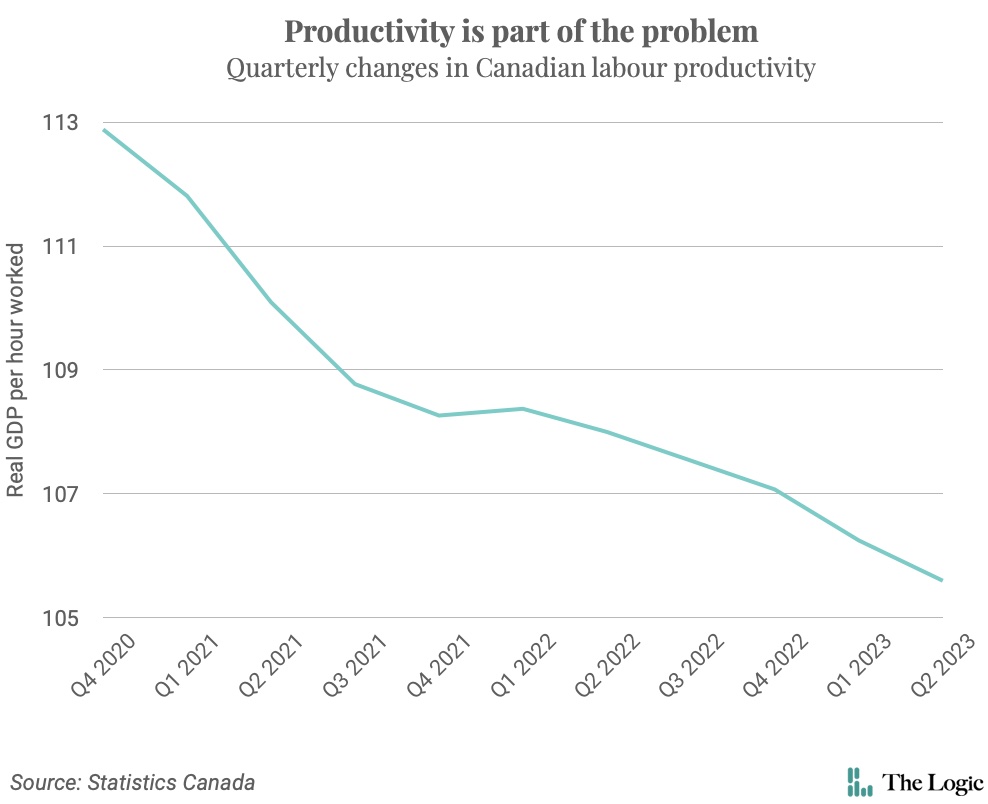
Siddall’s dig at Ottawa’s failure to find an answer to Canada’s embarrassing productivity numbers, despite decades of trying various tax incentives and spending plans, will have stung. Never good, labour productivity declined in 10 of 11 quarters through the second quarter of this year—and it was little changed in the quarter that it didn’t drop. By comparison, the amount of output generated per hour in the United States surged 4.7 per cent in the third quarter. Canada and the U.S. are different economies, but the disparity in productivity rates suggests that we’re doing something terribly wrong. 

Productivity is an important part of the retirement story, so much so that it’s reasonable for policymakers to include pension funds in an urgent discussion over what to do about it. Politicizing investment decisions could harm returns, but there might be ways to minimize political influence while at the same time enlisting pension funds to help Canada ready for what promises to be an extended period of high volatility. 

An economy that generates more wealth per worker will be less vulnerable to a shrinking workforce. To become more productive, workers need to upgrade their skills, and need their employers to give them better tools. But Canadian companies are notoriously stingy when it comes to investment, despite a competitive tax structure.

Related Articles

Carmichael: Freeland eyes power of pension funds to lift Canadian economy

By Kevin Carmichael

Carmichael: The end of the gen-X economic consensus

By Kevin Carmichael

Jean-François Perrault, chief economist at Scotiabank and a former senior official at the Finance Department, said on a recent episode of the podcast “The Herle Burly” that it’s fair to conclude that governments have done enough to bring businesses “to the water.” He said the one big difference between the U.S. and Canada is the availability of capital— partly the result of our more conservative banking system, which avoids riskier investments. 

That’s a problem, because Canada desperately needs financiers who aren’t beholden to a strict regulator—the Office of the Superintendent of Financial Institutions forces banks to keep enough cash in reserve to weather a wave of insolvencies. It also needs short-term investors who reward sturdy profit margins and upward sloping dividend payments. 

The energy transition will require trillions of dollars, Siddall’s former employer estimates that by 2030 Canada will need 3.5 million housing units in addition to what’s already being built to balance supply and demand, and the country’s most innovative and ambitious companies will need money to exploit once-in-a-lifetime advances in digital technology and life sciences. If we don’t find the money, the societal issues related to housing affordability will continue, and we’ll miss a chance to take advantage of the opportunities presented by mass disruption. 

“You’ve got to think outside the box,” said Perrault, who observed that Canadian pension funds’ share of domestic investments has been falling over time. So, he said, “Maybe what you do is you mandate a minimum threshold of Canadian investment in pension plans.” Do that, he continued, and “you would be adding massive amounts of financing to the Canadian economy—and maybe that’s the solution.”  

Considering the stakes, and given the country seems to value a banking system that emphasizes stability and dividend payments, maybe a domestic investment requirement for pension funds would be the surest way to address Canada’s investment shortfall, albeit a less than perfect one. 

Ideally, Canada’s cash-rich corporations would fill the capital void that Perrault identified. But if former Bank of Canada governor Stephen Poloz is right, companies will soon be shouldering a bigger share of the retirement burden. 

In a paper published this month by the Healthcare of Ontario Pension Plan, Poloz makes the case for a “renaissance” in defined-benefit pension plans, which would offer people a certain amount of comfort amid the volatility we face from climate and technological change, political upheaval, geopolitical clashes and our aging society. He submits that employers will have to offer defined-benefit plans to attract scarce talent, or leave jobs unfilled.  

Finance Minister Chrystia Freeland appears at a news conference against a backdrop of Canadian flags. She is wearing a bright blue jacket, with a yellow and blue ribbon on her lapel.
Deputy Prime Minister and Finance Minister Chrystia Freeland speaks during a news conference in Ottawa in November 2023. Photo: The Canadian Press/Justin Tang

The goal is a secure retirement for as many people as possible. If more of us have defined-benefit plans, it matters less if pension funds settle for something less than maximum returns in a trade-off for contributing to nation building.

Gift the full article

Companies moved away from defined-benefit pension plans because their owners decided it was too expensive to fund them. Poloz advised governments to make it easier for employers—especially smaller businesses—to pool pension contributions, which would distribute the risk and make it easier to guarantee a payout. It’s something Freeland should consider as she prepares her next budget. It would make her plans to work “collaboratively” with the pension funds look less like a raid on their assets. 

Kevin Carmichael is The Logic’s economics columnist and editor-at-large. He has spent more than two decades covering economics, business and finance for outlets including Bloomberg News, The Globe and Mail and the Financial Post, where he also served as editor-in-chief. 

#Chrystia Freeland #commentary #economy #fall economic statement 2023 #pensions #Stephen Poloz

Sponsored Content

The real-world economic offshoots of sovereign AI

By Deborah Aarts
Illustration of a plane flying above a mailbox

Increasing healthcare access across Canada

By Deborah Aarts

What it takes to lead a frontier firm

By Deborah Aarts
Paid promotional content

Loading...

Thanks for sharing!

You have shared 5 articles this month and reached the maximum amount of shares available.

Close
This account has reached its share limit.

If you would like to purchase a sharing license please contact The Logic support at [email protected].

Close
Want to share this article?

Upgrade to all-access now

Close
Gift the full article!

You have gifted 0 article(s) this month and have 5 remaining.

Copy link and gift
Copy Link
Email to a friend
Send Email
Gift on Social Media

Recipients will be able to read the full text of the article after submitting their email address. They will not have access to other articles or subscriber benefits.

Photo: The Canadian Press/Nathan Denette

Finance Minister Chrystia Freeland appears at a news conference against a backdrop of Canadian flags. She is wearing a bright blue jacket, with a yellow and blue ribbon on her lapel.

Deputy Prime Minister and Finance Minister Chrystia Freeland speaks during a news conference in Ottawa in November 2023.

Most Popular This Week

Janice Charette and Dominic LeBlanc walking toward the camera next to a white pavilion that bears the logo of the 2026 G7 meeting in France.
News

Canada ‘can’t even talk about anything else’ if Trump makes good on latest tariff threat

By Joanna Smith
A man walks across a large greenhouse with large glass ceilings. He is walking on a white path through rows of green lettuce growing on the ground.
News

Canadian businesses were bracing for a wave of retirees. Then along came AI

By Anita Balakrishnan
An image of a man wearing a dark suit jacket and tie. He is wearing a mic and looking slightly away from the camera.
News

Brookfield and Cohere execs among high-profile guests at CVCA summit

By Catherine McIntyre
In this photo illustration the Moneris logo is seen displayed on a smartphone.
News

U.S. private equity is buying Canada’s biggest payments processor. Some people are worried about sovereignty

By Claire Brownell

In-depth, agenda-setting reporting

Great journalism delivered straight to your inbox.

Workers in bright orange safety gear walk through a spacious industrial warehouse with machinery surrounded by yellow railings and a Canadian flag overhead.
News

Trade talks go into final hours with new U.S. tariffs set to hit Canada

By Joanna Smith

Briefing

Clearco taps Macquarie for US$100M in financing to back its rebound

By Anita Balakrishnan   |   Aug 18, 2026 | 3:35 PM ET

Canadian foodtech startups rely on foreign investors to fuel growth

By Catherine McIntyre   |   Aug 18, 2026 | 2:55 PM ET

Alberta regulator rejects Olds power plant for data centre

By Murad Hemmadi   |   Aug 18, 2026 | 2:02 PM ET

Best business newsletter in Canada

Get up to speed in minutes with insights and analysis on the most important stories of the day, every weekday.

Exclusive events

See the bigger picture with reporters and industry experts in subscriber-exclusive events.

Membership in The Logic Council

Membership provides access to our popular Slack channel, participation in subscriber surveys and invitations to exclusive events with our journalists and special guests.

Recent Popular Stories

News

U.S. private equity is buying Canada’s biggest payments processor. Some people are worried about sovereignty

By Claire Brownell   |   Aug 12, 2026
In this photo illustration the Moneris logo is seen displayed on a smartphone.
News

Brookfield and Cohere execs among high-profile guests at CVCA summit

By Catherine McIntyre   |   Aug 13, 2026
An image of a man wearing a dark suit jacket and tie. He is wearing a mic and looking slightly away from the camera.
News

Canadian businesses were bracing for a wave of retirees. Then along came AI

By Anita Balakrishnan   |   Aug 13, 2026
A man walks across a large greenhouse with large glass ceilings. He is walking on a white path through rows of green lettuce growing on the ground.
Special Report

Meet Canada’s leading innovators from the Class of 2026

By Sara Harowitz   |   Jul 29, 2026
A multimedia illustration showing images of six smiling individuals, on a dark background with blue shapes.
Commentary

Carmichael: Canada’s biggest companies aren’t wired for growth. That’s a problem for us all

By Kevin Carmichael   |   Aug 15, 2026
News

The Fisheries Department is losing its ability to back maritime innovations, documents warn

By David Reevely   |   Aug 11, 2026
A wide-lens aerial shot of a red Canadian Coast Guard ship amid a sea of white ice pans. The effect of the lens exaggerates the curvature of the horizon.

Canada's most influential executives and policymakers are reading The Logic

  • CPP Investments
  • Sun Life Financial
  • C100
  • Amazon
  • Telus
  • Mastercard
  • bdc
  • Shopify
  • Rogers
  • RBC
  • General Motors
  • MaRS
  • Government of Canada
  • Uber
  • Loblaw Companies Limited
logic-logo

Canada's Business and Tech Newsroom

100% human-crafted journalism

Newsroom

  • News Tips
  • AI Policy
  • Editorial Disclosures
  • Story Pitches

Company

  • About Us
  • Terms of Service
  • Privacy Statement
  • Corporate Information

Contact

  • Contact Us
  • Advertise
  • FAQs
  • Work at The Logic

© 2026 The Logic Inc. All Rights Reserved.

Trusted by leaders

Error

Account creation failed.

Please email us at [email protected].

Create Account

[wppb-register form_name=”cozmo-registration-form-for-modal”]

I do have an account
Login
or

[wppb-login]

I don’t have an account