Skip to content

Canada's Business and Tech Newsroom

  • Professional Subscription
  • Partnerships & Advertising
  • Licensing & Syndication
Log In Subscribe
Welcome,
  • My Account
  • Log Out
  • Business
  • Tech
  • National
  • The Big Read
  • Briefings
  • Commentary
Search
Log In Subscribe
Welcome,
  • My Account
  • Log Out
Commentary

Carmichael: The end of the gen-X economic consensus

The 1990s are having a moment. The “60 Songs That Explain the ’90s” podcast is a runaway hit. Earlier this month, it covered its 109th song, Puff Daddy’s “I’ll Be Missing You.” Host Rob Harvilla’s book went on sale this month. It might pair well with Chuck Klosterman’s The Nineties, if you’re looking for gift ideas for that nostalgic gen-Xer in your life. 

There are four economic policies that explain the ’90s in Canada: an inflation target of two per cent, free trade, balanced budgets and active management of mandatory government pension contributions. These policies formed a consensus that was impervious to partisan attack and set up the country for a nice run of wealth creation. Following Finance Minister Chrystia Freeland’s fall economic statement this week, however, all of them are on the table for reconsideration.  

Commentary

Carmichael: The end of the gen-X economic consensus

Chrystia Freeland looks set to abandon the ‘90s-era policies that created wealth for so many Canadians

By Kevin Carmichael
Finance Minister Chrystia Freeland in Ottawa in November 2023. Photo: The Canadian Press/Justin Tang
Nov 25, 2023
A A
A Small A Medium A Large
Share

Share

The 1990s are having a moment. The “60 Songs That Explain the ’90s” podcast is a runaway hit. Earlier this month, it covered its 109th song, Puff Daddy’s “I’ll Be Missing You.” Host Rob Harvilla’s book went on sale this month. It might pair well with Chuck Klosterman’s The Nineties, if you’re looking for gift ideas for that nostalgic gen-Xer in your life. 

There are four economic policies that explain the ’90s in Canada: an inflation target of two per cent, free trade, balanced budgets and active management of mandatory government pension contributions. These policies formed a consensus that was impervious to partisan attack and set up the country for a nice run of wealth creation. Following Finance Minister Chrystia Freeland’s fall economic statement this week, however, all of them are on the table for reconsideration.  

First, a recap for readers who discovered The Police through the artist currently known as Diddy. The ’70s and ’80s were marked by inflation, budget deficits, trade wars and weak economic growth, creating the conditions for a global economic rethink that favoured markets over government intervention. 

In 1991, Brian Mulroney’s Progressive Conservative government and the Bank of Canada agreed that monetary policy would be guided by an inflation target. Canada was a founding member of the World Trade Organization in 1995, a natural progression from its decision to join the original North American free-trade agreement, enacted in 1994. Liberals Jean Chrétien and Paul Martin ended a generation of budget deficits in 1997 and made balanced budgets an unassailable feature of Canadian politics for the generation that followed. Martin and the provinces also overhauled the Canada Pension Plan in 1997, doubling contributions and creating the Canada Pension Plan Investment Board to manage the fund’s assets actively.   

Related Articles

Chrystia Freeland is seen pushing her hair out of her face. There are two Canadian flags in the background.

Carmichael: Is Freeland serious about taming inflation? She can prove it in her fall economic statement

By Kevin Carmichael

Carmichael: Freeland eyes power of pension funds to lift Canadian economy

By Kevin Carmichael

Canada’s economy grew 5.2 per cent in both 1999 and 2000, the most since 1984, when the country was recovering from a deep recession, according to International Monetary Fund data. (Growth hasn’t come near that mark since.) Inflation averaged 1.9 per cent between 1995 and early 2020. The CPPIB redefined financial risk, showing that it was to earn a safe return by taking measured bets on equities and infrastructure, making it easier for a declining population of active workers to make good on the country’s pension obligations.  

Today, that consensus is breaking down. 

Opposition Leader Pierre Poilievre said if he becomes prime minister he will fire Bank of Canada governor Tiff Macklem, violating the convention of central-bank independence, a tenet of inflation targeting. What’s more, the Conservative and New Democratic members of the “Curse of Politics” podcast—a must-listen for Canada’s politicos and a bellwether for partisan political thought—regularly argue that the two per cent target should be reconsidered. 

Freeland has defended the central bank’s independence, although calling the central bank’s September decision to leave interest rates unchanged “welcome relief for Canadians” could be interpreted as applying subtle pressure. 

Less subtle was this week’s fall economic statement, which showed the other three pillars of Canada’s economic policy consensus are either up for debate or no longer apply. Freeland said she will shrink the deficit to below one per cent of gross domestic product by 2027, but stopped short of pledging a return to surpluses. She also said the government “will work collaboratively” with Canadian pension funds to invest more in Canada, an encroachment on the understanding that active management of our mandatory retirement savings should be based on maximizing returns, not political considerations. 

The Logic’s coverage of the fall economic statement highlighted Prime Minister Justin Trudeau’s re-interpretation of fiscal responsibility and his government’s sudden interest in the $3 trillion in assets under management at Canadian pension funds. Time and space kept us from getting to a companion piece the government released alongside Freeland’s update, called “Policy Statement on Ensuring Reciprocal Treatment for Canadian Businesses Abroad.” There’s an inverse relationship between trade policy’s importance to Canadians’ livelihoods and their interest in it, so on Tuesday we set it aside. Let’s give it some attention now. 

The statement frees negotiators and policymakers from any lingering commitment to virtue when it comes to international trade. Canada won’t throw the first punch, but it is burying its Boy Scout image and will now hit back when it feels mistreated. The federal government’s new “reciprocity-based approach” will involve designing trade, investment and procurement rules that match those faced by Canadian companies in other countries; working with the provinces to ensure “sub-federal” rules also are tit-for-tat; and implementing incentives that encourage businesses to source from “trusted, reliable partners.” 

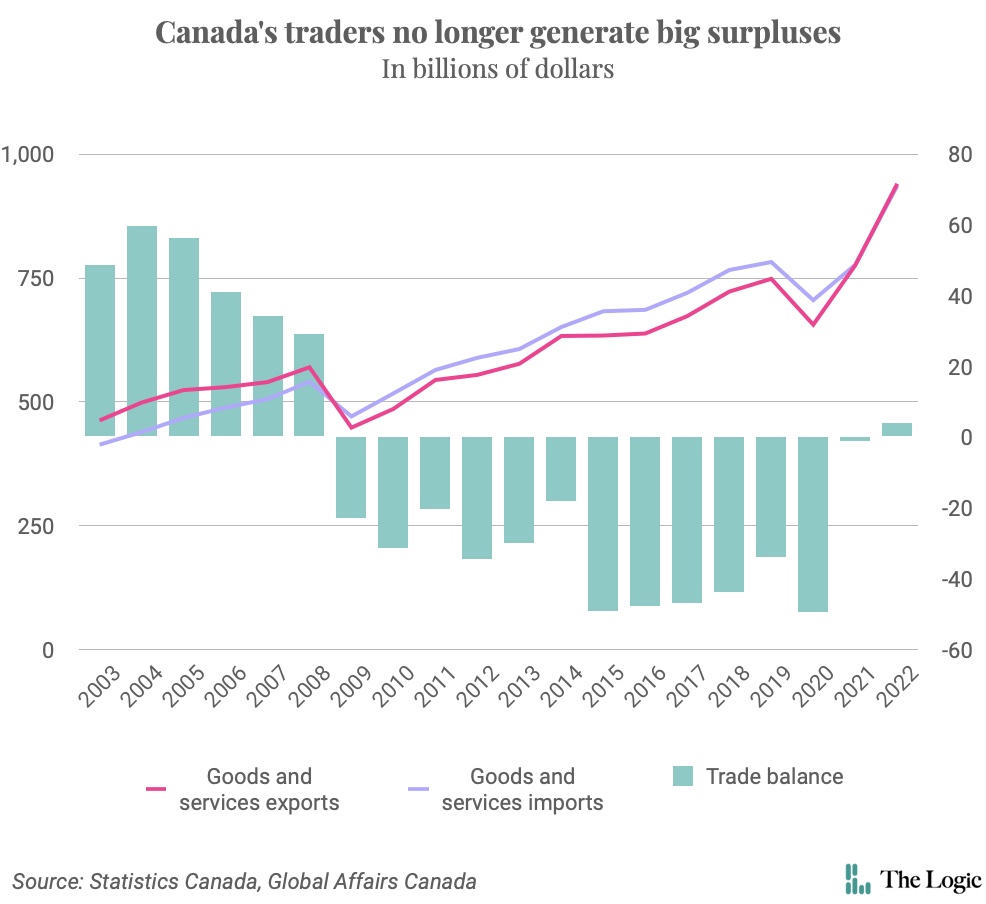
Trudeau will continue to support the WTO, and reciprocal policies will include exceptions and waivers for the “limited circumstances” where it is too difficult to source supply from a friendly country or “regional considerations” need to be taken into account. But effectively, Canada has codified the turn from liberalized trade that started with Donald Trump’s presidency, and that has accelerated under Joe Biden. We’re managed traders now. 

It’s unclear whether Canada is built for a tit-for-tat world. The overall market is relatively small, and many industries are controlled by oligopolies with significant homefield advantages. That makes it easy to ignore Canadian counterattacks, and the resulting trade wars end up hurting innocents—including Canadian importers and consumers.   

But here we are. The previous policy consensus was rooted in a belief that market-oriented policies were the answer to high unemployment, inflation and geopolitical conflict. It worked for a while, but the last few years show that it was probably naive to have assumed everything was sorted. If there are things you liked about the ’90s, you should call your member of Parliament and tell them not to sabotage a good thing, because all those ideas are under review.  

Kevin Carmichael is The Logic’s economics columnist and editor-at-large. He has spent more than two decades covering economics, business and finance for outlets including Bloomberg News, The Globe and Mail and the Financial Post, where he also served as editor-in-chief. 

#Chrystia Freeland #commentary #economy #fall economic statement 2023 #inflation #markets #pensions #trade

Loading...

Thanks for sharing!

You have shared 5 articles this month and reached the maximum amount of shares available.

Close
This account has reached its share limit.

If you would like to purchase a sharing license please contact The Logic support at [email protected].

Close
Want to share this article?

Upgrade to all-access now

Close
Gift the full article!

You have gifted 0 article(s) this month and have 5 remaining.

Copy link and gift
Copy Link
Email to a friend
Send Email
Gift on Social Media

Recipients will be able to read the full text of the article after submitting their email address. They will not have access to other articles or subscriber benefits.

Photo: The Canadian Press/Justin Tang

Most Popular This Week

News

Everything you need to know about the debate over stablecoin yields

By Claire Brownell
In this photo illustration, the Manulife company logo is seen displayed on a smartphone screen.
News

Manulife and Intact buck a global trend by reporting AI returns

By Anita Balakrishnan
A photo of Daniel Sax shot through a circular piece of ironwork on a stairway balustrade. He's looking off-camera, and is wearing a dark blue jacket bearing his company's logo.
The Big Read

Mining the moon. Selling nuclear reactors. For this Canadian, it’s all part of the plan

By David Reevely
News

Bay Street backs Canada’s AI strategy, but warns the devil is in the details

By Anita Balakrishnan and Chaimae Chouiekh

In-depth, agenda-setting reporting

Great journalism delivered straight to your inbox.

A person holds a smartphone with the Wealthsimple app, which displays various company names, including SoFi, Ciena, Affirm Holdings and Discord, on a dark screen.
News

Wealthsimple will let Canadians place bets on prediction market Kalshi

By Claire Brownell

Briefing

Liberals force controversial lawful access bill through the House

By Laura Osman   |   Jun 18, 2026 | 3:58 PM ET

G7 leaders and tech CEOs look for common front on AI standards

By Murad Hemmadi   |   Jun 18, 2026 | 3:42 PM ET

Shopify-backed Frontier recruits Anthropic and commits US$915M to carbon removal

By Anita Balakrishnan   |   Jun 18, 2026 | 2:58 PM ET

Best business newsletter in Canada

Get up to speed in minutes with insights and analysis on the most important stories of the day, every weekday.

Exclusive events

See the bigger picture with reporters and industry experts in subscriber-exclusive events.

Membership in The Logic Council

Membership provides access to our popular Slack channel, participation in subscriber surveys and invitations to exclusive events with our journalists and special guests.

Recent Popular Stories

Commentary: Quebec Ink

Quebec just found out what not having digital sovereignty really means

By Martin Patriquin   |   Jun 8, 2026
A yellow ambulance is pictured outside of a hospital in Montreal. A red sign in the foreground reads, “Urgence / Emergency.”
News

OMERS investment chief departs for Singapore’s Temasek

By Chaimae Chouiekh   |   Jun 10, 2026
News

Manulife and Intact buck a global trend by reporting AI returns

By Anita Balakrishnan   |   Jun 16, 2026
In this photo illustration, the Manulife company logo is seen displayed on a smartphone screen.
News

Canada’s surprise plan to buy Saab command jets leaves competitors seeking answers

By David Reevely   |   May 29, 2026
A closeup of a scale model of a jet covered in pixellated camouflage, with sensor equipment attached to the top of its fuselage. There are civilians and uniformed military personnel milling in the background.
The Big Read

We found every data centre in Canada

By Murad Hemmadi, David Reevely, Aleksandra Sagan, Chaimae Chouiekh, Martin Patriquin and Catherine McIntyre   |   Apr 8, 2026
Four vertical slices of aerial view photos. From left, a building in downtown Toronto housing several data centres, a picture of the Albertan wilderness where the proposed Wonder Valley data centre would go, a lit-up QScale data centre in Quebec, and a data centre at a Hydro-Quebec dam.
The Big Read

Mining the moon. Selling nuclear reactors. For this Canadian, it’s all part of the plan

By David Reevely   |   Jun 12, 2026
A photo of Daniel Sax shot through a circular piece of ironwork on a stairway balustrade. He's looking off-camera, and is wearing a dark blue jacket bearing his company's logo.

Canada's most influential executives and policymakers are reading The Logic

  • CPP Investments
  • Sun Life Financial
  • C100
  • Amazon
  • Telus
  • Mastercard
  • bdc
  • Shopify
  • Rogers
  • RBC
  • General Motors
  • MaRS
  • Government of Canada
  • Uber
  • Loblaw Companies Limited
logic-logo

Canada's Business and Tech Newsroom

100% human-crafted journalism

Newsroom

  • News Tips
  • AI Policy
  • Editorial Disclosures
  • Story Pitches

Company

  • About Us
  • Terms of Service
  • Privacy Statement
  • Corporate Information

Contact

  • Contact Us
  • Advertise
  • FAQs
  • Work at The Logic

© 2026 The Logic Inc. All Rights Reserved.

Trusted by leaders

Error

Account creation failed.

Please email us at [email protected].

Create Account

[wppb-register form_name=”cozmo-registration-form-for-modal”]

I do have an account
Login
or

[wppb-login]

I don’t have an account