This week in Canadian politics could make one think the political class is OK with the country they manage becoming the 51st state.
Skip to content
Commentary
Carmichael: Canada’s leaders need to stop playing games
The unseriousness of the country’s political class could make this economic crisis worse
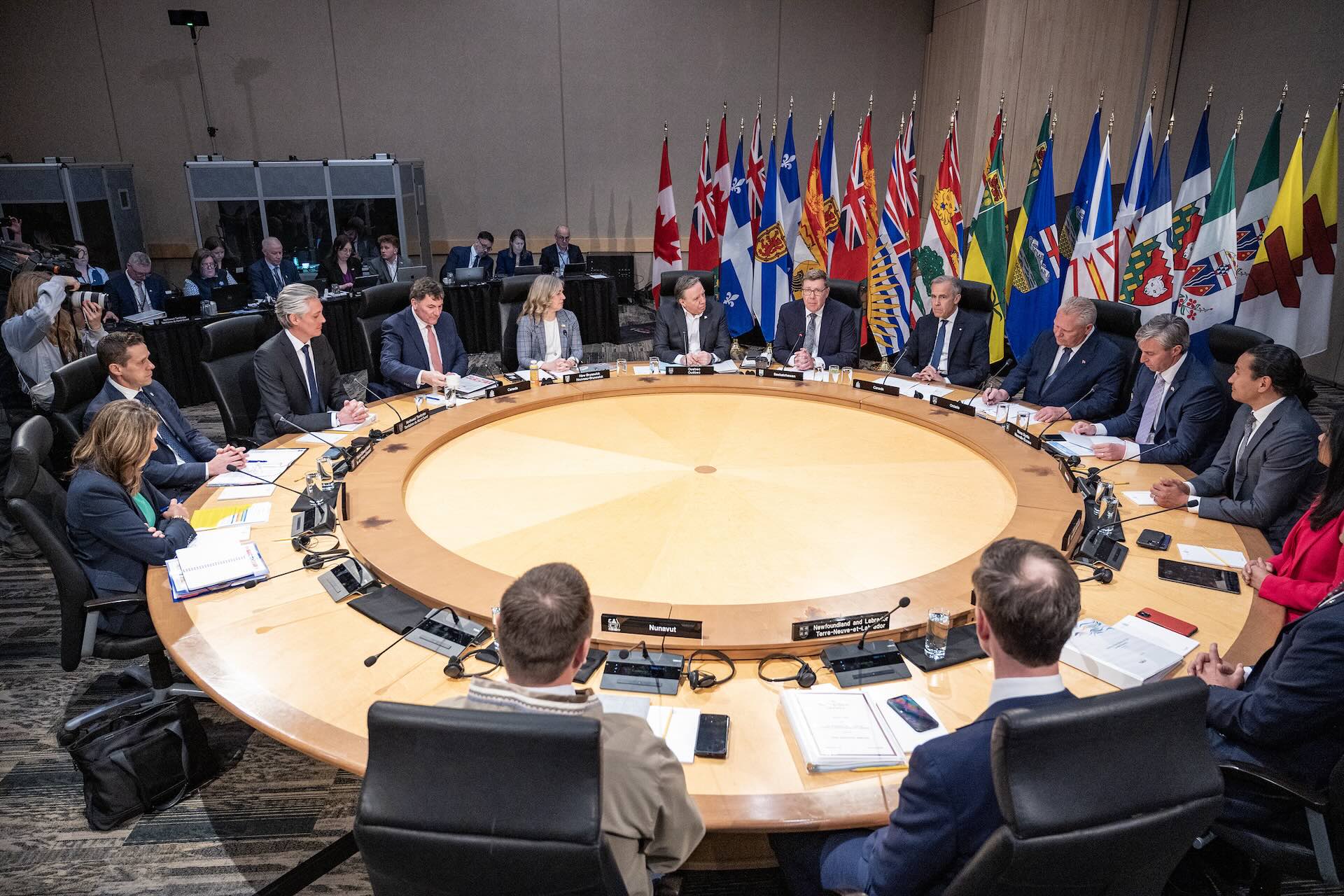
The First Ministers’ Meeting in Saskatoon on Monday, June 2, 2025. Photo: The Canadian Press/Liam Richards
This week in Canadian politics could make one think the political class is OK with the country they manage becoming the 51st state.
Conservative member of Parliament Michelle Rempel Garner told the readers of her Substack newsletter that she had put her campaign team on “full election red alert.” True, creating a sense of false urgency is something political parties do to boost donations, and Pierre Poilievre’s party is particularly good at it. But Conservatives whose livelihoods are now based on the usefulness of their advice were saying similar things.
“This Parliament is five months old and already circling the drain,” wrote Fred DeLorey, chief strategy officer at NorthStar Public Affairs and manager of former Conservative leader Erin O’Toole’s 2021 election campaign. “The Liberals will table their budget on Nov. 4, and it’s going to fail—not because of scandal or surprise, but because the math, the momentum and the mood have all turned.”
Related Articles


Meanwhile, provincial unity is crumbling. British Columbia and Alberta were already fighting over pipelines, and Saskatchewan and Manitoba had said they think Ottawa is shielding Ontario auto workers at the expense of western canola farmers. This week, Ontario Premier Doug Ford insulted Quebec Premier François Legault by joining New Brunswick in attempting to poach disgruntled Quebec doctors.
“It’s a total lack of judgment,” Legault said after Ford urged “all the docs” to call “1-800-DOUG FORD.”
I’m unsure what to make of all of this. Maybe it’s nothing, and my morning habit of scanning Politico’s Canada Playbook is affecting my judgment. A meeting of the first ministers might be all it takes to dull this spasm of parochialism. The election talk may amount to little. DeLorey is a credible voice, but he’s no oracle—just ask Erin O’Toole. Polls suggest that far more people approve of Prime Minister Mark Carney’s performance than disapprove, and the New Democratic Party lacks money, official party status and a leader. Why would the seven of them left in Parliament vote for an election?
But the field of economics didn’t start as the study of political economy for nothing. There was a broad understanding once that politics was an important economic variable. I’m in my 25th year of earning a living from writing about both. I’ve come to think that one of the reasons that economists—and by extension, those of us who write about them—have been of relatively little use to most people since at least the Great Recession is because they tend to live inside their theories and models.
Those theories and models have a lot to say about how the world works, but they tend to assume that most of us are rational actors. The highly polarized politics that has caused people like Martin Wolf to worry about the future of democratic capitalism is anything but rational, and the failure of economics—and those of us who write about economics—to remain credible has opened a void.
Here’s an example of what happens in that void. On Friday, Canada Spends, a spinoff of Build Canada—a talking shop that seeks to amplify the policy ideas of Canadian founders—documented the large increase in federal spending on “Indigenous priorities” since 1995. I like what Canada Spends and Build Canada are trying to do. Both were born out of frustration with the status quo and the general erosion in political accountability. But context matters, no matter how frustrated you are.
Much of that surge in spending is related to compensation ordered by the Canadian Human Rights Tribunal; money paid to settle treaty violations; and additional funds set aside for future treaty settlements. Canada Spends omitted all of this from its analysis. In isolation, the facts it assembled suggest profligacy. Add the context and you see that the spending is an overdue attempt at justice, and an underrated source of economic development.
Context is everything right now.
There are lots of examples of political misfires at difficult moments that ultimately turn out OK. Joe Clark’s star-crossed tenure as the leader of a minority government led to the unexpected return of Pierre Trudeau, who used his last gasp of power to patriate the Constitution, adding the Charter of Rights and Freedoms. Former Liberal finance minister Paul Martin needed two budgets to convince bond markets that Jean Chrétien’s government was serious about the debt crisis in the 1990s, and former prime minister Stephen Harper nearly triggered a constitutional crisis amid the 2008-09 financial crisis before ultimately doing a decent job of managing the global recession that followed.
But all of those mishaps occurred when Canada could count on its unique access to the U.S. market to bail us out. There was always a floor on how bad things could get. Wait long enough, and the combination of a weaker currency and the U.S. consumer’s insatiable demand for stuff would get the economy going again.
For the first time since Confederation, we are alone in the world. The U.S. under President Donald Trump and his MAGA movement is unfriendly and unreliable. That means everything we thought about how the world works needs to be rethought. Our margin for error has narrowed. “The path forward is narrow but non-negotiable,” Scotiabank economist Rebekah Young said in her preview of next week’s budget.
That’s a lot of pressure on Carney, François-Philippe Champagne and the rest of the government. Young reckons there’s enough fiscal space remaining to do some things that would make the economy more resilient, but just barely; Harper’s tax cuts and former prime minister Justin Trudeau’s spending have used up most of the room. More “fiscal drift” and inattention to growth risks stagnation, but “across-the-board austerity would weaken the country now and leave it less prepared for whatever is coming,” Young wrote.
Carney, an economist who made his name as a central banker, probably needs to get better at politics. Partisan opportunism is an economic risk in this environment, just like all the others he’s pledged to subdue.
But this isn’t the prime minister’s fight alone.
Those who think that a wider deficit is the thing that will shock bond investors next week might be mistaken. Creditors are more sophisticated than that. Last year, an international investment house invited me to give a talk about Canada. One of the questions I was asked was whether the country was still governable. So don’t shrug at the shenanigans of opposition parties and the provinces. The games they choose to play have consequences.
Kevin Carmichael is The Logic’s economics columnist and editor-at-large. He has spent more than two decades covering economics, business and finance for outlets including Bloomberg News, The Globe and Mail and the Financial Post, where he also served as editor-in-chief.



Loading...
Thanks for sharing!
You have shared 5 articles this month and reached the maximum amount of shares available.
CloseThis account has reached its share limit.
If you would like to purchase a sharing license please contact The Logic support at [email protected].
CloseGift the full article!
You have gifted 0 article(s) this month and have 5 remaining.
Recipients will be able to read the full text of the article after submitting their email address. They will not have access to other articles or subscriber benefits.
Photo: The Canadian Press/Liam Richards
Most Popular This Week




In-depth, agenda-setting reporting
Great journalism delivered straight to your inbox.
News
Canada faces a satellite-launch crunch as SpaceX retires its workhorse rocket
Briefing
Rio Tinto gets nearly $165M in additional federal funds for Quebec aluminum
U.S. to lift tariffs on some Canadian products crucial to Maine: Collins
Carney warns of tech dependence after Starlink disruptions in Ukraine
Best business newsletter in Canada
Get up to speed in minutes with insights and analysis on the most important stories of the day, every weekday.
Exclusive events
See the bigger picture with reporters and industry experts in subscriber-exclusive events.
Membership in The Logic Council
Membership provides access to our popular Slack channel, participation in subscriber surveys and invitations to exclusive events with our journalists and special guests.